
Convert One Photo to Dropshipping UGC Ads in Under 2 Minutes
Turn one product photo into 9:16 UGC video ads in under two minutes. Micro test hooks and avatars with AI, then scale and stay FTC compliant.
The fastest, most cost-efficient way to produce dropshipping UGC ads in 2026 is an AI-driven workflow that turns a single product photo into a native 9:16 video, then micro-tests several hook variants before you spend real money on scaling. This approach cuts production time from weeks to minutes, keeps costs far below hiring creators individually, and lets you test multiple SKUs at once instead of betting the budget on one concept. The sections below walk through the formats that convert, the exact production steps, and how to test before you scale.
TL;DR:
- Using AI to create UGC-style ads from a single product photo allows testing multiple formats and variants rapidly at a fraction of the cost of hiring creators.
- The most effective ad format depends on the product’s price point, demonstrability, and trust factors, with formats like testimonials, demos, unboxing, and before-and-after suited to different products.
- Starting with three hook variants, two avatar personas, and one CTA in a short test budgeted under $50 provides reliable signals within 48 to 72 hours for scaling decisions.
- Disclosures are legally required for AI-generated or manipulated testimonials, with clear labeling of synthetic avatars and proper product claim substantiation.
- An AI platform can generate a complete, localized video in under two minutes, enabling fast iteration and scaling for dropshipping campaigns.
Table of Contents
- 1. Types of UGC Ads That Convert for Dropshipping Products
- 2. AI Workflows That Turn Product Photos into UGC-Style Video Ads
- 3. Step-by-Step: Build a Publishable Dropshipping UGC Ad in Minutes
- 4. Hooks and Creative Tactics That Make AI UGC Feel Real
- 5. Testing Matrix, KPIs, and When to Scale a Winning Creative
- 6. Legal and Disclosure Rules for UGC and AI-Generated Testimonials
- 7. What Instant-UGC Delivers for Dropshipping Video Testing
- What to Test First and How Long It Takes
- Get Dropshipping UGC Ads Running Today with Instant-UGC
- Sources
- FAQ
1. Types of UGC Ads That Convert for Dropshipping Products
Not every dropshipping product needs the same style of ad. Matching the format to the product’s price point, how demonstrable it is, and how much trust the purchase requires makes the difference between a video that stops the scroll and one that gets skipped. Shopify’s breakdown of UGC ad types groups the format into four core categories, and each one solves a different buyer objection.
- Testimonial: A satisfied customer explains the result in their own words, best for products where trust is the barrier (skincare, supplements, subscription boxes).
- Demo: The product is shown solving a problem in real time, ideal for gadgets, kitchen tools, or anything with a visible mechanism.
- Unboxing: The reveal and first impression carry the ad, which works well for gift items, novelty products, or anything with satisfying packaging.
- Before and after: A visual transformation anchors the pitch, suited to beauty tools, fitness accessories, or cleaning products with a dramatic result.
Before picking a format, run through a short checklist: What is the price point (impulse buy under $30 needs less persuasion than a $100 purchase)? Is the product demonstrable in five seconds or does it need a slower buildup? Does the audience need to trust a stranger’s experience, or just see the thing work? Is there a visual “wow” moment you can lead with?
A phone-mounted LED ring light, for example, is a natural demo: show the light turning on and the before-and-after selfie quality. A pet grooming brush works better as before-and-after, since the payoff is the pile of loose fur. A posture corrector leans testimonial, because the benefit (less back pain) is felt, not seen. A collapsible kitchen organizer suits unboxing, since the appeal is watching it expand.
Shopify’s guidance points to a wide sourcing range for these formats, from repurposing real customer clips to commissioning creators, and notes that UGC content can multiply conversion rates well beyond standard branded video. The trick for a dropshipper testing multiple SKUs is producing several format variants fast enough to find out which one actually earns that lift before committing spend. This is where an AI production pipeline earns its place in the workflow, covered next.
2. AI Workflows That Turn Product Photos into UGC-Style Video Ads
An AI video pipeline needs surprisingly little to get started, and understanding what goes in versus what comes out helps you prep assets correctly the first time. The required inputs are simple:
- One hero photo of the product, ideally on a clean background or in realistic use.
- Three to five feature bullets describing what the product does and why it matters.
- Price or promo detail if the ad includes an offer.
- An optional customer quote or review snippet to ground the script in a real reaction.
From there, the AI tool handles the production chain automatically: it drafts a script from your bullets, selects an avatar and speech cadence that match the product’s tone, edits the footage into a vertical 9:16 format, and burns in captions sized for mobile viewing. Some platforms also let you swap the avatar’s language or persona programmatically, so the same script becomes five region-specific ads without a reshoot, useful for dropshippers selling into more than one country.
The time and cost gap versus hiring a creator is the real story here. A single freelance UGC creator typically charges $100 to $500 per asset depending on experience and usage rights, and turnaround often runs one to three weeks once you account for briefing, filming, and revisions. An AI-generated equivalent can be ready in minutes, which means you can test five product concepts in the time it takes a single creator brief to get approved.
Pro Tip: Feed the AI tool a real customer quote whenever you have one, even a short one from a review. It grounds the script in an actual reaction instead of a generic marketing line, and that small detail is often what makes an AI-generated ad feel like a real person talking.
The tradeoff is nuance: AI avatars are faster and cheaper, but they cannot replicate a genuinely unscripted reaction the way a real unboxing video can. The smart move for most dropshippers is to use AI for volume and speed on early testing, then reserve real customer clips for the formats where authenticity is the entire pitch, like a before-and-after result. Handled together, the strategy captures both speed and the moments where a real face still wins.
3. Step-by-Step: Build a Publishable Dropshipping UGC Ad in Minutes
Turning a product photo into a ready-to-run ad follows a repeatable sequence. Skipping steps is where most first attempts go wrong, so treat this as a checklist rather than a suggestion.
- Pick the test product and best visual asset. Choose a SKU with clear margin room for testing and select the photo that shows the product’s use or result most clearly.
- Write a one-line benefit statement. State the single biggest reason someone buys this, not every feature. Then choose an avatar or persona whose age, tone, and setting match your target buyer.
- Draft a six-second hook and a fifteen-to-thirty-second body. The hook should name the problem or tease the result immediately. AI script templates speed this step up considerably, since they generate several hook variants from the same bullets.
- Generate the video. Most AI platforms render output in under two minutes once the script and avatar are set.
- Edit for authenticity. Trim any line that sounds too polished, add a slight pause or a natural filler word if the tool allows script edits, and keep the pacing close to how a real person talks.
- Add captions and platform-specific formatting. Confirm the export is 9:16, captions are legible on mobile, and the file meets the platform’s length and resolution requirements.
- Publish with a tracking checklist in place before the ad goes live.
That final checklist matters more than it looks:
- UTM parameters on every ad link so performance ties back to the exact creative.
- Consistent file naming (product, hook version, avatar, date) so results are easy to sort later.
- Creative labels in your ad platform’s naming convention, separating hook, persona, and CTA variables so you can isolate what actually moved the number.
Dropshippers who skip the naming convention step almost always regret it once they have a dozen video variants running and no clean way to tell which hook or avatar drove the result. A five-minute setup here saves hours of confused reporting later.
For a deeper walkthrough on sourcing footage and planning a fuller campaign around these steps, the dropshipping UGC sourcing guide covers the planning side in more detail.

4. Hooks and Creative Tactics That Make AI UGC Feel Real
The first few seconds decide whether the rest of the ad gets watched at all, which is why the hook deserves more attention than any other part of the script.
Nearly all of an ad’s recall impact happens in the first six seconds, according to TikTok’s own ad-effectiveness notes, and ads that feel inauthentic perform noticeably worse on purchase intent within that same window. That single fact should shape every script you write: the hook is not a warm-up, it is the pitch.
A handful of tactics consistently make AI-generated UGC feel closer to something a real customer filmed:
- Lead with the problem, not the product. “My back used to hurt after every shift” beats “Introducing our posture corrector.”
- Slightly imperfect framing. A hand-held angle or a small camera wobble reads as more genuine than a perfectly centered studio shot.
- Natural speech cadence. Short sentences, a pause before the reveal, and normal word choice instead of ad copy read aloud.
- Fast product reveal. Show the product doing its job within the first two or three seconds rather than building up to it.
- Caption placement that does not block the product. Keep text in the upper or lower third and sync it to speech instead of dumping a paragraph on screen.
- One clear CTA, spoken and captioned. “Link in bio” or “tap to shop” said once near the end outperforms a CTA repeated three times.
What to avoid is just as important: generic claims (“this changed my life”) with no specific detail, a hook that spends its first three seconds on a logo or brand name, and captions that repeat exactly what the avatar is saying word for word, which reads as filler rather than reinforcement.
For a longer breakdown of hook formulas and worked examples by product category, the TikTok UGC hooks guide goes deeper into scroll-stopping openers.
5. Testing Matrix, KPIs, and When to Scale a Winning Creative
Before any creative earns real ad spend, it needs to survive a small, structured test. Watching the right numbers in the first 48 to 72 hours tells you almost everything you need to know about whether a hook is working.
The core KPIs to track in a micro-test are watch rate at three and six seconds, click-through rate, add-to-cart rate, and early return on ad spend. Watch rate at six seconds is the earliest signal, since it reflects whether the hook itself is doing its job before anything else has a chance to matter.
A practical test matrix for a single SKU looks like this: three hook variations, crossed with two avatar personas, paired with one consistent call to action. That gives you six creative combinations, run for 48 to 72 hours with creative-level tracking, which is enough time to gather a meaningful read without burning through budget on a concept that was never going to work.
- Scale a creative when its six-second watch rate clears roughly 20% and click-through and add-to-cart rates hold steady or improve as spend increases.
- Kill a creative when watch rate drops off sharply before the six-second mark, since that almost always means the hook failed regardless of what follows.
- Refresh creatives on a rolling basis, since even winning ads fatigue as the same audience sees them repeatedly, and a new hook variant on the same winning structure often outperforms starting from scratch.
Running variants through a dedicated hook testing workflow keeps this process organized without manually rebuilding a spreadsheet for every SKU. The goal is not to find one perfect ad, it is to build a repeatable habit of testing small before spending big.
6. Legal and Disclosure Rules for UGC and AI-Generated Testimonials
UGC ads move fast, but the legal requirements around endorsements do not bend for speed. The FTC’s Endorsement Guides require disclosure of any material connection between an advertiser and the person endorsing the product, whether that connection is payment, free product, or an incentive of any kind. A testimonial that looks organic but was paid for without disclosure is a deceptive practice, not a gray area.
The FTC’s Consumer Reviews and Testimonials Rule adds a more recent layer specifically relevant to AI-generated content: advertisers remain liable when reviews or testimonials are fabricated, manipulated, or presented without disclosure, and that liability extends to marketers using AI avatars to voice a testimonial. The practical rule is straightforward:
- Never imply an AI avatar is a real customer. If the voice or face is generated, the ad should not be framed as an authentic review from a specific person.
- Substantiate every product claim the avatar makes, the same way you would for a human spokesperson.
- Disclose material connections clearly, using plain language a viewer would actually notice, not buried in fine print.
- Keep a documented log of which avatar was used, the script prompt, any synthetic voice settings, and the final export file, so you can respond quickly if a platform or regulator asks questions.
Two disclosure phrasings that work well in short-form video: a spoken or captioned “This is a paid partnership” when a real creator was compensated, or “AI-generated avatar” in the caption when the on-screen presenter is synthetic rather than a real customer. When repurposing an actual customer’s clip, get written permission that specifically covers ad usage, not just a comment thread mention. For a closer look at how these disclosure norms apply to creator partnerships more broadly, this overview of influencer marketing responsibilities covers the advertiser side of the relationship.
7. What Instant-UGC Delivers for Dropshipping Video Testing
An AI platform can take a product photo and generate a finished 9:16 video in 90 to 120 seconds, ready for testing rather than waiting on a creator’s calendar.
- Output specs: 9:16 vertical format, multiple supported languages, and a variety of customizable avatars, which means the same product concept can be localized or re-cast without a new shoot.
- Reported outcome: a brand reports a client using such a platform saw return on ad spend move from 2.1x to 4.8x, a client-reported result rather than an independent study.
- Two fast use cases for dropshippers: turning a single supplier product photo into a testable ad batch, and building retargeting creatives for Amazon FBA listings that need a fresh angle without a new photoshoot.
For a small-batch dropshipper running a first test, the Test option at $9 one-off is enough to try a single concept before committing to a subscription. Anyone planning to test multiple SKUs weekly will get more value from a recurring plan, covered in the next section. The dropshipping product video use case shows how the workflow maps directly onto a supplier catalog.
What to Test First and How Long It Takes
If I were starting from zero this week, I would run three tests before touching anything else: one hook comparing a problem-first opening against a result-first opening, one avatar comparison to see whether a younger or older persona pulls better watch rates for the product, and one CTA comparison between a direct “shop now” and a softer “see how it works.” Budget for this stage should stay under $50 in ad spend and under an hour of production time, since the AI workflow itself does the heavy lifting.
The one habit worth protecting through all of this: never let the speed of AI production tempt you into skipping the small imperfections that make a video feel like a person talking rather than a script being read.
— Syno
Get Dropshipping UGC Ads Running Today with Instant-UGC
Instant-UGC turns the workflow described above into something you can run without waiting on a creator’s schedule or budgeting hundreds of dollars per asset. Upload a product photo, pick an avatar, and get a finished 9:16 ad in under two minutes, which means a full batch of hook variants can be tested in an afternoon instead of a month.
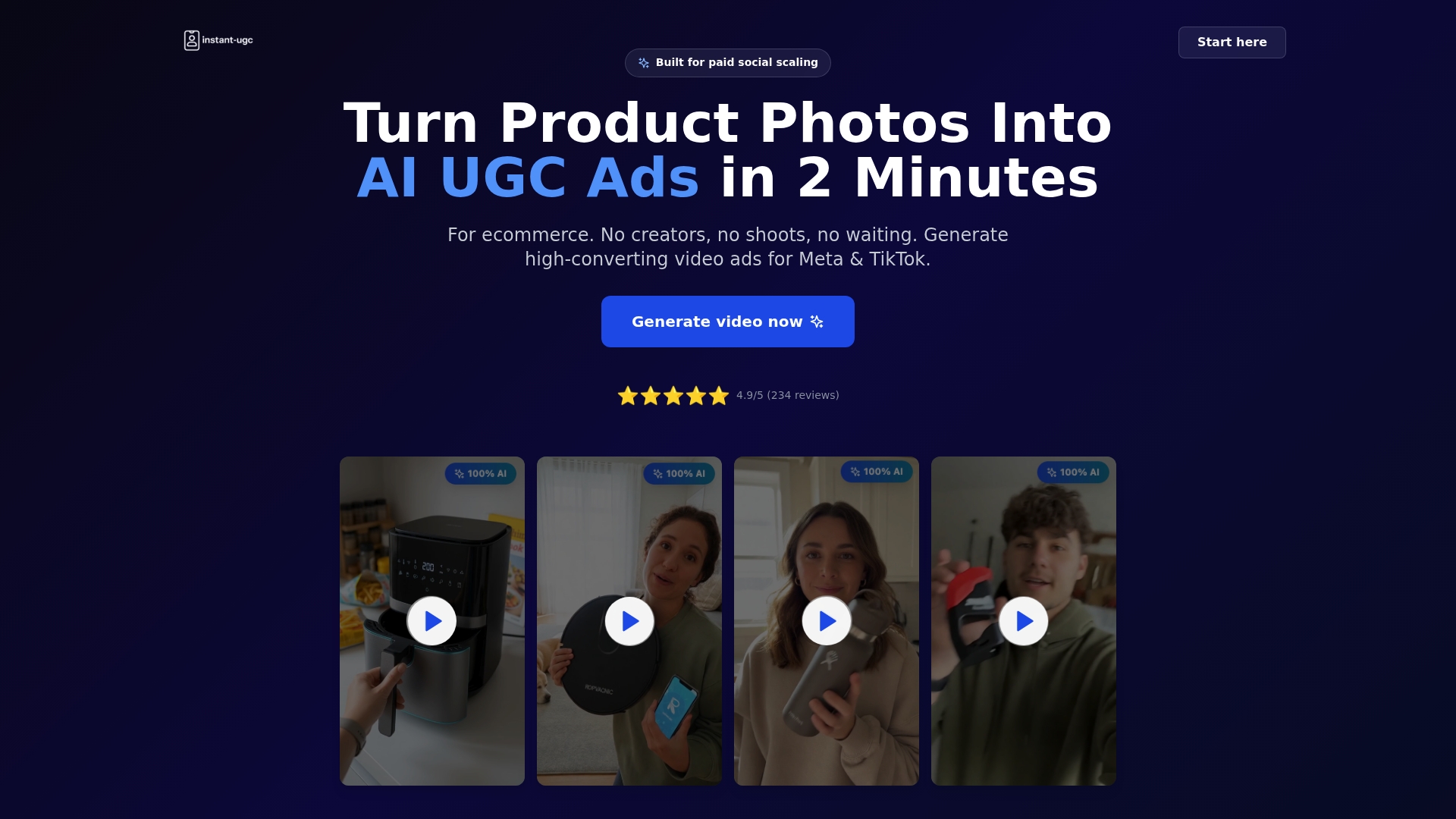
This fits small-batch testers validating a new SKU before committing real spend, and it fits brands already scaling who need fresh creative variants faster than fatigue sets in.
Visit the Instant-UGC pricing page to pick a plan and generate your first test video today.
Sources
This article draws on the FTC’s Endorsement Guides and Consumer Reviews and Testimonials Rule for disclosure standards, Shopify’s guide on UGC ad types and sourcing, TikTok’s ad-effectiveness notes on early-second recall, and Instant-UGC’s own product and case pages.
- TikTok shares new notes to maximize ad effectiveness (SocialMediaToday)
- 4 types of UGC ads and how to collaborate on UGC ads (Shopify)
- Guides concerning the use of endorsements and testimonials in advertising (FTC)
FAQ
How do I generate UGC ads using AI?
Upload a product photo and a short list of feature bullets to an AI video platform, which drafts a script, selects an avatar, and renders a vertical video with captions. Most platforms complete this in one to two minutes, letting you test several variants before spending on ad delivery.
How do dropshippers typically make their ads?
Dropshippers usually pull product photos or videos from their supplier, then either commission an independent creator, repurpose customer clips, or use an AI tool to generate UGC-style video from those assets. AI workflows have become common specifically because they remove the wait time and per-video cost of hiring creators individually.
Are Google Ads worth it for dropshipping?
Google Ads can work for dropshipping, particularly for products with clear search demand, but most successful dropshippers find hook and creative testing on short-form video platforms first, since early creative iteration predicts downstream conversion more reliably than channel expansion. Once a creative wins on TikTok or Meta, it often transfers well to Google’s video placements.
What does UGC stand for in advertising?
UGC stands for user-generated content, meaning video or images created by real customers or creators rather than a brand’s in-house production team. In advertising, UGC-style ads mimic that authentic, unpolished look even when produced through an AI avatar, provided any material connection or synthetic element is properly disclosed.
What is the fastest way to test a new dropshipping product ad?
Generate three hook variations paired with two avatar personas and one consistent CTA, then run all six combinations for 48 to 72 hours with creative-level tracking. Watch rate at six seconds is the earliest signal of whether a hook is working, followed by click-through and add-to-cart rates.
