
15 Testimonial Ad Examples That Actually Convert in 2026
Discover 15 powerful testimonial ad examples that convert in 2026. Explore winning formats like UGC videos and quote cards to boost your sales.
The six formats driving the strongest results right now are: short UGC video, quote card, carousel proof, before/after, expert endorsement, and landing-page case study. Each one works because it puts a real customer’s words between your brand claim and the buyer’s skepticism.
Here’s how each format earns its place:
- Short UGC video (15s): A customer on camera, problem stated in the first two seconds, result delivered before the skip. Best for cold Meta and TikTok audiences. Needs: customer name, specific metric (“lost 12 lbs in 6 weeks”), and a tight CTA.
- Quote card (static): A single sentence from a verified buyer, their photo, and a star rating. Works well for retargeting and email. Needs: full name, company or location, and one concrete outcome.
- Carousel proof: Three to five short quotes covering different objections, one per card. Ideal for mid-funnel Meta feed. Needs: varied customer profiles and a results-focused final card.
- Before/after: A visual or verbal contrast showing the state before and after using the product. Strong for health, beauty, and SaaS. Needs: a clear timeframe and a measurable change.
- Expert endorsement: A credentialed third party (doctor, industry analyst, certified trainer) vouching for a specific claim. Best for regulated or high-consideration categories. Needs: the expert’s credentials and a specific, verifiable statement.
- Landing-page case study: A longer narrative (200–400 words) with a named customer, a quantified result, and a supporting quote. Converts high-intent visitors who need more proof before purchasing.
Pick one format, build a single 15-second video or quote card this week, and measure CTR and signups against your current control.
Key Takeaways
Specificity is the single most important creative variable in testimonial advertising: a named customer, a concrete metric, and a timeframe convert at a materially higher rate than any vague endorsement.
| Point | Details |
|---|---|
| Best format by funnel stage | Use 15s UGC video for cold traffic; quote cards and carousels for retargeting; case studies for high-intent post-click pages. |
| Primary metric to watch | Track CTR for cold creative and CPA for retargeting; a higher CTR on Meta feed signals a strong hook. |
| FTC compliance is non-negotiable | Disclose any material connection (free product, payment, employment) clearly in the caption — “#ad” or “Paid partnership” meets the standard. |
| Capture once, produce many cuts | One 10-minute customer interview yields awareness, retargeting, landing-page, and sales clips — plan the shoot for paid media from the start. |
| Instant-ugc accelerates production | AI-generated testimonial-style videos at $4–$7 each and 90–120 seconds per video make high-volume A/B testing financially viable for any team size. |
Table of Contents
- What makes a testimonial ad work (and why buyers trust them)
- Real-brand testimonial ad examples by format and channel
- Copy and video script templates you can use today
- How to collect authentic testimonials and stay FTC-compliant
- How to scale testimonial video production without burning budget
- How to measure and optimize testimonial ads
- Swipe file: 10 ready-to-run testimonial ad concepts
- What practitioners are seeing work in 2026
- Instant-ugc produces testimonial-style videos in under two minutes
- Sources
What makes a testimonial ad work (and why buyers trust them)
A testimonial ad is a paid placement that uses a real customer’s words, image, or video to make a brand claim credible. According to WordStream’s testimonial advertising roundup, the format spans everything from UGC clips and quote excerpts to review screenshots and TV-style customer stories. The common thread: a third party says what the brand cannot say about itself without sounding self-serving.
The mechanism behind the persuasion is not new. Harvard Business Review’s analysis of persuasion principles traces the same three levers — credible sources, clear claims, and narrative structure — back 2,000 years. Testimonial ads package all three into a single creative unit. A named customer is a credible source. The problem-to-result arc is a narrative structure.
Why these ads convert:
- Reduces perceived risk. A buyer who sees someone like them succeed with a product feels less exposed making the same purchase.
- Short-circuits objections. A quote that directly addresses a common hesitation (“I was worried it wouldn’t work for my skin type”) neutralizes that objection before the buyer raises it.
- Demonstrates fit. Specificity (age, industry, use case) signals to the right buyer that this product was built for someone like them.
- Builds platform-native trust. A video that looks like a friend’s post bypasses the mental filter buyers apply to polished ads.
The specificity point deserves emphasis. “I loved it” converts far worse than “I saved $400 in the first month.” Numbers give buyers a reference point and make the claim feel verifiable, even when they cannot verify it themselves.
Real-brand testimonial ad examples by format and channel
The formats below cover social feeds, display, and post-click pages. Each one includes a platform fit, a creative formula, and a brand case that shows the lesson in practice.
Short UGC video (Meta and TikTok)
First three seconds must carry the proof or the hook.
Creative formula: Customer on camera → state the problem in their own words → name the product → deliver the result with a specific number or timeframe → CTA overlay.
Calm runs 15-second UGC-style clips where users describe their sleep before and after using the app. The ad opens with the problem (“I was waking up at 3 AM every night”) and closes with a metric (“I’ve slept through the night for 30 days straight”). No voiceover, no studio lighting. The rawness is the point.
Headspace takes a similar approach but leans on a before/after emotional contrast: anxious commuter versus calm commuter. The format works because the viewer self-identifies with the before state in under two seconds.
Noom uses customer-submitted video clips with on-screen text overlays showing weight-loss milestones. The combination of a real face, a real number, and a real timeframe makes the claim feel earned rather than manufactured.
UGC-style ads on Facebook that mimic organic posts consistently outperform polished brand creative because they bypass the mental filter buyers apply to anything that looks like an advertisement.
Quote card (static, Meta feed and retargeting)
Platform specs: 1:1 or 4:5 for Meta feed, minimal text, customer photo preferred. Caption under 125 characters for above-the-fold display.
Creative formula: One sentence quote → customer name and photo → star rating or platform badge → brand logo.
Grammarly runs quote cards featuring writers and professionals who describe a specific workflow improvement (“I used to spend an hour editing every email. Now it takes five minutes”). The quote is short, the outcome is concrete, and the customer’s job title adds credibility for the target audience.
Glossier uses customer selfies with a single quote overlaid. The aesthetic matches the brand’s minimalist visual identity, which makes the ad feel like a product review rather than a paid placement.
Carousel proof (mid-funnel Meta)
Platform specs: Up to 10 cards, 1:1 per card, each card needs its own hook. Final card is typically a CTA.
Creative formula: Card 1 = strongest quote → Cards 2–4 = quotes covering different objections → Final card = CTA with aggregate rating.
SurveyMonkey uses carousel ads where each card features a different customer segment (HR manager, marketing director, small business owner) with a quote specific to their use case. The format signals breadth of fit without a single ad feeling generic.
ILIA Beauty runs carousel proof with customer photos on each card, a short quote about a specific product benefit (coverage, skin feel, longevity), and a star rating. The variety of skin tones across the carousel is itself a trust signal.
Before/after (health, beauty, SaaS)
Creative formula: Left/right or top/bottom visual contrast → timeframe label → customer name → result metric.
Dove uses before/after testimonial formats in both video and static ads, focusing on skin feel and confidence rather than dramatic physical transformation. The restraint makes the claims more believable. The customer’s name and a short quote anchor the visual.
Boxed Water takes a different angle: their before/after testimonials contrast the customer’s previous single-use plastic habit with their current routine, using a sustainability metric (“I’ve eliminated 400 plastic bottles this year”). The format works because the “before” is a shared cultural guilt point.
Expert endorsement (high-consideration and regulated categories)
Creative formula: Expert name and credentials → specific claim tied to their expertise → product name → CTA.
Alan David Custom (a custom menswear brand) uses endorsements from style editors and professional stylists who describe the fit and construction quality in specific terms. The expert’s credentials do the trust work that a customer quote cannot do alone in a high-ticket category.
Landing-page case study (post-click, high-intent)
Platform specs: No strict length limit. 200–400 words with a pull quote, a results metric in bold, and a customer photo converts well for high-ticket or high-consideration offers.
Salesforce publishes detailed customer case studies on landing pages tied to paid search campaigns. Each study names the company, the problem, the Salesforce product used, and a quantified outcome. The format is long by ad standards, but the buyer arriving from a “Salesforce CRM for enterprise” search query is ready for that depth.
General Assembly uses student testimonial pages that combine a photo, a career-change narrative, and a specific outcome (job title and employer after the program). For a $15,000+ bootcamp, a two-paragraph story with a named graduate converts better than a five-word quote.
Copy and video script templates you can use today
The right template depends on funnel stage. A 15-second video works for cold audiences who need a fast reason to care. A 30-second video suits warm audiences who need more proof. Quote cards and captions work best for retargeting, where the buyer already knows the brand.
15-second video script template (cold traffic)
- Hook (0–3s): “[Customer name] was [specific problem] before [product].”
- Discovery (3–10s): “Then [he/she/they] tried [product] and [specific action taken].”
- Result (10–14s): “Now [metric + timeframe]. [Customer name], [job title or location].”
- CTA (14–15s): “[Brand name]. [One-line CTA].”
Production note: Shoot on a phone in 9:16. No studio. Natural light. Customer reads from a prompt card, not a teleprompter. Keep the audio clean — a $30 lapel mic is enough.
30-second video script template (warm/retargeting)
- Hook (0–3s): “[Specific problem statement in customer’s own words].”
- Context (3–10s): “I’d tried [alternative] but [why it didn’t work].”
- Discovery (10–18s): “A friend recommended [product]. I [specific action]. Within [timeframe]…”
- Result (18–26s): “[Specific metric or outcome]. I [emotional payoff].”
- CTA (26–30s): “If you’re dealing with [problem], [product] is worth trying. [CTA].”
Production note: Add captions. On Facebook, 85% of video is watched without sound. A talking-head video with no captions loses most of its audience before the result lands.
Quote card copy variants
Short (under 15 words): “[Product] cut my [task] time from [X] to [Y]. Genuinely.” — [Name], [Title]
Medium (15–30 words): “I was skeptical. But after [timeframe], [specific outcome]. I’ve recommended it to [number] people on my team.” — [Name], [Company]
Long (30–50 words, for landing pages or email): “Before [product], I was [problem]. I tried [alternative] but [limitation]. [Product] gave me [specific result] in [timeframe]. The [specific feature] alone was worth it.” — [Name], [Title], [Company]
Caption snippets
- Cold hook: “She [specific result] in [timeframe]. Here’s how. ↓”
- Retargeting hook: “Still thinking about it? Here’s what [Name] said after [timeframe].”
- Objection-handling hook: “Worried it won’t work for [specific concern]? [Name] had the same question.”
Pro Tip: Ask customers to state the timeframe and metric in the first sentence of their video. “I lost 12 lbs in 6 weeks” is a better hook than “I’ve been using this for a while and I’ve seen results.” The specificity is what makes the claim feel real.
How to collect authentic testimonials and stay FTC-compliant
The best collection workflow starts at the moment of highest satisfaction: right after a customer achieves a result, not weeks later when the memory has faded. A post-purchase or in-app request sent 7–14 days after delivery (for physical products) or after a key activation milestone (for SaaS) consistently outperforms generic “leave a review” blasts.
Trustpilot’s research on review motivations shows that customers write reviews primarily to help others and to share a genuinely positive experience. Your collection message should frame the request the same way: “Your experience could help someone else make a better decision.”
Collection checklist:
- Send the request at peak satisfaction (post-result, not post-purchase).
- Ask for a specific outcome: “What result did you see, and in what timeframe?”
- Request both a written quote and a short video (landscape for YouTube/TV, vertical for TikTok/Meta).
- Get explicit written permission to use their name, photo, quote, and video in paid advertising.
- Ask which platforms they’re comfortable being featured on (social, website, email, paid ads).
- Confirm they received no compensation that would require disclosure (or document the compensation for FTC purposes).
Consent and release outline:
Your release should cover: (1) the customer’s name and likeness, (2) the specific content being used (quote, photo, video), (3) the platforms and formats where it may appear, (4) the duration of use, and (5) whether any compensation was provided.
FTC disclosure basics for U.S. testimonial ads:
The FTC’s endorsement guidelines require clear disclosure when there is a “material connection” between the endorser and the brand. This includes:
- Free products or discounts given in exchange for a testimonial.
- Paid partnerships or affiliate relationships.
- Employment relationships (an employee testimonial must be disclosed).
The disclosure must be clear and conspicuous. “#ad” or “Paid partnership” in the caption meets the standard. Burying it in a long list of hashtags does not.
Pro Tip: Use a prompt template to elicit specificity: “In one sentence, describe the problem you had before using [product]. In one sentence, describe the result you saw and how long it took.” Customers who answer this prompt give you a ready-made 15-second script with no editing required.
How to scale testimonial video production without burning budget
The most cost-efficient testimonial production model is: capture once, produce many cuts. One 10-minute customer interview contains enough material for an awareness clip, a retargeting clip, a landing-page hero video, and a sales-support clip. The key is planning the footage as paid-media assets from the start, not repurposing content that was shot for something else.
Scalable production workflow:
- Pre-production (Day 1–2): Send the customer a prompt sheet with three to five questions designed to elicit problem, discovery, result, and a specific metric. Confirm consent and release in writing.
- Capture (Day 3–5): Record a 10–15 minute interview on video. For remote customers, a Zoom recording at 1080p is sufficient. Ask them to re-state key answers in shorter versions (30s, 15s, 10s).
- Edit (Day 6–8): Cut the master interview into platform-specific lengths: 60s for YouTube pre-roll, 30s for Meta warm audiences, 15s for cold Meta and TikTok, 6s for bumper ads.
- Captions and overlays (Day 8–9): Add auto-generated captions (review for accuracy), metric overlays, and a CTA card. Tools like Descript or CapCut handle this in under an hour per video.
- Variant production (Day 9–10): Create two to three hook variants per length (different opening frames, different first-sentence text overlays) for A/B testing.
Cost benchmarks per output (traditional workflow):
- Full interview capture with a freelance videographer: $300–$800
- Editing per platform cut: $75–$150 per cut
- Caption and overlay pass: $25–$50 per video
- Total for five platform cuts from one interview: $700–$1,600
AI-assisted video generation changes this math significantly. Platforms that generate testimonial-style video from product photos can produce a platform-ready 9:16 video in under two minutes at a fraction of traditional production cost, which makes high-volume A/B testing financially viable for teams that previously could only afford one or two creative variants per campaign.
For SaaS and app teams, AI video tools for SaaS have matured enough in 2026 to handle avatar-based testimonial formats that look credible at scroll speed, particularly for top-of-funnel awareness where the goal is a click, not a close.
Pro Tip: Batch your consent and capture sessions. Invite three to five customers to a 30-minute group video call, record each one individually for 10 minutes, and you leave with enough raw footage for 15–20 platform-ready cuts. One afternoon of coordination replaces weeks of back-and-forth scheduling.
How to measure and optimize testimonial ads
The KPIs that matter depend on where the ad sits in the funnel. Tracking the wrong metric at the wrong stage leads to cutting creative that is actually working.
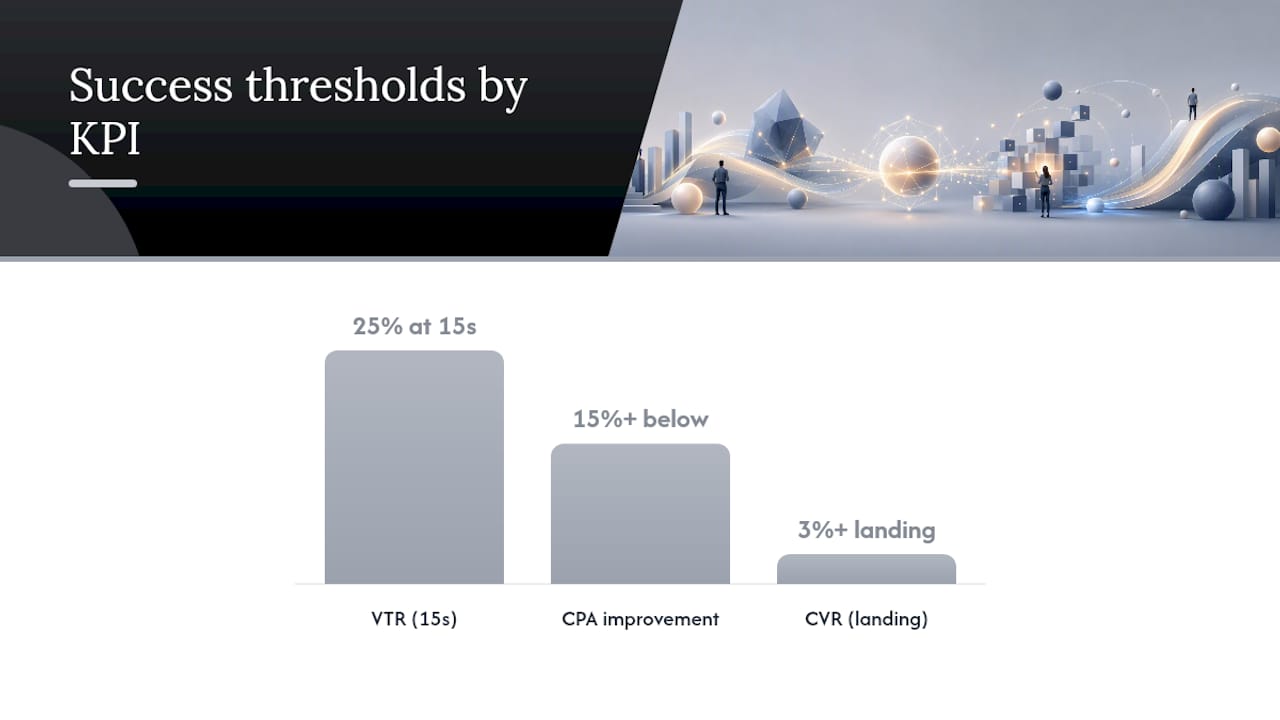
| KPI | Funnel stage | Recommended A/B test | Success threshold |
|---|---|---|---|
| CTR (click-through rate) | Cold/awareness | Hook variant (first frame + first line) | Above average for Meta feed |
| Video view-through rate (VTR) | Cold/awareness | 3s vs. 15s retention comparison | Above 25% at 15s mark |
| Cost per acquisition (CPA) | Mid/retargeting | Specificity vs. emotional copy | Below your target CPA by 15%+ |
| Conversion rate (CVR) | Bottom/retargeting | CTA wording (“Try free” vs. “See how it works”) | Above 3% for landing page |
| ROAS | Full-funnel | UGC vs. polished creative | Above average for paid social |
A/B testing UGC ad creatives at scale requires at least 1,000 impressions per variant before drawing conclusions. Running tests with smaller sample sizes produces results that don’t hold when you scale spend.
Practical A/B test ideas:
- Hook-first-frame variants: Test a customer’s face vs. a text overlay vs. a product shot as the first frame. The winner often surprises you.
- Specificity vs. emotion: “I lost 12 lbs in 6 weeks” vs. “I finally feel like myself again.” Specificity usually wins for cold traffic; emotion often wins for retargeting.
- UGC vs. polished cuts: Raw phone-shot video vs. professionally edited testimonial. UGC-style formats consistently outperform polished creative on social feeds, but polished cuts can outperform on YouTube pre-roll and display.
- CTA wording: “Start free trial” vs. “See how [Name] did it” vs. “Get the same result.” Narrative CTAs often outperform generic ones for testimonial formats.
- Thumbnail variations: Customer face vs. results screenshot vs. before/after split. For video ads, the thumbnail determines whether the video gets played.
Troubleshooting checklist for underperforming testimonial ads:
- Vague quote with no metric: replace with a specific outcome and timeframe.
- Poor audio quality: even great content loses viewers if the audio is hard to follow. Re-record or add clean captions.
- Mismatch between ad and landing page: the testimonial in the ad should appear (or be reinforced) on the landing page the buyer reaches.
- No disclosure on compensated testimonials: adds legal risk and can reduce trust if discovered.
- Testimonial customer profile doesn’t match the audience: a B2B software testimonial from a solo freelancer won’t convert enterprise buyers.
Swipe file: 10 ready-to-run testimonial ad concepts
These 10 concepts cover cold, mid, and bottom-funnel needs. Each one is designed to be dropped into a creative brief or a production ticket with minimal adaptation.
-
UGC talking-head (problem → result): Customer on camera, 15s, 9:16. Hook: “I was [problem] for [timeframe].” CTA: “Link in bio / Swipe up.” Mood: natural light, no studio. Best for cold Meta and TikTok.
-
Carousel objection-handler: Five cards, 1:1, each card addresses one common objection with a customer quote. Final card: aggregate star rating + CTA. Hook: “Still not sure? Here’s what [number] customers said.” Best for mid-funnel Meta.
-
Before/after timeline: Static or short video showing state at Day 0 vs. Day 30. Customer name and metric overlay. Hook: “[Name] in [timeframe].” CTA: “See the full story.” Best for health, beauty, fitness, SaaS.
-
Expert-minute endorsement: 30s video, expert credentials on screen in first 3 seconds. Specific claim tied to expertise. CTA: “Recommended by [credential].” Mood: clean background, professional framing. Best for regulated or high-ticket categories.
-
Reaction stitch (TikTok): Brand video on left, customer reaction on right. Customer reacts to a product demo or result reveal. Hook: “Wait, it actually works?” CTA: “Try it yourself.” Best for TikTok cold audiences.
-
Star-rating static: Customer photo, 5-star graphic, one-sentence quote, brand logo. Minimal design. Hook: “[Name] gave us 5 stars. Here’s why.” Best for retargeting display and Meta.
-
Review-screenshot native-style: Screenshot of a real review (App Store, Google, or Trustpilot) with a subtle brand frame. Looks organic. Hook: “Real review. Real result.” Best for cold Meta and Instagram Stories.
-
Wall-of-love landing hero: Grid of 9–12 customer photos with short quotes. Used as a landing-page hero section above the fold. No CTA needed — the volume of proof is the conversion mechanism. Best for post-click pages tied to paid search.
-
Founder + customer read: Split screen or alternating cuts. Founder states the product promise; customer confirms it happened. 30s, 16:9 or 9:16. Hook: “We promised [outcome]. [Name] got it.” Best for YouTube pre-roll and warm email.
-
Results card with metric: Minimal graphic: customer name, metric in large type (“$4,200 saved in 90 days”), and a one-line quote. Clean, data-forward. Hook: “[Metric]. [Name]'s result after [timeframe].” Best for LinkedIn, B2B display, and retargeting.
What practitioners are seeing work in 2026
The single most important shift in testimonial advertising right now is the collapse of tolerance for polished content on social feeds. Buyers have become skilled at identifying produced creative, and their response is to scroll past it. The formats gaining ground are the ones that look like they were shot on a phone by someone who didn’t know they were making an ad.

This doesn’t mean low quality. It means low production signaling. A well-lit phone video with clean audio and a specific result stated in the first three seconds outperforms a $5,000 studio shoot on Meta and TikTok in most performance tests. The UGC-style formats that mimic organic posts are winning because they bypass the ad-detection filter buyers apply automatically.
What’s losing effectiveness: generic quote cards with no photo, polished brand videos that lead with the product rather than the customer’s problem, and testimonials that use vague language (“I really liked it,” “great product”) without a metric or timeframe.
What’s scaling: short vertical video with a metric in the first three seconds, carousel formats that address specific objections by customer segment, and AI-generated avatar testimonials for top-of-funnel awareness where volume and speed matter more than a real face.
The tactical shift that makes the biggest difference for conversion-focused teams: lead with a verifiable metric in the first three seconds. Specificity is the creative asset. Everything else is production.
Instant-ugc produces testimonial-style videos in under two minutes
Traditional UGC production takes 2–3 weeks and costs $500–$2,000 per video. For teams that need to test five hook variants across three audience segments, that math makes high-volume creative testing impossible.
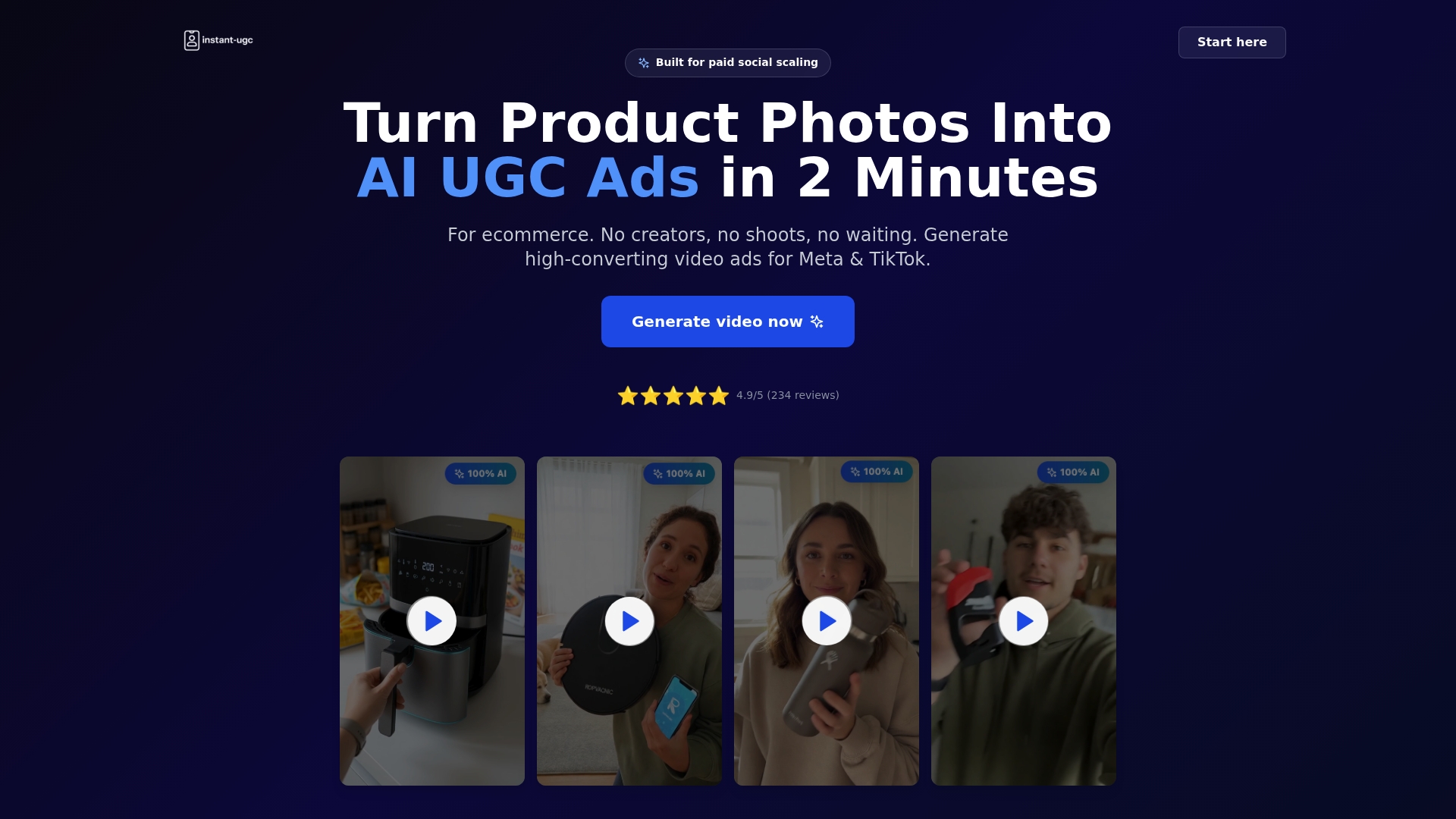
Instant-ugc solves the production bottleneck directly. The platform takes product photos or app screenshots and generates a 9:16 testimonial-style video in 90–120 seconds, with 10+ customizable AI avatars, automatic script generation, and support for 17 languages. Per-video cost runs $4–$7.
The platform runs two dedicated workflows: one for physical products (Shopify, Amazon FBA, dropshipping) and one for mobile apps and SaaS (App Store-optimized testimonial-style cuts). Agencies can use the white-label option to deliver client videos at scale without building an in-house production team.
For Facebook and TikTok campaigns specifically, the AI Facebook ads video generator and TikTok ads generator produce platform-native formats out of the box. Start a free trial at Instant-ugc and generate your first testimonial-style video today.
Sources
These sources back the article’s recommendations on testimonial ad formats, UGC performance, persuasion research, and collection best practices.
- Testimonial Advertising: 17 Examples You Can (& Should) Steal | WordStream
- Testimonial Facebook Ad Examples That Actually Work In 2026 - The DailyMoss
- The art of persuasion hasn’t changed in 2,000 years | Harvard Business Review
