
UGC vs Influencer: Choosing Right for Awareness or Conversion
Discover whether UGC or influencers better drive your campaign's awareness or conversion goals. Learn how to leverage both effectively.
Buy audience, not assets, for influencers. Buy assets, not audience, for UGC creators. That’s the entire decision in one line, and it maps cleanly to your campaign goals: influencers win for awareness and trust, UGC creators win for conversion and paid creative testing, and retention usually needs a mix of both.
Here’s the evidence in three moves. Influencer marketing remains a multi-billion dollar category because reach and borrowed trust still convert attention into consideration. Meanwhile, UGC routinely beats branded content on CTR and conversion when it runs as paid ad creative or product-page proof. Your next moves:
- Awareness campaign: book 2 to 3 vetted influencers with clear usage-rights clauses.
- Acquisition/conversion campaign: commission UGC creators (or generate AI-assisted UGC) for testable ad variants.
- Retention/loyalty: repurpose top-performing UGC into email and lifecycle content, then layer in an ambassador-tier influencer for community trust.
Key Takeaways
The right choice between UGC and influencer marketing depends on whether the campaign job is to build trust and reach or to produce testable, high-converting ad creative.
| Point | Details |
|---|---|
| Match tactic to job | Use influencers for awareness and trust; use UGC for conversion and creative testing. |
| Rights come first | Lock usage rights, license scope, and paid-ad permissions into every contract before content ships. |
| Test before you scale | Run cheap UGC variants to find winning messages, then amplify proven ones through influencers. |
| Measure by goal | Track reach and engagement for influencers, CTR/CPA/ROAS for UGC, not the same KPI for both. |
| Scale with AI-assisted UGC | Instant-ugc generates testimonial-style video ads from product photos in minutes, cutting typical multi-week creator timelines. |
Table of Contents
- UGC vs Influencer: What You’re Actually Buying
- Comparing UGC and Influencer Marketing Side by Side
- Pros and Cons of UGC Creators vs Influencers
- When Should You Use UGC Creators?
- When Should You Use Influencers?
- Should You Combine UGC and Influencer Marketing?
- How Do You Measure UGC and Influencer Performance?
- What Do UGC and Influencer Campaigns Typically Cost?
- How Do You Scale UGC Production Without Losing Quality?
- Scale UGC Creative With an AI-Assisted Platform
- Sources
UGC vs Influencer: What You’re Actually Buying
The confusion between UGC creators and influencers usually comes down to one mistake: treating them as the same purchase. They’re not.
A UGC creator produces raw or lightly edited content, usually video, that looks native and unpolished, in exchange for a flat fee. You’re buying a reusable asset: a piece of creative you own (per your contract) that you can run as a paid ad, embed on a product page, or drop into an email. The creator typically never posts it publicly themselves.
An influencer posts to their own audience, on their own channel, under their own name. You’re buying access: reach, credibility, and the halo effect of their followers trusting their recommendation. The content usually lives on their feed, not yours, unless you’ve negotiated whitelisting rights.
- UGC creator example: a $150 kitchen-gadget video shot for Meta ads, never posted anywhere else.
- Influencer example: a food creator with 40,000 engaged followers posting an organic Reels review that tags your brand.
- Rights differ sharply: UGC contracts usually transfer ownership or grant a broad license; influencer deals usually grant limited usage rights tied to a time window, per CA Agency’s contract guidance.
Comparing UGC and Influencer Marketing Side by Side
Once you separate “asset” from “audience,” the comparison of UGC and influencer marketing gets easy to act on. Each dimension below tells you what to check before you sign a contract or brief a creator.
- Best for: UGC wins for conversion and creative testing; influencers win for awareness and trust transfer.
- Ownership: UGC content is typically brand-owned or broadly licensed; influencer content stays creator-owned unless whitelisting is negotiated.
- Creative control: High with UGC (you write the script); lower with influencers (you’re borrowing their voice and format).
- Speed: UGC can turn around in days; influencer campaigns often need weeks for vetting, negotiation, and posting windows.
- Scale: UGC scales cheaply across many variants; influencer scale is capped by available creator inventory and budget per post.
- Authenticity: Both trade on perceived authenticity, but HBR’s research on trust shows influencer credibility depends heavily on disclosure and audience fit, not follower count alone.
- Typical KPIs: CTR, CPA, and ROAS for UGC; reach, engagement rate, and brand lift for influencers.
Pro Tip: Before briefing either, decide which KPI you’ll judge success against. A UGC video judged on “reach” or an influencer post judged on “CTR” will always look like a bad investment, even when it did exactly its job.
Pros and Cons of UGC Creators vs Influencers

Neither format is universally better. The trade-offs just fall in different places.
UGC creators
- Pro: Cheap to produce at volume, so you can test five hooks for the price of one influencer post.
- Pro: Full creative control means the script hits your exact value proposition.
- Con: No built-in distribution. The video is worthless until you pay to put it in front of someone.
- Con: Without a real customer voice, overly polished UGC can feel staged and hurt trust.
Influencers
- Pro: Instant access to a warmed-up, trusting audience.
- Pro: Strong for category discovery and niche credibility that a stranger’s ad can’t buy.
- Con: Slower turnaround and higher per-post cost, especially at the macro tier.
- Con: Less creative control, which can produce off-brand messaging if the brief is thin.
The most common budget mistake: paying influencer-level fees for content you’ll only ever use as a paid ad, or briefing a UGC creator like an influencer and expecting organic reach that was never part of the deal.
When Should You Use UGC Creators?
UGC creators earn their keep in three channels: paid social, product pages, and lifecycle email. Each rewards a different KPI. Paid social wants CTR and CPC efficiency. Product pages want conversion rate lift and reduced bounce. Email wants revenue per send. Promote’s benchmark data shows UGC-style creative consistently narrowing the gap between cost per asset and cost per acquisition compared to polished branded video.
A compact UGC brief should cover:
- Key message (the one thing the viewer must remember).
- Proof point (a specific benefit, stat, or use case, not a vague claim).
- Call to action (exact wording, not “buy now” left to interpretation).
- Format specs (aspect ratio, length, caption style, on-screen text needs).
Before you pay, lock down usage rights in writing:
- Perpetual license, not a 90-day window, if you plan to run the ad long-term.
- Explicit paid-advertising rights, not just “organic posting” language.
- Geographic and platform scope (Meta, TikTok, connected TV) spelled out by name.
Two quick use cases show the pattern. An ad creative pipeline might commission 10 UGC videos monthly, testing hooks against a $50 daily spend each before scaling winners. A product-page use case swaps a stock hero image for a 15-second UGC clip showing unboxing and first use, which Shopify’s research ties to measurable conversion lift.
When Should You Use Influencers?
Influencers do their best work on jobs UGC can’t touch: building category trust, reaching a niche community, and creating a moment of discovery around a launch. If your KPI is reach, engagement rate, or affiliate-tracked sales rather than raw CTR, this is your channel.
Three campaign structures cover most needs:
- Single-launch macro push: one or two larger creators for a product debut, optimized for reach and press pickup.
- Micro-influencer cohort: 10 to 20 smaller creators (10,000 to 50,000 followers) for authentic, distributed coverage at lower total cost.
- Ongoing ambassador program: a handful of creators posting monthly, building long-term association rather than a single spike.
Negotiate these clauses before anything goes live:
- Posting windows and content deliverable count.
- Usage rights if you want to run the post as a paid ad (whitelisting/allowlisting).
- Exclusivity terms, especially in crowded categories.
- Payment model: flat fee, affiliate commission, or hybrid.
Vet fit with three checks: does their audience demographic overlap with yours, is their engagement rate believable for their follower count, and does their existing content tone match your brand voice.
Pro Tip: Ask for a creator’s past sponsored-post performance, not just their overall engagement rate. Sponsored content typically underperforms organic posts by a meaningful margin, and that gap tells you more about real influence than any follower count.
Should You Combine UGC and Influencer Marketing?
Most mature programs don’t pick one lane forever. Three hybrid patterns show up repeatedly:
- UGC-first testing, then influencer amplification: run cheap UGC variants to find the winning message, then hand that proven script to an influencer to record in their own voice. Budget split: roughly 20% UGC testing, 80% influencer scale once a winner is confirmed.
- Influencer content with paid whitelisting: an influencer posts organically, then you pay to boost that same post as a targeted ad using allowlisted access. Split: 60% content fee, 40% media spend.
- Simultaneous split-test allocation: run UGC and influencer creative side by side in the same paid campaign and let performance data decide where more budget goes.
8x’s sequencing research backs the first pattern specifically: testing message-market fit with cheap UGC before paying for influencer reach tends to lift the return on that influencer spend, because you’re amplifying something already proven to convert.
How Do You Measure UGC and Influencer Performance?
Testing either channel well means committing to a real framework before launch: run true A/B splits, hold sample sizes large enough to trust the result, and keep a holdout group so you can attribute lift honestly instead of guessing.
- Define the primary goal before you brief anyone, not after results come in.
- Separate acquisition metrics (CTR, CPA) from engagement metrics (likes, saves, comments); they answer different questions.
- Give awareness plays more time to show up in brand lift surveys or search volume; conversion plays should show signal within days.
| Goal | Primary KPI | What It Tells You |
|---|---|---|
| Awareness | Reach, impressions | Whether the message got seen; watch for brand lift over weeks. |
| Consideration | Engagement rate | Whether the audience found the content worth reacting to. |
| Acquisition | CTR, CVR, CPA | Whether the creative and offer combination actually converts. |
| Retention | Revenue per visitor | Whether repurposed content sustains value after the first purchase. |
If a UGC variant is winning on CTR but flat on CPA, the hook is working but the landing page or offer isn’t. If an influencer post drives reach but no measurable site lift, check attribution windows before assuming it failed.
What Do UGC and Influencer Campaigns Typically Cost?
Budgets vary widely by creator tier and market, but the published ranges give you a starting point for negotiation.
| Program Size | UGC Allocation | Influencer Allocation |
|---|---|---|
| Small (test budget) | Several UGC videos at low per-asset cost | One or two micro-influencers |
| Medium (growth stage) | A steady monthly UGC pipeline for paid testing | A micro-influencer cohort or one mid-tier creator |
| Enterprise | High-volume UGC across SKUs and languages | Macro-influencer push plus ambassador program |
Promote’s benchmark ranges show traditional UGC production and influencer post rates sitting in very different cost brackets, which is exactly why conflating the two purchases wastes budget. Before you sign anything, negotiate usage rights up front. A cheap post rate that excludes paid-ad usage often costs more later once you pay a separate licensing fee to run it as an ad.
How Do You Scale UGC Production Without Losing Quality?
Scaling UGC used to mean scaling headcount and outreach. A working pipeline looks like this: source creators or generate variants, write a tight brief, produce the asset, run quality control against brand guidelines, lock usage rights, then repurpose the winner across formats.
Automation fits cleanly into the production and repurposing stages. AI-assisted UGC tools can generate testimonial-style video from a product photo or app screenshot in minutes, letting teams test far more hooks than a traditional 2 to 3 week creator turnaround allows.
The goal isn’t to replace the human creator’s voice, it’s to widen the top of the testing funnel. AI-generated variants find the winning message faster; human creators and influencers still carry the trust and nuance that close the sale once you know what to say.
Governance matters more as volume increases. Run a consistency check against brand voice on every batch, keep a test-and-learn cadence (weekly, not quarterly), and flag any output that reads as generic rather than specific to your product.
- Sourcing and briefing take the most human judgment; don’t automate this step.
- QA and rights logging need a real checklist, not a mental note.
- Repurposing (ads, product pages, email) is where scale pays off fastest.
Author perspective: recommended choice for three common brand scenarios
For a high-velocity DTC product, start with UGC to find winning hooks fast, then scale the best ones as paid creative, since speed and cost-per-test matter more than reach here, as noted in Top Apps & Games: Live Rankings by Store. For a niche B2C brand with a tight community, lead with micro-influencers, since trust inside a small audience beats volume. For a new-category launch, run both simultaneously: influencers build category awareness while UGC tests the exact message that converts once curiosity turns into consideration. Use the decision framework above to map your own goal and budget shape before committing spend.
Scale UGC Creative With an AI-Assisted Platform
If the math above made UGC’s cost advantage obvious but the 2 to 3 week creator timeline still feels slow, that gap is exactly what Instant-ugc closes. Instant-ugc turns a product photo or app screenshot into a UGC-style video ad in 2 to 5 minutes, using customizable AI avatars and automatic script generation, so you can test dozens of hooks in the time it takes to book a single creator shoot.
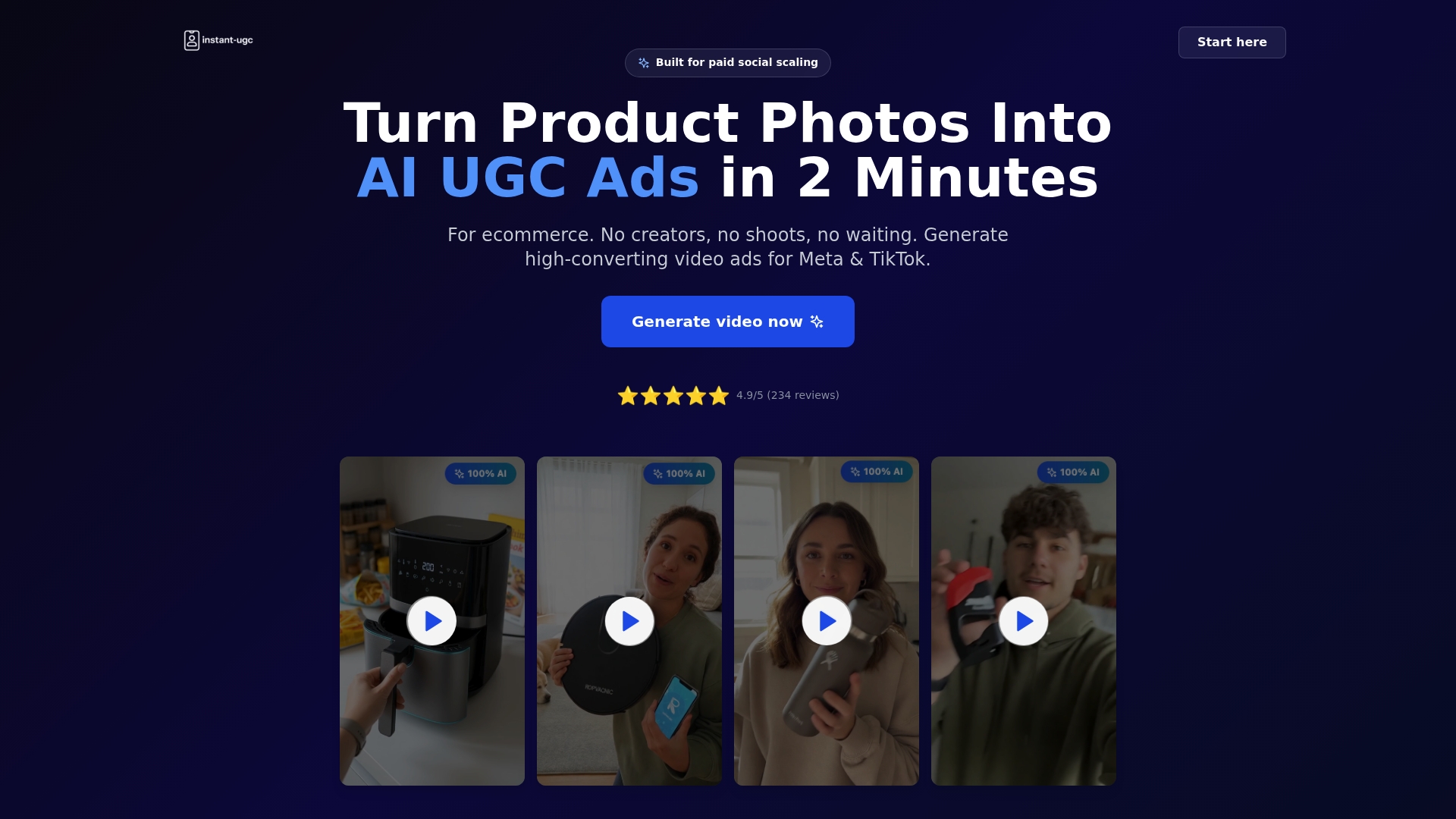
- Ad creative pipelines: generate multiple hook variants for Facebook or TikTok testing without waiting on creator schedules.
- Multi-language delivery: produce localized versions across 17 supported languages from a single product asset.
- Fast iteration: brands using the platform have reported ROAS improvements from 2.1x to 4.8x by testing more creative variants at lower cost per asset.
If you’re running a Shopify store, an app launch, or a lean marketing team competing against bigger budgets, generating your first AI product video is the fastest way to see whether this closes your own testing gap.
Sources
- Influence marketing (topic) | Statista
- How to do influencer marketing that customers actually trust | Harvard Business Review
- User-generated content (UGC) | Shopify Blog
- UGC vs Influencer Marketing: Key Differences in 2026 | Promote Blog
Recommended
- UGC Conversion Optimization: Transform Customer Content Into Sales | Instant-UGC Blog
- Influencer Marketing vs AI UGC: The Complete 2026 Guide for Modern Marketers | Instant-UGC Blog
- How to Combine Influencers and AI UGC for Maximum Marketing Impact | Instant-UGC Blog
- High Converting UGC Ads: The Complete Guide to Testing, Optimization, and Scaling Performance | Instant-UGC Blog
