The Best UGC Video Ad Examples You Can Copy Right Now
Discover effective UGC video ad examples that boost engagement and authenticity. Start creating winning campaigns today!
Start with a testimonial or before-and-after video on TikTok or Instagram Reels. Shoot vertical (9:16), keep it under 30 seconds, and open with a hook in the first two seconds. That single test cell will tell you more about your audience than a month of polished brand creative.
TikTok data reported by Shopify shows A strong preference exists among users for brand posts that don’t feel too polished. Your production budget is not the advantage you think it is. Authenticity is.
Week 1 quick-start: Pick one product, write three hook variations including problem-first, result-first, and curiosity-gap, and brief a creator or use an AI workflow to generate the first batch. Set up a simple tracking sheet for 3-second view rate and click-through rate before you launch. Spend no more than $200–$300 testing before you scale the winner.
Key Takeaways
The fastest path to UGC ad performance is launching a high volume of short, authentic creatives, testing hooks aggressively, and scaling only what the data confirms.
| Point | Details |
|---|---|
| Start with testimonials or before-and-after | These two formats carry the strongest social proof and work across TikTok, Reels, and Meta from week one. |
| Use the 5-part structure | Hook, problem, solution, proof, and CTA in under 30 seconds is the repeatable anatomy behind every high-converting UGC ad. |
| Get usage rights in writing | Capture platform, duration, territory, and music rights before running any creator content as paid advertising. |
| Test hooks first, scale winners | Kill creatives with a 3-second view rate below 15% after $30 in spend; scale anything above 1.5% CTR on cold traffic. |
| Instant-ugc for volume testing | At $4–$7 per video with 90-second delivery, Instant-ugc lets you test 10–15 hook variations before committing to a paid creator. |
Table of Contents
- UGC video ad examples by type: a swipe file you can use today
- The anatomy of a high-converting UGC video ad
- Where to run UGC ads and the platform specs that matter
- How to source or create UGC: creators, seeding, briefs, and pricing
- Permissions, usage rights, and the legal checklist
- How to turn UGC into paid ads: editing, testing, and scaling
- Ready-to-use micro-scripts, hooks, and caption formulas
- Five brand examples and what to copy from each
- What most brands get wrong about UGC (a field note)
- Instant-ugc cuts UGC production from weeks to minutes
- Frequently asked questions about UGC video ads
- Sources
UGC video ad examples by type: a swipe file you can use today
UGC ads take seven core forms. Each fits a different funnel stage, and each has a distinct creative anatomy. Here is the full swipe file.
Testimonial videos
A real person speaks directly to camera about a result they got. No studio, no script that sounds scripted. The best ones open with the outcome (“I lost 12 pounds in six weeks”) and spend the rest of the video explaining how.
Micro-examples to adapt:
- “I’ve tried every [category] product. This one actually works. Here’s why.” (direct response)
- “My dermatologist recommended this. I was skeptical. Three weeks later…” (consideration)
- “Honest review after 90 days of daily use.” (trust-building, retargeting)
- “I almost returned it. Then I figured out the right way to use it.” (objection-handling)
Best use-case: direct response and retargeting. Testimonials carry the social proof that moves someone from “interested” to “buying.”
Testimonial formats often include before-and-after or personal-story elements that function as compressed social proof in short-form ads. The personal story is not decoration; it is the mechanism.
Product demo and tutorial videos
Someone uses the product on camera, showing exactly how it works. No voiceover narration, no text-only explainer. The hands, the product, the result.
Micro-examples:
- “Watch me set this up in under two minutes.” (consideration)
- “Three things I do with this every morning.” (lifestyle + consideration)
- “You’re probably using [product] wrong. Here’s the right way.” (curiosity + retention)
Best use-case: consideration stage, especially for products with a learning curve or a “wow” moment that needs to be seen.
Unboxing videos
The creator opens the package on camera. The appeal is vicarious excitement and product reveal. For tech gadgets and phone accessories, unboxing is often the highest-performing format because the product’s physical quality speaks for itself.
Micro-examples:
- “I ordered this on a whim. Let’s see if it was worth it.” (awareness)
- “Unboxing the thing everyone on my FYP is talking about.” (social proof + awareness)
Before-and-after videos
Split-screen or sequential clips showing a clear transformation. Works for beauty, fitness, home organization, and any product with a visible outcome.
Micro-examples:
- “My skin before [product] vs. 30 days later. No filter.” (direct response)
- “What my desk looked like before vs. after this one change.” (lifestyle + consideration)
Lifestyle videos
The product appears naturally in someone’s daily routine. No hard sell. The viewer sees themselves in the creator’s life.
Best use-case: top-of-funnel awareness, especially for fashion, beauty, wellness, and audio products.
Review and reaction videos
The creator reacts to receiving or trying the product for the first time. Genuine surprise, delight, or even mild disappointment (quickly resolved) reads as authentic. Dieux Skin built early traction partly on this format: creators reacting to the brand’s transparent ingredient philosophy, not just the product texture.
Micro-examples:
- “I finally tried the product everyone’s been tagging me in.” (awareness)
- “My honest first impression after one use.” (consideration)
Challenge and user-hack videos
The creator shows an unexpected use, a workaround, or a community challenge tied to the product. Gymshark’s early UGC success came from fitness challenges where creators tagged the brand while demonstrating workouts in Gymshark gear. The brand did not script the content; it seeded the product and let the community create.
Micro-examples:
- “I used [product] every day for 30 days. Here’s what happened.” (challenge format)
- “Nobody told me you could do this with [product].” (user-hack)
The anatomy of a high-converting UGC video ad
Every UGC ad that consistently drives results follows the same five-part structure: hook → problem → solution → proof → CTA. The order is not arbitrary. Each part earns the viewer’s attention for the next.
Hook (0–2 seconds): The single most important frame in the video. If the viewer scrolls past here, nothing else matters. Three micro-hooks that work on TikTok, Reels, and Shorts:
- “I’ve been hiding this product for three months because I didn’t want everyone to have it.”
- “Stop buying [common alternative]. Here’s what actually works.”
- “POV: you finally found the thing that fixes [specific problem].”
Problem (2–6 seconds): Name the pain point the viewer already feels. One sentence. No elaboration needed. “I was spending $80 a month on [category] and getting zero results.”
Solution (6–15 seconds): Introduce the product as the answer. Show it in use. The camera should be on the product doing something, not on a talking head describing it.
Proof (15–22 seconds): A result, a number, a before-and-after, or a social signal (“over 40,000 five-star reviews”). Short-form UGC ads boost watch time and conversions when they show real people using products, and the proof element is where that credibility lands.
CTA (22–30 seconds): One action. “Link in bio.” “Tap to shop.” “Use code [X] for 15% off.” Two CTAs in one video split attention and reduce conversion.
For awareness ads, the hook and lifestyle proof carry the most weight. You can soften or drop the explicit CTA. For direct-response ads, the problem, solution, and CTA must be tight and sequential. Every second of ambiguity costs you a click.
Where to run UGC ads and the platform specs that matter
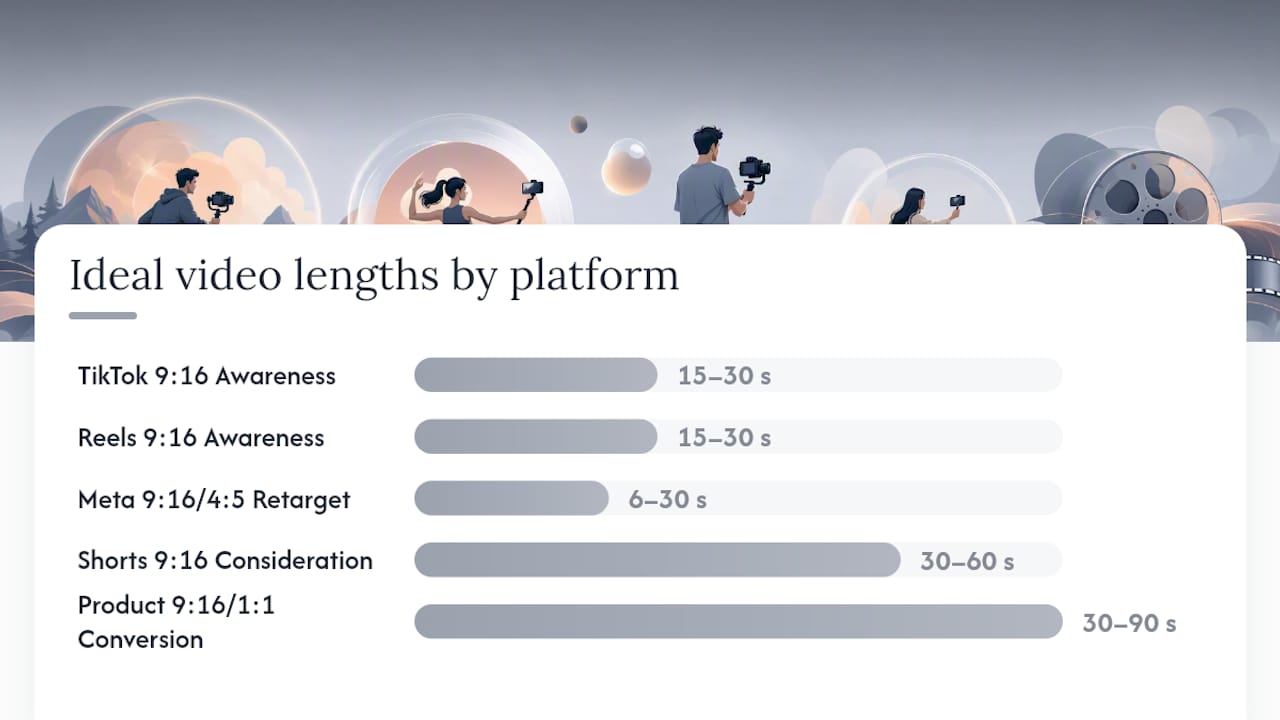
TikTok and Instagram Reels reward raw, vertical, fast-paced content. YouTube Shorts tolerates slightly more polish. Meta Feed and product pages sit at opposite ends of the production-quality spectrum.
| Platform | Aspect Ratio | Ideal Length | Best Use-Case |
|---|---|---|---|
| TikTok | 9:16 | 15–30 seconds | Awareness, direct response, viral hooks |
| Instagram Reels | 9:16 | 15–30 seconds | Awareness, retargeting, lifestyle |
| Meta Feed (video) | 4:5 or 1:1 | 15–30 seconds | Direct response, retargeting |
| Meta Stories | 9:16 | 6–15 seconds | Retargeting, flash offers |
| YouTube Shorts | 9:16 | 30–60 seconds | Consideration, tutorials, demos |
| Product page (embedded) | 9:16 or 1:1 | 30–90 seconds | Conversion, objection-handling |
TikTok: Keep captions minimal. Let the audio and on-screen action carry the message. Native sounds and trending audio increase organic reach on Spark Ads. Text overlays should reinforce the spoken hook, not repeat it word for word.
Instagram Reels: Slightly more visual polish is acceptable, but the first frame still needs to stop the scroll. Subtitles are critical because a large share of Reels plays without sound.
Meta Feed and Stories: Stories demand a CTA in the first six seconds. Feed placements tolerate a slightly slower build, but the problem-solution arc should still land before the 15-second mark.
YouTube Shorts: The longer format gives you room for a fuller tutorial or demo. This is where a 45-second before-and-after with a clear product walkthrough outperforms a 15-second hook-only clip.
Product pages: Longer, more detailed UGC works here. Viewers on a product page have already expressed intent. A 60–90 second testimonial with specific results and objection-handling can directly lift add-to-cart rates.
For brands distributing across multiple channels, streaming ads on connected TV platforms is a growing extension of the same UGC creative, particularly for lifestyle and brand-awareness formats.
How to source or create UGC: creators, seeding, briefs, and pricing
You have five practical routes to UGC content. The right one depends on your timeline, budget, and how much creative control you need.
- Organic ask: Email or DM existing customers. Offer a discount code or early access in exchange for a short video review. Low cost, slow volume, high authenticity.
- Paid creator: Commission a UGC creator (not an influencer with a large following, but someone who makes ad-style content) for a flat fee per deliverable. Typical range: a typical paid creator fee per video varies based on experience and usage rights.
- UGC marketplace: Platforms that connect brands with creators experienced in video ads let you post a brief and receive multiple deliverables within days. Useful for testing multiple hooks quickly.
- Internal micro-shoots: A team member or founder films a 30-second demo on a smartphone. Founder-led UGC often outperforms polished creator content for early-stage brands because the authenticity is unambiguous.
- AI-generated UGC: Tools like Instant-ugc generate UGC-style video ads from product photos in under five minutes, at $4–$7 per video. Useful when you need to test 10–15 hook variations before committing to a paid creator.
Practical collection tactics include hashtag contests, influencer seeding, incentive programs, and social monitoring tools to surface organic mentions you can repurpose.
Creator brief template
Use this structure when briefing any creator, paid or organic:
- Deliverable: One 15–30 second vertical video (9:16), no watermarks, raw file + final edit
- Hook: Open with [specific hook line or problem statement]
- Required shots: Product in hand, product in use, close-up of [key feature]
- Do: Speak naturally, show your face, mention [specific result or benefit]
- Don’t: Use competitor names, add your own music, include other brand logos
- Usage rights: Request in writing: paid ads, all platforms, 12-month term, worldwide
Pro Tip: Give creators a hook to start from, not a full script. A brief that says “open with a problem you personally had before finding this product” produces more authentic content than one that says “say: I used to struggle with X.” Creators convert better when given required shots and an example hook rather than rigid scripts, as Insense’s UGC research confirms.
Product seeding checklist and pricing
- Include a handwritten note with the product (increases unboxing video likelihood)
- Ship with a one-page brief card explaining what you’d love them to create
- Set a response deadline (7–10 days) and follow up once
- For paid creators: confirm deliverables, timeline, and usage rights before shipping
Ballpark pricing:
- Organic/incentive-only: $0–$50 (discount code or free product)
- Paid UGC creator (no posting required): $150–$500 per video
- AI-generated UGC (Instant-ugc): $4–$7 per video
- Agency-managed UGC production: $800–$2,000+ per video
For a deeper playbook on timing and sequencing UGC around a product launch, the UGC for product launch guide covers the full workflow.
Permissions, usage rights, and the legal checklist
Always obtain written, time-limited usage rights before running any creator content as paid advertising. Verbal agreements do not hold up, and organic posts do not grant paid-ad rights by default.
Usage rights release: fields to capture
- Creator’s full legal name and social handle
- Date of agreement
- Platforms covered (e.g., Meta, TikTok, YouTube, email)
- Duration (12 months is standard; 24 months for evergreen content)
- Territory (worldwide or specific countries)
- Compensation amount and payment terms
- Music confirmation (creator confirms all audio is royalty-free or original)
- Minor release (if anyone under 18 appears, a parent or guardian must sign)
- Right to edit (confirm you can trim, add captions, or overlay text)
Common red flags and how to handle them:
- Unlicensed music: A creator uses a trending song. The video gets flagged or pulled mid-campaign. Fix: require creators to use royalty-free audio from a licensed library, or strip and replace audio before running as a paid ad.
- Minors in footage: A creator’s child appears in the video. Without a guardian release, you cannot run this as paid creative. Fix: add a minor-release clause to your standard brief.
- Paid reviews misrepresented as organic: Running a paid creator’s content without disclosure violates FTC guidelines in the US and equivalent regulations in other markets. Fix: include “Paid partnership” or “Ad” labels on all paid placements, regardless of how organic the content looks.
How to turn UGC into paid ads: editing, testing, and scaling
Raw UGC rarely needs heavy editing to perform. The goal is to preserve authenticity while removing friction.
Minimum viable edits before launch
- Trim the first two seconds if the creator takes time to settle in before speaking
- Add subtitles (85% of social video plays without sound in many markets)
- Drop a text overlay on the hook line to reinforce it visually
- Add a CTA card or end-frame with your offer
- Check audio levels and remove background noise if it competes with the voice
Metrics to track and thresholds to act on
- 3-second view rate: Below 25% means the hook is not working. Test a new opening line.
- View-through rate (to 50%): Below 40% on a 30-second video suggests the problem-solution arc is losing people. Tighten the middle.
- Click-through rate (CTR): A CTR above 1.5% on cold traffic is a signal worth scaling on Meta. Above 2% on TikTok Spark Ads is strong.
- Add-to-cart rate: The clearest conversion signal for e-commerce. If CTR is high but add-to-cart is low, the landing page is the problem, not the ad.
- ROAS signal to scale: When a creative hits 2x your target ROAS on a $50–$100 test budget, increase spend by 20–30% every 48 hours rather than doubling overnight.
Scaling playbook
Once a UGC creative wins, expand it in this order:
- More placements: Move the winning creative from one placement (e.g., TikTok feed) to adjacent ones (Reels, Stories, Shorts)
- Hook variations: Keep the winning middle and CTA, swap only the first two seconds with three new hook lines
- Longer cutdowns: If a 30-second version wins, test a 15-second version for Stories and a 60-second version for YouTube Shorts
- Geo expansion: Duplicate the winning ad set into new geographic targets
- Lookalike audiences: Build a lookalike from purchasers who converted on the winning creative
Stop testing first: Kill creatives with a 3-second view rate below 15% after $30 in spend. Do not wait for statistical significance on a clearly underperforming hook.
Ready-to-use micro-scripts, hooks, and caption formulas
Ten high-performing hook lines
- “I’ve been using this for 60 days and I’m never going back.”
- “This is the [product category] I wish I’d found two years ago.”
- “Everyone on my FYP has this. I finally tried it.”
- “POV: you find the product that actually fixes [specific problem].”
- “I almost didn’t buy this. Here’s why I’m glad I did.”
- “Three things nobody tells you about [product category].”
- “Watch me use this for the first time.”
- “My [friend/sister/coworker] told me about this and I thought it was overhyped. It’s not.”
- “The [product] that sold out twice this month. I finally got one.”
- “Honest review: I paid full price, no gifting, no code.”
Three 15-second script templates
Template 1: Problem-solution testimonial
- 0–2s: Hook — “I spent [X] on [category] products that didn’t work.”
- 2–7s: Problem — “My [specific issue] was getting worse, not better.”
- 7–12s: Solution — Show product in use. “Then I tried [product]. [Specific result] in [timeframe].”
- 12–15s: CTA — “Link in bio. Use code [X] for [offer].”
- Caption: “Real results, no filter. [Product name] changed my [routine/skin/sleep]. 🔗 Link in bio.”
Template 2: Unboxing + first impression
- 0–2s: Hook — “I ordered the [product] everyone’s been talking about.”
- 2–8s: Unboxing — Show packaging, product reveal, tactile details.
- 8–13s: First impression — “Okay, I wasn’t expecting it to feel this [quality/light/solid].”
- 13–15s: CTA — “I’ll report back after a week. Follow for the update.”
- Caption: “First impressions of [product]. Worth the hype? 👀 [Hashtag]”
Template 3: Before-and-after
- 0–2s: Hook — “Before [product] vs. after. No edits.”
- 2–8s: Before clip — Show the problem state clearly.
- 8–13s: After clip — Show the result. Let the visual do the work.
- 13–15s: CTA — “Shop the link. Results in [timeframe].”
- Caption: “[X] days with [product]. The difference is real. 🔗 Tap to shop.”
Caption and CTA formulas by funnel stage
- Awareness: “You need to know about this. [Hook line]. Follow for more.”
- Consideration: “[Specific result] in [timeframe]. Here’s exactly what I used. 🔗 Link in bio.”
- Conversion: “Limited stock. Use code [X] for [offer]. Link in bio.”
Five brand examples and what to copy from each
1. Brooklinen: the honest review format
Brooklinen’s UGC strategy leaned on creators filming themselves in bed, speaking directly to camera about sleep quality and fabric feel. No set dressing, no professional lighting. The creative looked like a friend’s recommendation, not an ad. The authenticity signal was the setting itself: a real bedroom, real morning light, real person.
What to copy: Film in the natural use environment. For a home product, the home is the set. For a skincare product, the bathroom mirror is the set. Context communicates credibility before the creator says a word.
Best funnel stage: Consideration and retargeting.
2. Gymshark: community challenge UGC
Gymshark seeded product to fitness creators and encouraged workout challenge content with branded hashtags. The brand did not script the videos. Creators showed their own routines, tagged Gymshark, and the community amplified it. The result was thousands of pieces of UGC that functioned as both organic content and paid creative.
What to copy: Design a challenge or hashtag that naturally requires showing the product in use. The brief is the challenge mechanic, not a script.
Best funnel stage: Awareness and top-of-funnel brand building.
3. Rhode Skin: founder-adjacent authenticity
Rhode Skin’s UGC success came from creators who mirrored the brand’s own aesthetic: minimal, skin-focused, honest about ingredients. The creative felt like a skincare diary entry rather than an ad. Reaction videos and first-use impressions drove early traction because the brand’s positioning (clean, effective, no-fluff) matched the format’s tone.
What to copy: Brief creators on your brand’s tone as much as your product’s features. A mismatch between brand voice and creator style reads as inauthentic even when the content is technically good.
Best funnel stage: Awareness and consideration.
4. Shokz: lifestyle-first wearable UGC
The Shokz OpenDots One UGC creative demonstrates why lifestyle integration outperforms spec-driven content for wearables. The creator wore the headphones during a run, a commute, and a work session. No technical explanation of bone-conduction audio. The viewer understood the product’s value by watching someone live with it.
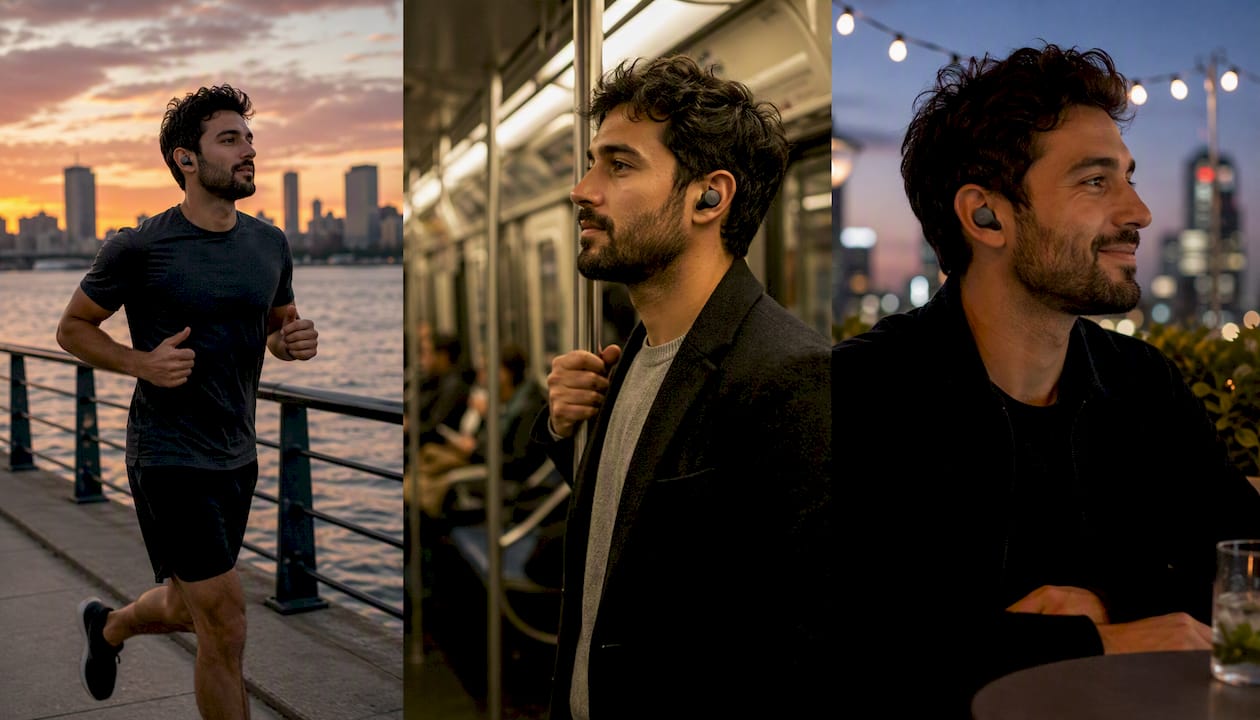
What to copy: For any wearable, audio, or fitness product, show the product in three different real-life contexts in a single 30-second video. Context variety signals versatility without a single word of copy.
Best funnel stage: Awareness and consideration.
5. Dieux Skin: transparency as the creative hook
Dieux Skin built UGC momentum by being unusually transparent about ingredients and pricing. Creators who reviewed the brand often led with “this brand actually tells you what you’re paying for,” which became the hook. The UGC was not about the product’s texture or scent; it was about the brand’s honesty. Social signals from real users affect credibility and engagement across industries, and Dieux Skin turned that principle into a creative strategy.
What to copy: If your brand has a genuine differentiator (transparent pricing, unusual ingredients, a founder story), brief creators to lead with that differentiator as the hook. The product is the proof, not the premise.
Best funnel stage: Awareness and direct response.
What most brands get wrong about UGC (a field note)
The most common mistake is not a bad hook or a weak CTA. It is over-polishing. A brand receives raw creator footage, hands it to a video editor, and gets back something that looks like a TV commercial with a creator’s face on it. The authenticity signal is gone. The ad performs like a polished brand video, which means it performs poorly on TikTok and Reels.
The second mistake is treating UGC as a one-time creative asset rather than a testing engine. The brands that win with UGC run 10–20 creative variations per month, kill the bottom half quickly, and reinvest in the top performers. Volume and iteration beat any single “perfect” video.
Three practical tips worth testing immediately:
- Brief for the hook, not the product. Give creators three hook options and let them choose. The one they feel most natural saying will perform better than the one you think is most on-brand.
- Test the same creative with and without subtitles. On TikTok, subtitles often lift 3-second view rate. On Meta Feed, the effect is smaller. Run the test before assuming.
- Repurpose your best organic posts as paid Spark Ads before commissioning new content. Repurposing organic UGC into paid placement often requires only minimal edits — a quick trim, a caption tweak, a text overlay — while preserving the authenticity that made it perform organically. You may already have winning creative sitting in your mentions.
For a deeper look at what separates authentic UGC from content that just looks authentic, the authentic UGC content guide covers the distinction in detail.
Instant-ugc cuts UGC production from weeks to minutes
Traditional UGC production takes 2–3 weeks and costs $500–$2,000 per video when you factor in creator fees, revisions, and usage rights negotiations. That timeline makes it nearly impossible to run the volume of creative tests that actually move ROAS.
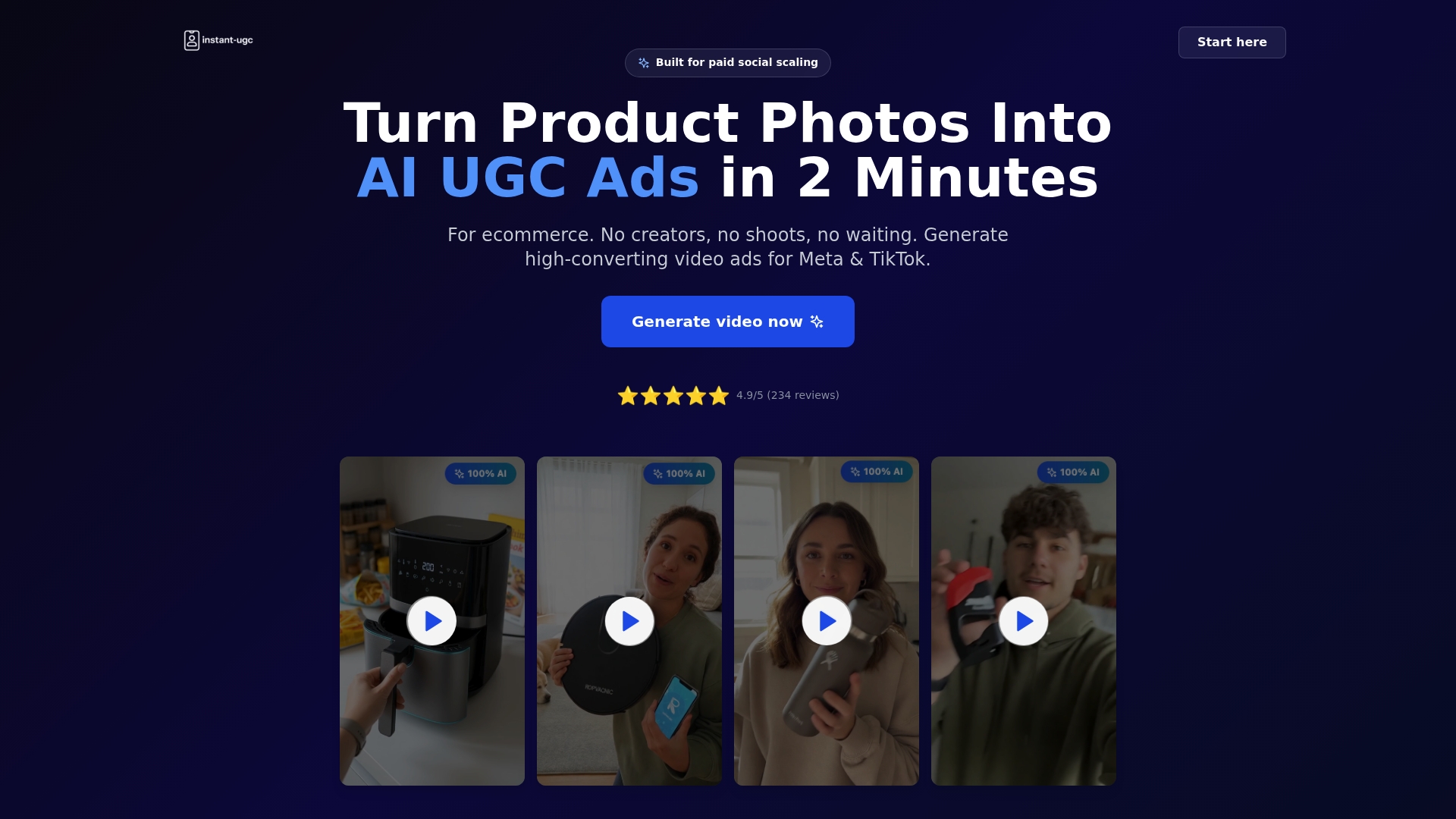
Instant-ugc generates UGC-style video ads from product photos in 90–120 seconds, at $4–$7 per video. The platform supports 10+ customizable AI avatars, automatic script generation, and 17 languages, with output delivered in 9:16 format ready for TikTok, Meta, and Reels. Brands using the platform have reported ROAS increases from 2.1x to 4.8x after switching from low-volume polished creative to high-volume UGC-style testing.
- Videos delivered in 9:16, production-ready for TikTok and Meta
- 10+ AI avatars with customizable scripts in 17 languages
- Physical product and app/SaaS workflows in one platform
- AI TikTok ad generation and Facebook ad video generation built in
If you want to test 10 hook variations this week without waiting on a creator pipeline, Instant-ugc is the fastest route to your first winning creative.
Frequently asked questions about UGC video ads
What is a UGC video ad? A UGC video ad is a short video created by a real person (a customer, creator, or founder) that is repurposed as paid advertising. It looks and feels like organic social content rather than a produced brand commercial, which is why it tends to outperform polished creative on TikTok, Reels, and Meta.
How long should a UGC video ad be? 15–30 seconds for TikTok, Reels, and Meta placements. 30–60 seconds for YouTube Shorts and product pages. The hook must land in the first two seconds regardless of total length.
Do I need a real creator to make UGC ads? No. Founder-led content, internal team videos, and AI-generated UGC (such as Instant-ugc’s avatar-based workflow) all qualify as UGC-style creative. The format and authenticity signal matter more than the source.
What aspect ratio should UGC ads use? 9:16 vertical for TikTok, Reels, Stories, and Shorts. 4:5 or 1:1 for Meta Feed placements. Always produce in 9:16 first and crop down as needed.
How much does UGC ad production cost? Organic or incentive-only UGC costs $0–$50 per video. Paid UGC creators typically charge $150–$500 per deliverable. AI-generated UGC through Instant-ugc runs $4–$7 per video. Agency-managed production starts around $800 per video.
What metrics should I track for UGC ads? Start with 3-second view rate (target above 25%), view-through rate to 50% (target above 40%), and CTR (target above 1.5% on cold traffic for Meta). Add-to-cart rate and ROAS are the conversion signals that tell you when to scale.
Do I need permission to run a creator’s organic post as a paid ad? Yes. Organic posting does not grant paid-ad rights. Always obtain a written usage rights agreement covering platforms, duration, territory, and music before running any creator content as paid advertising.
Sources
- 4 Types of UGC Ads and How To Collaborate on UGC Ads (2026) - Shopify
- 10 UGC Video Examples And Steps How to Collect Them
- UGC Video Examples: Real-World Ideas to Boost Your Brand
Recommended
- Best Eco-Friendly Products UGC Ads Examples: Real Campaigns, AI Tools, and How to Create Your Own | Instant-UGC Blog
- The Best Video Length for UGC Ads: Data-Backed Guide to Maximizing Performance | Instant-UGC Blog
- UGC Ad Performance: How User-Generated Content Drives Superior Results in 2026 | Instant-UGC Blog
- Viral Supplements Hooks for YouTube Shorts: AI Ads, UGC Tips & Strategies That Actually Convert | Instant-UGC Blog
