
What UGC Usage Rights Mean for Your AI Video Ads
Understand UGC usage rights for your AI video ads. Learn how vendor licenses shape your strategies for effective advertising.
Here’s the direct answer: with Instant-ugc, you get a vendor-granted license to use your generated videos in paid media, not federal copyright ownership. The U.S. Copyright Office has stated that purely AI-generated content lacks the human authorship required for copyright protection. That means your contract with the platform, not a copyright certificate, defines what you can actually do with the footage.
That single distinction changes how you should treat every AI-generated UGC-style ad you run this year.
- Confirm your paid-media license covers the platform, format, and duration you’re planning to use.
- Document human input (scripting, editing, avatar direction) since it may support copyright claims on the finished asset.
- Add a disclosure when a synthetic performer appears, especially for New York audiences, where Senate Bill 8420 takes effect June 9, 2026, with civil penalties of $1,000 for a first violation and $5,000 for each one after that.
Key Takeaways
Usage rights for AI-generated UGC ads come from your vendor contract, not federal copyright, and disclosure compliance now carries real financial penalties in states like New York.
| Point | Details |
|---|---|
| Ownership isn’t automatic | Purely AI-generated video lacks federal copyright protection, so your license terms define what you can do with it. |
| Read the contract, not the marketing page | Confirm commercial use, sublicensing, duration, and whether rights survive a plan downgrade. |
| Disclosure is now legally required | New York’s SB8420 takes effect June 9, 2026, with penalties starting at $1,000 per violation. |
| Document human input | Scripting, editing, and creative direction can support copyright claims and prove provenance later. |
| Instant-ugc grants a commercial license | Paid subscriptions include usage rights for paid media across Meta, TikTok, and App Store, with prompt history saved by default. |
Table of Contents
- Who Actually Owns an AI-Generated UGC Video?
- What Should You Check in Your AI Video Vendor Agreement?
- What Do FTC Rules and New York’s Law Require for Disclosure?
- When Does an AI Avatar Cross Into Likeness or Voice Risk?
- What Contract Language Should You Request From Vendors?
- What’s Your Pre-Launch Checklist Before Running Paid Media?
- What Rights Do You Get When You Generate Videos With Instant-ugc?
- Why Documentation Matters More Than Most Marketers Assume
- How Instant-ugc Helps You Launch Compliant Ads Faster
- Frequently Asked Questions
- Sources
Who Actually Owns an AI-Generated UGC Video?
Nobody owns it under federal copyright law, at least not in the way you’d expect. The Copyright Office’s position is that copyright protection requires a human author, and content generated purely by an AI model doesn’t clear that bar. If you strip out human involvement entirely, the video sits outside copyright protection altogether.
That has a practical consequence most marketers miss: you can’t sue for infringement over a purely AI-generated clip the way you could over a photograph your in-house designer shot. There’s no underlying federal copyright to enforce.
This is exactly why the license you get from Instant-ugc matters more than any copyright claim. Your usage rights come from your service agreement, which spells out what you’re permitted to do (run paid ads, edit the footage, distribute across platforms) regardless of copyright status. A vendor contract can grant broad commercial rights even when copyright law grants none, which is why clear disclosures and provenance increase consumer trust and reduce enforcement risk as explained in AI Visibility Intelligence Reports.
Here’s the workaround worth knowing: when you contribute genuine creative input (writing the script, directing avatar performance, selecting and arranging shots), that human contribution can qualify parts of the final work for copyright protection. Keep records of that input.
- Save your prompts, script drafts, and edit notes.
- Log who made creative decisions and when.
- Treat this documentation as your enforcement backup, since traditional creator-supplied UGC still carries stronger copyright footing than AI-only output.
What Should You Check in Your AI Video Vendor Agreement?
Before you run a single dollar of ad spend, read your contract for these ten items. Most marketers skip this step, then discover the gap only after legal flags a campaign.
- Commercial use rights. Does the agreement explicitly permit paid advertising and resale, or only personal or preview use?
- Ownership versus license language. Are you granted ownership of the output, or a license to use it? These are legally different outcomes.
- Sublicensing and transfer. Can you hand the asset to an agency or media buyer without violating terms?
- Duration and territory. Is your right to use the video permanent, or tied to your subscription staying active?
- Exclusivity. Can the vendor reuse your generated content elsewhere?
- Attribution and watermark rules. Does removing a watermark change your rights, or just the visual?
- Tier dependency. Does the commercial right survive if you downgrade your plan later?
- Indemnity and defense. Who pays if a third party sues over the content?
- Training and data retention. What happens to your uploaded photos or screenshots after generation?
- Provenance metadata and beta carveouts. Are preview or beta features excluded from commercial guarantees?
Vendor terms vary widely across the AI video market: some platforms disclaim ownership entirely, others grant it but restrict commercial use to paid tiers. The rule that trips people up most: check the plan and feature status you used to generate the asset, not your current subscription. Downgrading doesn’t retroactively strip rights you already secured, but generating on a free or beta tier might mean you never had commercial rights to begin with.
Pro Tip: Ask your vendor in writing to confirm they preserve generation logs and prompt history, and get a stated retention period. If you ever need to prove provenance for an audit or dispute, that log is your evidence.
What Do FTC Rules and New York’s Law Require for Disclosure?
The FTC’s Endorsement Guides don’t distinguish between a human influencer and an AI avatar. If your synthetic performer implies first-hand product experience (“I’ve used this for three weeks and my skin cleared up”), that’s a testimonial claim, and it triggers the same disclosure duty a real person’s endorsement would. Avoid scripting your AI avatar to sound like it personally used the product.
New York goes further with a hard statutory requirement. Senate Bill 8420 defines a “synthetic performer” and mandates conspicuous disclosure whenever one appears in an ad. The law takes effect June 9, 2026, and carries civil penalties of $1,000 for a first violation and $5,000 for each subsequent one.
Practical disclosure wording that works across most placements:
- On-screen text: “AI-generated performer” or “Synthetic performer”
- Video caption: a plain-language line noting AI generation
- Paid media ad copy: a brief disclosure in the primary text field, not buried in a link
Place the disclosure where a viewer will actually see it, meaning on-screen and in the caption, not only in a terms-of-service link nobody clicks. Our FTC compliance guide breaks down placement examples by platform if you want more detail.
When Does an AI Avatar Cross Into Likeness or Voice Risk?
Some AI outputs get close enough to a real person that they raise rights-of-publicity concerns, separate from copyright or FTC disclosure rules entirely. Watch for these red flags:
- A recognizable likeness, even if unintentional
- A cloned or closely mimicked voice
- Distinctive gestures, catchphrases, or mannerisms tied to a known individual
- Any asset trained on a specific living or deceased person’s content without consent
If any of these apply, you need clearance before you publish, not after. Take these steps:
- Get written consent from anyone whose likeness or voice the output resembles.
- Document licenses for any third-party media used to train or reference the generation.
- Never use a cloned voice without express, documented permission from the voice owner.
- Run a similarity review to flag outputs that could plausibly be confused with a real, identifiable person.
Pro Tip: Build a clearance record that links each prompt and version to its signed consent form and provenance metadata. When legal asks for proof six months from now, you want a five-minute lookup, not a scramble.
What Contract Language Should You Request From Vendors?
Most vendor agreements are written to protect the vendor first. You can push back with specific clause requests, and most agencies will negotiate on at least a few of these.
A license grant should read something close to: “Vendor grants Client a non-exclusive, worldwide, sublicensable license to use, reproduce, edit, and distribute Generated Content for paid advertising and commercial purposes for the duration of the applicable subscription term, surviving termination for content already generated and paid for.”
Beyond the license grant, request:
- Warranty of commercial rights and non-infringement. The vendor affirms the output doesn’t infringe third-party IP.
- Provenance and metadata preservation. The vendor commits to storing generation logs for a defined period, ideally two to three years.
- Indemnity for third-party claims. The vendor covers legal costs if a rights-of-publicity or IP claim arises from their generation process.
- Survival of rights after downgrade or termination. Assets you already generated and paid for keep their commercial license even if you cancel later.
For a short test campaign, a narrower territory and shorter duration clause is fine. For a global, evergreen asset you’ll run for years, push for worldwide territory and no fixed expiration on the license grant.
What’s Your Pre-Launch Checklist Before Running Paid Media?
Run through this before you spend a dollar on distribution:
- Confirm the vendor’s paid-media license covers this specific asset.
- Verify the plan or tier used to generate it, and rule out beta-feature restrictions.
- Confirm no voice cloning occurred without documented consent.
- Add conspicuous on-screen disclosure where a synthetic performer appears.
- Archive provenance metadata, prompts, and signed consent forms.
- Update influencer and agency statements of work to reflect AI-generation rules.
- Get final legal sign-off before the campaign goes live.
Pro Tip: Assign ownership of each step. Someone collects the evidence, someone approves the disclosure copy, someone archives the logs. Diffuse responsibility is how compliance steps get skipped under launch deadlines.
What Rights Do You Get When You Generate Videos With Instant-ugc?
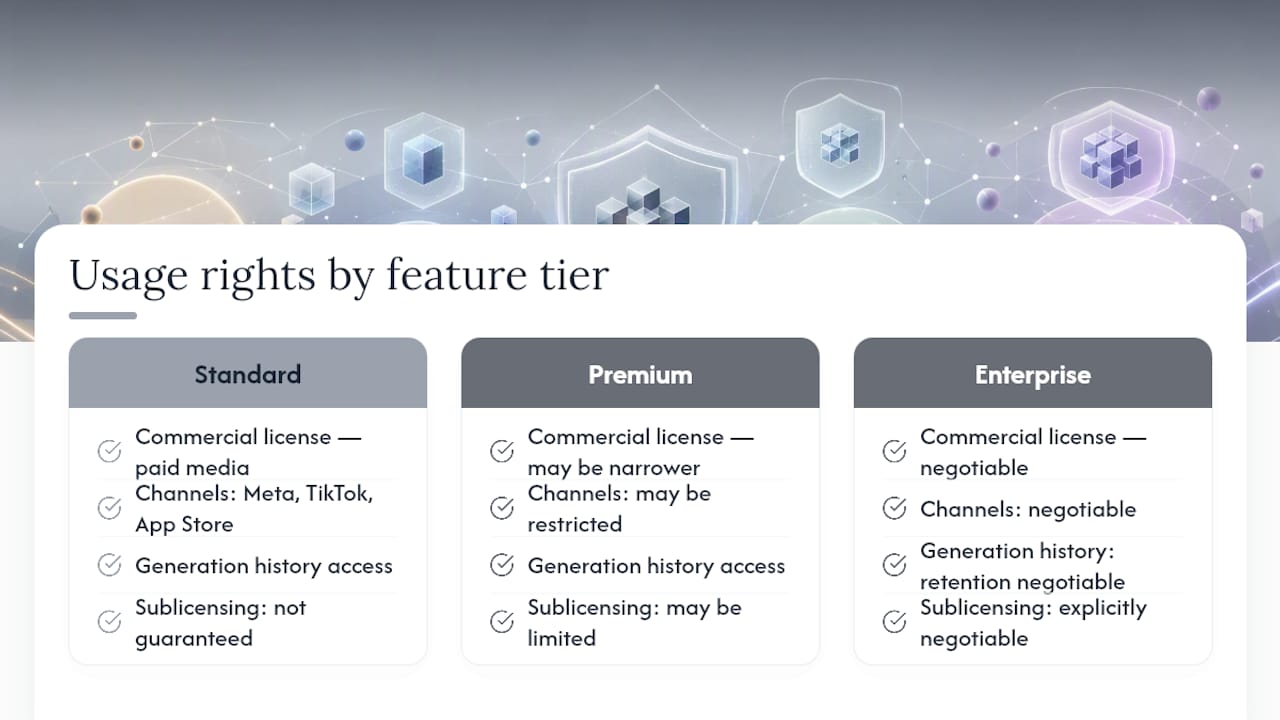
Instant-ugc turns product photos or app screenshots into 9:16 video ads in 90 to 120 seconds, using over 10 customizable AI avatars across 17 languages, with automatic script generation for both physical-product and app/SaaS workflows. Paid subscriptions grant clients a commercial usage license covering paid media distribution across Meta, TikTok, and App Store placements, the standard use case for e-commerce and SaaS marketers running acquisition campaigns.
After purchase, you should expect access to your generation history and prompt records, useful evidence if you ever need to document provenance for an enterprise legal review. Enterprise clients negotiating custom contracts should specifically request retention terms for that history and clear language on sublicensing rights for agency use.
One practical note: confirm whether premium features like voice cloning or newly released beta avatars carry additional consent requirements or narrower usage terms than the platform’s standard commercial grant. Not every feature ships with identical rights, and that gap is exactly where marketers get caught off guard.
Why Documentation Matters More Than Most Marketers Assume
Working through customer questions on this topic, one pattern shows up constantly: brands that scale AI UGC fastest are the ones that skip documentation first, and it catches up with them at the worst moment, usually mid-campaign, when an agency partner or ad platform asks for proof of rights. The fix isn’t complicated. A five-minute habit of saving prompts, consent forms, and vendor confirmations before launch prevents a legal scramble that can freeze a campaign generating strong return on ad spend. Compliance work here isn’t a blocker to creative speed. It’s what lets you keep that speed without risking the account.
How Instant-ugc Helps You Launch Compliant Ads Faster
Instant-ugc is built so compliance documentation happens automatically, not as a separate task you bolt on after generation. Every video comes with prompt and version history captured by default, so you’re not reconstructing provenance records after the fact when legal asks for them.
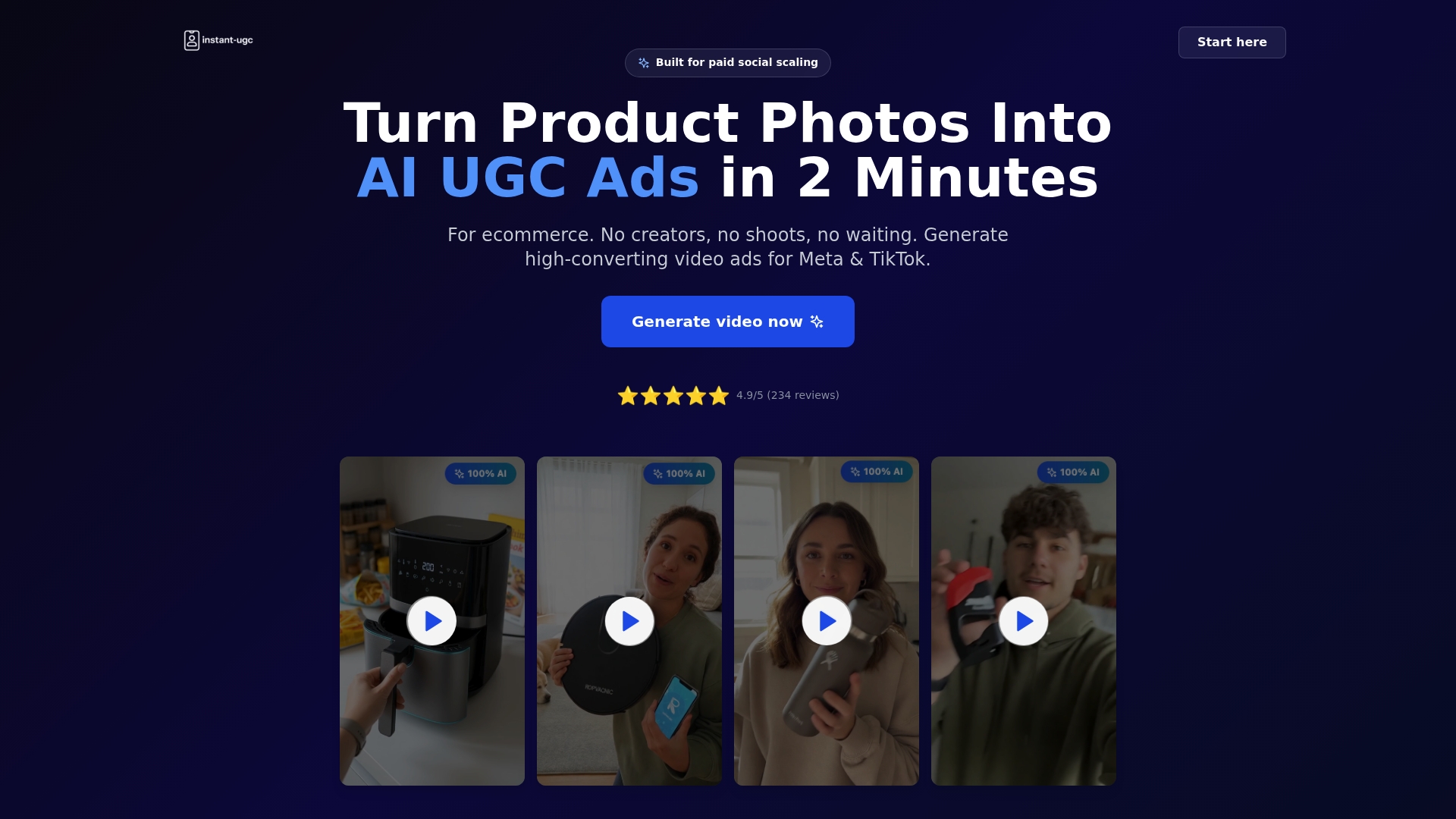
The platform’s avatar library includes consent-controlled options, and export-ready formats are optimized directly for Meta and TikTok ad specs, meaning your creative and your disclosure placement are ready for paid media the moment generation finishes. If you’re running Meta campaigns specifically, the Facebook ad video generator produces assets sized and formatted for that placement out of the gate. Enterprise clients can also arrange custom contracts with extended metadata preservation and added indemnity language, worth raising if you’re running high-volume campaigns across multiple markets. Start by exploring the AI video generator for advertising to see current formats, avatar options, and generation workflow before your next launch.
Frequently Asked Questions
Does Instant-ugc give me full ownership of the videos I generate? You receive a commercial usage license covering paid media distribution rather than copyright ownership, since purely AI-generated content isn’t eligible for federal copyright protection. Your license terms define your actual rights.
Do I need to disclose that a video uses an AI avatar? Yes, especially for New York audiences under SB8420, and the FTC’s Endorsement Guides apply broadly whenever your avatar implies first-hand product experience. A brief on-screen disclosure like “AI-generated performer” satisfies most placements.
Can I use a cloned voice in my ad without permission? No. Voice cloning without express, documented consent from the voice owner creates rights-of-publicity exposure, regardless of what platform generated the content.
What happens to my usage rights if I downgrade my subscription? Check your specific contract, since terms vary by vendor. Well-drafted agreements let previously generated and paid-for assets keep their commercial license even after a downgrade, but this isn’t automatic everywhere.
How is AI-generated UGC different from traditional creator UGC for rights purposes? Traditional UGC from a human creator carries stronger built-in copyright footing since a human author exists. AI-generated UGC depends entirely on your vendor’s contractual license grant, making that agreement your primary source of usage rights.
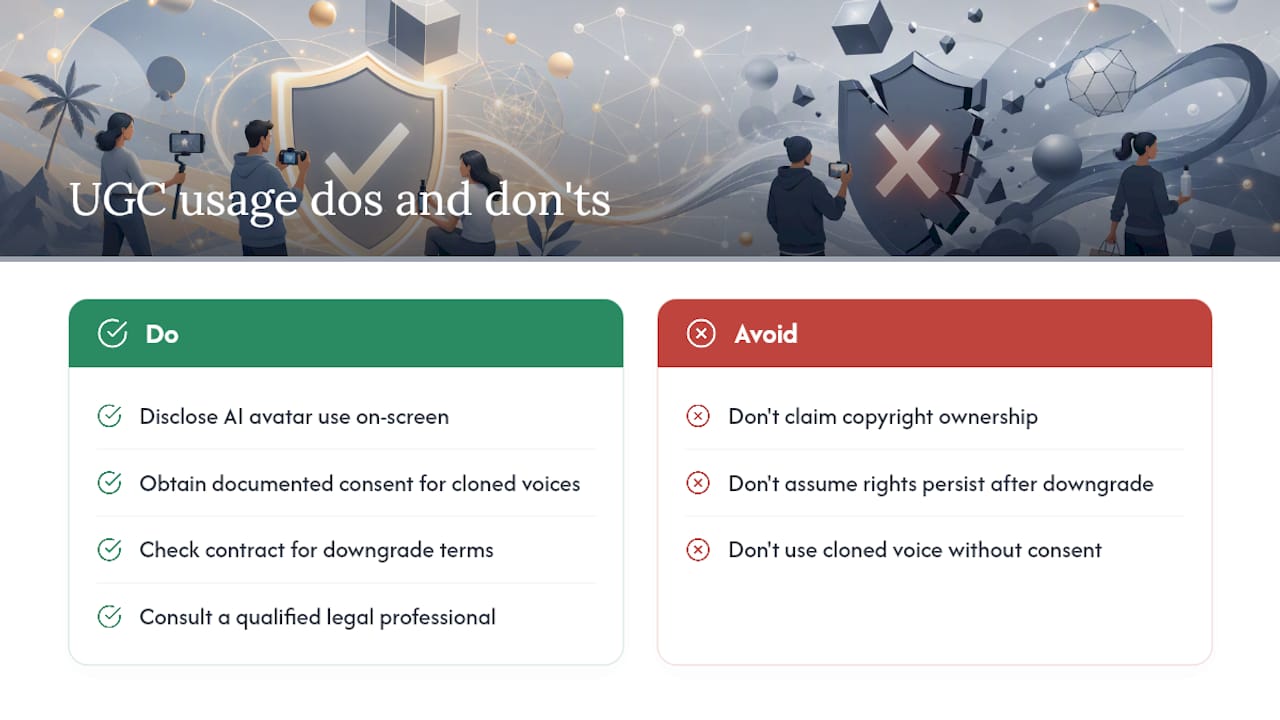
This article is general information, not a substitute for advice from a qualified lawyer. Consult a qualified legal professional about your own circumstances before acting on anything here.
Sources
- S8420 Amendment — New York State Senate
- Copyright Office releases part 2 of artificial intelligence report — Library of Congress / U.S. Copyright Office
Recommended
- What is AI UGC and How is it Transforming Content Creation? | Instant-UGC Blog
- UGC Ad Performance: How User-Generated Content Drives Superior Results in 2026 | Instant-UGC Blog
- AB Testing UGC Ads: A Complete Guide to Data-Driven Campaign Optimization | Instant-UGC Blog
- AI UGC vs Real UGC: Which Content Type Drives Better Results for Your Brand? | Instant-UGC Blog
