
6s, 15s, 30s UGC Ad Length Rules and Fast AI Production for Ecommerce
Ecommerce marketers: use platform specific UGC ad length rules and a fast AI workflow to produce and test 6s, 15s, 30s and optimize by CPA.
The sweet spot for most UGC ads is 15 to 30 seconds, with 6 to 30 seconds covering the full range worth testing for cold-audience attention. Push to 30 to 60 seconds or longer only when you’re educating a warmer, higher-intent audience about a complex product. No single number wins across every campaign, so treat any recommendation here as a starting point and confirm it against your own conversion-per-dollar data.
TL;DR:
- UGC ad length should generally be between 15 to 30 seconds for optimal performance across most platforms, with shorter times better for cold audiences.
- TikTok favors videos from 6 to 20 seconds to maximize replays, while Instagram Reels perform best at 15 to 30 seconds, with Stories auto-splitting at 15 seconds.
- Testing three lengths simultaneously — 6, 15, and 30 seconds — is critical to identify the most cost-effective duration based on conversion data.
- Longer videos over 30 seconds work well for complex products, tutorials, or remarketing audiences, especially when demonstrating layered features or deep storytelling.
- Using AI video generation platforms enables rapid production of multiple length variants from the same asset, reducing costs and speeding up testing cycles.
Table of Contents
- Key Takeaways for UGC Ad Length
- Recommended UGC Ad Lengths by Platform
- How to Structure a UGC Script Around Timing Windows
- Testing Framework: Finding Your Ad’s Optimal Length
- When Longer UGC Ads (30 to 90+ Seconds) Actually Win
- Technical Specs That Affect How Your Ad Actually Plays
- Producing Length Variants Fast: A Practical Workflow
- A Media Buyer’s Checklist for This Week
- Generate and Test UGC Ad Lengths in Minutes, Not Weeks
- Sources
- FAQ
Key Takeaways for UGC Ad Length
Before you brief a single script, pin these rules to your creative doc. They come from platform documentation and testing patterns that hold up across most e-commerce and app campaigns.
- Instagram Reels: 15 to 30 seconds performs best for most product ads.
- TikTok: 6 to 20 seconds for loop-driven awareness, 15 to 30 seconds for short narrative ads.
- YouTube Shorts: stay under 60 seconds, since only the first 60 seconds play in-feed regardless of upload length.
- The first three seconds decide everything. If the hook doesn’t stop the scroll, the rest of the script never gets watched.
- Test three lengths at once, not sequentially, and judge the winner by conversion-per-dollar, not by raw view count.
One number worth sitting with: Instagram Stories longer than 15 seconds automatically split into separate cards, and each split adds another chance for a viewer to swipe away before your CTA ever loads.
Recommended UGC Ad Lengths by Platform
Optimal UGC ad duration isn’t one number. It’s a range that shifts by placement, because each platform surfaces video differently and rewards different viewing behavior. Here’s how the major placements break down.
Instagram Reels and Stories
Reels ads perform best at 15 to 30 seconds, with the format technically supporting up to 90 seconds for brands that need room for a layered before-and-after or a multi-step demo. Stories are a different animal entirely. Anything past 15 seconds gets auto-split into separate 15-second cards, which can create additional exit points for viewers. If you’re building for Stories, design every 15-second segment to work as its own mini-story, with its own micro-hook, rather than writing one continuous 45-second script and hoping the platform doesn’t chop it awkwardly.
TikTok
TikTok rewards loopability more than any other placement. A 6 to 20 second video that ends on the same visual or line it opened with can rack up replays, and those replays feed the algorithm’s engagement signals. For UGC that tells a slightly longer story, such as an unboxing with a reveal, 15 to 30 seconds is the practical ceiling before drop-off accelerates.
YouTube Shorts
Shorts technically accept uploads up to three minutes, but Google’s own guidance recommends keeping video ads under 60 seconds because the Shorts feed only plays the first 60 seconds regardless of the source file’s length. For direct-response, action-oriented ads, Google suggests trimming videos to a short duration, typically between 10 and 30 seconds.
Meta Feed and In-Stream
Feed placements behave more like a scroll-stopping billboard than a video player, so 6 to 15 seconds tends to maximize reach and cheap impressions. Once you need to show a product actually working, such as a demo or a side-by-side comparison, stretch to 15 to 30 seconds. Reels-specific placements can run up to 90 seconds when the ad is genuinely built around a layered narrative rather than a single pitch.
| Platform / Placement | Practical Length | Hard Ceiling | Best Use Case |
|---|---|---|---|
| Instagram Reels | 15 to 30s | 90s | Product demo, transformation |
| Instagram Stories | 6 to 15s | Auto-splits at 15s | Quick hook, single CTA |
| TikTok (loop-driven) | 6 to 20s | 60s+ | Awareness, humor, trends |
| TikTok (narrative) | 15 to 30s | 60s | Unboxing, reveal |
| YouTube Shorts | 10 to 30s | 60s in-feed | Direct-response, action CTA |
| Meta Feed | 6 to 15s | 30s | Reach, scroll-stop |
| Meta In-Stream / Reels | 15 to 90s | 90s | Layered story, comparison |
The pattern across every row: shorter wins for cold reach, longer earns its keep only when there’s a genuine reason to hold attention past the first act.
How to Structure a UGC Script Around Timing Windows
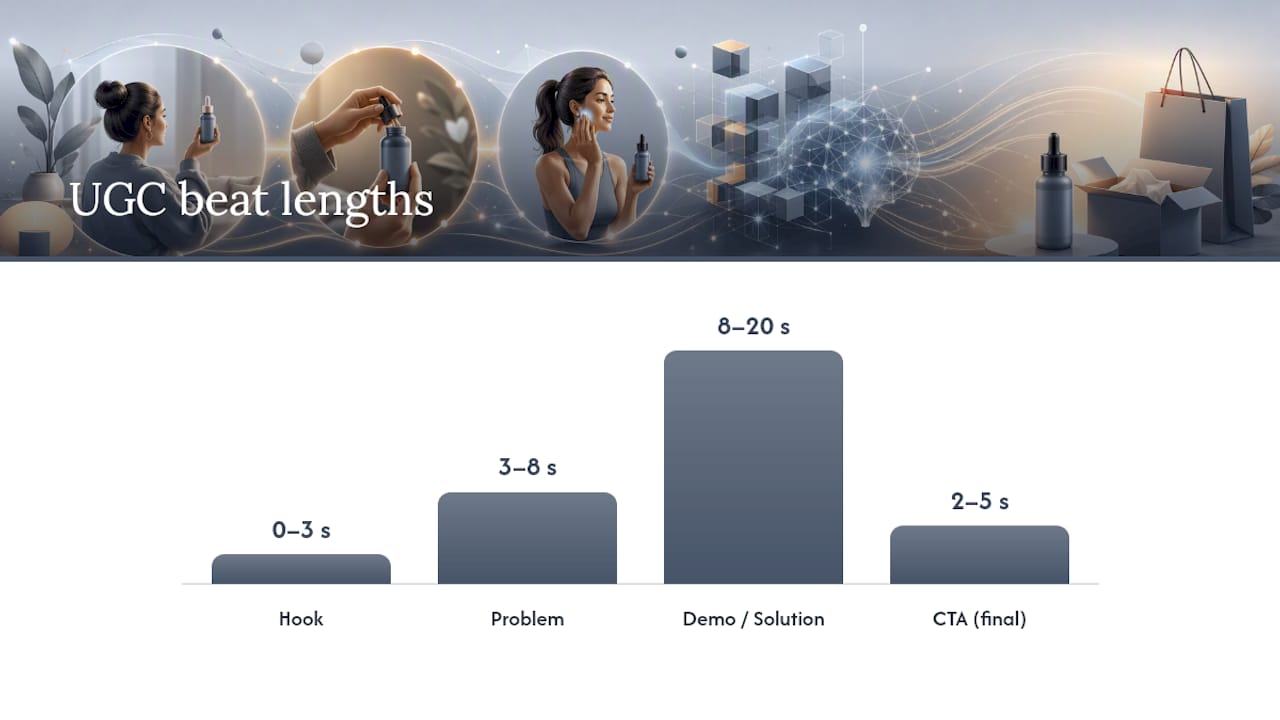
A UGC ad script isn’t a story with a beginning, middle, and end. It’s four timed beats, each with a job, and each with a deadline. Miss the deadline and the viewer scrolls before the CTA even loads.
- Hook (0 to 3 seconds). Open mid-action or mid-sentence. No logo intro, no “hey guys.” State the problem or show the payoff immediately.
- Problem (3 to 8 seconds). Name the pain point the viewer recognizes from their own life. This is where authenticity does the heaviest lifting.
- Demo or solution (8 to 20 seconds). Show the product doing the thing. Keep cuts tight; every second without a visual change is a second closer to a skip.
- CTA (final 2 to 5 seconds). State the offer plainly and repeat it on screen as text, since audio is often muted.
Scaling this structure down to 6 seconds means compressing hook and problem into one beat and letting the product visual double as the CTA. At 15 seconds, each beat gets roughly its proportional share. At 30 or 60 seconds, you can afford a second problem beat or a customer reaction shot before the CTA, but the CTA window itself should never grow past 5 seconds. Viewers who haven’t decided by then usually aren’t deciding.
Loop-friendly micro-edits, such as ending on the same frame or line that opened the video, can boost replay behavior on 15 to 20 second assets, which platforms read as an engagement signal even when the viewer isn’t converting on that view.
Pro Tip: Build one 30-second master script first, then cut down to 6s and 15s versions by keeping only the strongest hook moment and swapping in a shorter, punchier end-frame CTA for each length. This gets you three testable variants from one shoot instead of three separate scripts.
Testing Framework: Finding Your Ad’s Optimal Length
Guessing which length works is a waste of a perfectly good ad budget when the answer is one structured test away. Run three length variants concurrently, not one after another, so you control for the same audience, the same day of week, and the same seasonal noise.
- Variants to run: 6s, 15s, and 30s versions of the same core creative, launched at the same time with equal budget splits.
- Metrics to track: loop rate and view-through rate (VTR) tell you what’s holding attention; click-through rate (CTR) tells you what’s earning curiosity; post-click conversion tells you what’s actually selling.
- Metric to prioritize: cost per acquisition (CPA) and return on ad spend (ROAS) beat every top-funnel number, since a high-VTR ad that doesn’t convert isn’t doing its job.
- How long to run each variant: let the test run until each variant has enough conversions to trust the comparison, generally several hundred conversions per variant or a fixed window of at least a week, whichever comes first.
- Normalize by spend, not raw counts, because a variant that got more budget will naturally rack up more clicks and conversions even if it’s the weaker performer per dollar.
Once a length wins, don’t stop testing. Test that length against a new hook or a new avatar next, since duration is only one lever in a much larger creative equation.
When Longer UGC Ads (30 to 90+ Seconds) Actually Win
Longer isn’t worse, it’s just situational. Complex products, tutorials, and remarketing audiences who already know your brand are the three cases where stretching past 30 seconds tends to pay off rather than cost you.
- Complex or high-consideration products need enough time to demonstrate a real before-and-after, which a 15-second clip usually can’t sell convincingly.
- Tutorial-style UGC works because the viewer opted into learning something, so watch time itself becomes a qualifying signal rather than a liability.
- Remarketing audiences have already seen a short version of your ad once. A longer follow-up can go deeper without repeating the hook they’ve already responded to.
- Layered hooks and chaptering (announcing “three reasons this works” up front, then delivering each one as its own mini-segment) reduce drop-off by giving viewers a reason to stay for the next chapter.
- Measure watch-depth and conversion lift, not raw view count, since a long ad with a 90% drop-off rate at second 10 isn’t actually a long-form success story.
The Product Comparison Videos format is a natural fit here, since side-by-side comparisons genuinely need the extra seconds a quick hook-and-CTA ad doesn’t.
Technical Specs That Affect How Your Ad Actually Plays
Length recommendations only matter if the platform actually plays your ad the way you intended. A handful of technical rules quietly override whatever duration you picked in the script.
- Aspect ratio: 9:16 vertical is standard across Reels, Stories, TikTok, and Shorts; anything shot horizontally gets cropped or letterboxed and loses impact immediately.
- Stories auto-split: uploads longer than 15 seconds break into multiple cards automatically, so script each segment to survive on its own rather than assuming continuous viewing.
- Shorts in-feed limit: only the first 60 seconds plays in the Shorts feed no matter how long the source file is, so trim before uploading rather than relying on the platform to cut it for you.
- Captions are mandatory, not optional, since most viewers watch on mute for the first few seconds, and your hook needs to land as text as much as audio.
- Build multi-length master assets: shoot with enough raw footage to cut a 6s, 15s, and 30s version from the same session, so testing three lengths doesn’t mean three separate production cycles.
Producing Length Variants Fast: A Practical Workflow
The biggest obstacle to testing UGC ad length properly isn’t knowing the right ranges but scaling production efficiently using UGC platforms for brands to hire vetted creators at scale. It’s the cost and turnaround time of producing enough variants to test in the first place. An AI video generation platform produces UGC-style vertical videos from product photos or app screenshots in around two minutes, featuring multiple customizable avatars and automatic script generation across various languages.
- Generate 6s, 15s, and 30s variants from the same product input without re-shooting or re-briefing a creator each time.
- Test faster because production cost stops being the bottleneck. When a variant costs a few dollars instead of a few hundred, running three lengths at once is a formula, not a budget decision.
- Brands using the platform report ROAS improving from roughly 2.1x to 4.8x, a gap wide enough that it’s worth attributing at least some of the lift to faster iteration cycles rather than any single creative choice.
For teams running the exact testing framework outlined above, the UGC Testing Platform Guide walks through setting up statistically sound A/B tests once your variants are ready.
A Media Buyer’s Checklist for This Week
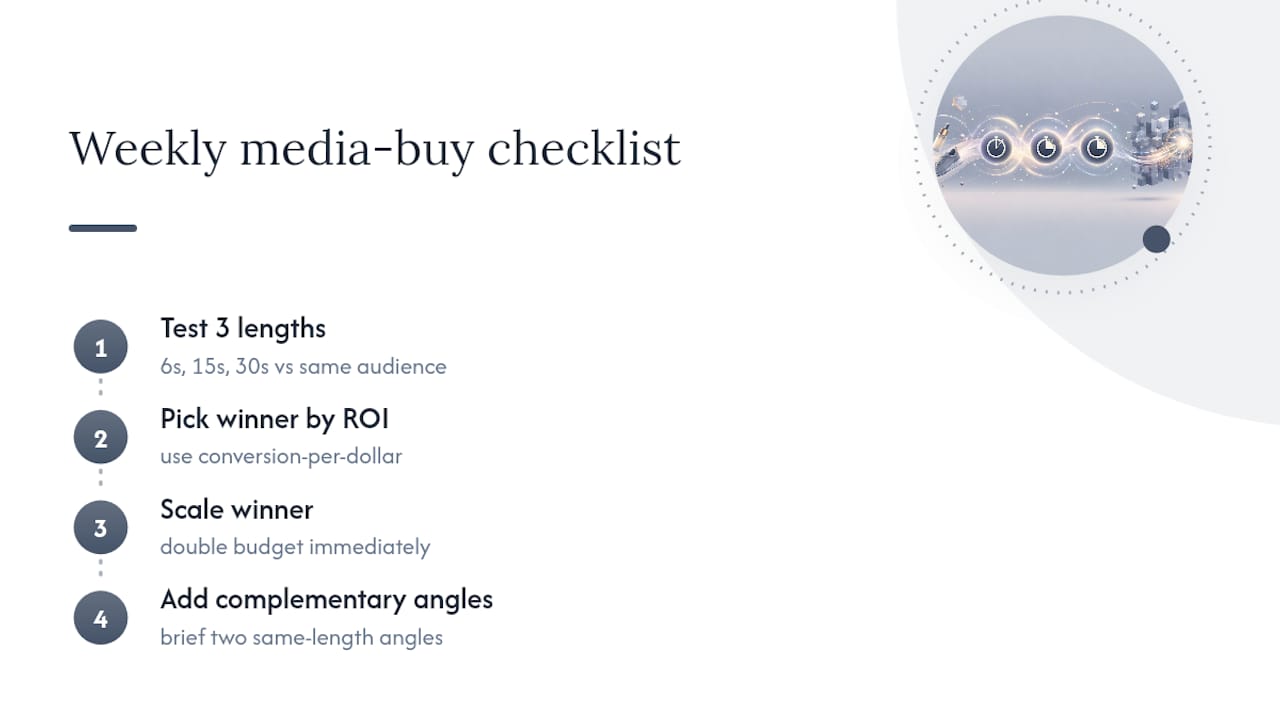
Skip the theory and run three length variants (6s, 15s, 30s) against the identical audience segment this week, then let conversion-per-dollar pick the winner, not your gut. Most teams stall here because producing three real variants used to mean three production cycles. A rapid pipeline like Instant-ugc removes that excuse entirely.
Once a length wins, don’t just keep spending on it. Double the budget on the winning length and immediately brief two complementary angles at that same duration. Length is one variable. Momentum comes from stacking wins on top of it.
— Syno
Generate and Test UGC Ad Lengths in Minutes, Not Weeks
Testing 6s, 15s, and 30s variants only works if producing each one doesn’t cost you a week and a few hundred dollars. Instant-ugc turns a product photo or app screenshot into a ready-to-run vertical video in 90 to 120 seconds, so a full three-length test costs a fraction of what a single traditional UGC creator typically charges.
Pick an avatar, let the script generate automatically, and export in the format your placement actually needs, whether that’s a Reels-ready 30-second cut or a punchy 6-second Shorts trim. The platform supports 17 languages, which matters if you’re running the same length test across multiple markets instead of just one. Start with the AI Video Generator to produce your first set of length variants, or head straight to Rapid Product Testing if you want a workflow built specifically around fast iteration.
Sources
For platform specs and legal grounding beyond this guide, see YouTube Shorts ad specs, Instagram ad format guidelines, and the FTC’s advertising guidance.
- YouTube Shorts ads: Asset specs and best practices - Google Ads Help
- Best UGC Ad Formats for Instagram, Meta and Google in 2026
FAQ
Is $10 a Day Enough for Google Ads With UGC Creative?
A $10 daily budget can work for narrow testing, but it limits how quickly you’ll gather enough conversions to judge a length variant with confidence. Larger budgets shorten the time needed to reach a reliable sample size.
Are UGC Ads Legal?
Yes, UGC ads are legal, but advertisers must follow FTC guidance on truthful advertising and clear endorsement disclosures, especially when the content resembles a personal testimonial. Review the FTC Guidelines for AI UGC for disclosure specifics that apply to AI-generated creator-style content.
How Much Does a UGC Ad Cost?
Traditional UGC creators typically charge $500 per video and take two to three weeks to deliver. AI-generated alternatives like Instant-ugc produce comparable vertical video ads for roughly $4 each in under two minutes.
Why Does YouTube Allow 30-Minute Ads?
YouTube allows longer ad uploads for placements outside the Shorts feed, but for Shorts specifically, only the first 60 seconds ever plays in-feed, so anything beyond that limit is wasted length for that placement.
What’s the Best UGC Video Length for a Cold Audience?
For cold, unfamiliar audiences, 6 to 15 seconds tends to perform best because the goal is a scroll-stopping hook, not a full product education, which is better saved for retargeting.
