
Marketers: UGC Ad Briefing That Delivers 3–5 Testable Hooks
Create a concise UGC ad briefing that produces 3–5 testable hooks, platform-ready specs, and FTC-compliant disclosure so you can iterate faster.
A great UGC ad brief gets usable, ad-ready footage on the first delivery by naming one objective and its success metric, giving creators clear hook direction, and spelling out usage rights up front. Keep it to one or two pages. Ask for three to five hook variations instead of one polished script, since the opening line is what makes or breaks performance testing.
TL;DR:
- Providing three to five hook variations enables effective A/B testing while helping identify the most attention-grabbing opening line.
- Clear technical specifications, including format, length, and raw footage, prevent delays and unnecessary reshoots during editing.
- Disclosing material connections early in the video with simple terms like “ad” or “sponsored” is essential to comply with FTC regulations and avoid penalties.
- Briefs should be limited to one or two pages, focusing on the objective, key messages, must-have details, and flexible creative guidance to preserve authenticity.
- Utilizing AI tools for quick, low-cost video generation allows testing multiple hooks and formats faster and cheaper than traditional creator shoots.
Table of Contents
- What Should Every UGC Ad Briefing Include?
- How Do You Brief Hooks for Fast Ad Testing?
- What Technical Specs Belong in a UGC Ad Briefing?
- What Does the FTC Require for UGC Ad Disclosures?
- How Do You Brief for Batch Testing at Scale?
- A Copy-Ready UGC Brief Template You Can Send Today
- What Marketers Get Wrong About UGC Briefs
- Test Your Next UGC Ad Brief Without Booking a Single Creator
- Sources
- FAQ
What Should Every UGC Ad Briefing Include?
A usable UGC ad brief works because it removes guesswork without removing personality. Conversion Studio found that brands using detailed briefs get usable content on the first delivery 73% of the time, compared to just 28% when direction is vague. That gap is the entire argument for structure.
Here’s the operational checklist that separates a brief creators can actually use from one that produces a reshoot:
- Brand one-liner and product details. One or two sentences on what the brand does and what makes this specific product worth talking about.
- Content objective, funnel stage, and metric. Is this brief for top-of-funnel awareness, mid-funnel consideration, or bottom-funnel conversion? Name the metric you’ll judge it by (thumbstop rate, click-through, add-to-cart).
- Creative direction. Format (talking head, unboxing, testimonial), tone (casual, excited, skeptical-turned-convert), a persona sketch, and two to three key messages the creator must hit.
- Must vs. Maybe framework. List non-negotiables (say the product name, mention the discount code) separately from optional flourishes (a joke, a specific location). This structure, recommended by Scale Growth Digital, keeps brand safety intact while letting creators sound like themselves.
- Delivery expectations. File type, whether raw footage is included, a naming convention, and how many revision rounds are covered.
Send this brief the day the product arrives, not a week later. Conversion Studio notes that creators who get direction while the product is still fresh in their hands produce more natural, less scripted-sounding footage than those working from memory days later.
How Do You Brief Hooks for Fast Ad Testing?
The first three seconds decide whether someone keeps watching or scrolls past, which makes the hook the single highest-leverage line in the entire brief. Everything else in the video can be strong and still fail if the opening doesn’t earn attention.
Give creators three hook types to choose from, not just one script to memorize:
- Bold claim. “This is the only serum that actually got rid of my redness in a week.”
- Relatable problem. “I was so tired of buying skincare that promised everything and did nothing.”
- Pattern interrupt. An unexpected visual or line that breaks the scroll, like holding up two products and saying, “One of these is a waste of money.”
Ask for three to five hook variants per creator, not one. The cheapest way to reshoot is to have them record just new openings against the same body footage. That turns one video into a small test batch without paying for a full reshoot. Pair each hook with a clear metric (thumbstop rate for awareness, click-through for consideration) so screening isn’t a guessing game later.
Pro Tip: Brief hooks as short prompts, not word-for-word scripts. A creator reading a script sounds like an ad; a creator reacting to a prompt sounds like a person, and that authenticity is what the format is built on.
What Technical Specs Belong in a UGC Ad Briefing?
Vague specs are the fastest way to end up paying for a reshoot. Give creators exact numbers, not general guidance, and they will not need to guess.
- Format: 9:16 vertical, 1080x1920 resolution, delivered as MP4.
- Length: Scale Growth Digital recommends 21 to 34 seconds for TikTok, 21 to 60 seconds for Instagram Reels, and up to 60 seconds for YouTube Shorts.
- Captions: specify whether you want them burned in or delivered as a separate file, and require clear, unmuffled audio since platform autoplay often starts on mute.
- No platform watermarks from other apps baked into the footage.
- Raw footage in addition to the edited cut, so your team can recut hooks without going back to the creator.
- File naming convention, something like
brand_hook1_v2.mp4, so a batch of a dozen files doesn’t turn into a guessing game. - Deadline tied to your posting date, with buffer time built in for one revision round.
Missing any of these is usually what turns a one-day edit into a week of back-and-forth.
What Does the FTC Require for UGC Ad Disclosures?
Any UGC ad that involves a material connection between the brand and the creator, paid, gifted product, or an ongoing partnership, requires a clear and conspicuous disclosure under FTC endorsement guidance. Penalties for non-compliance can run up to $50,120 per violation, which makes this a checklist item, not an afterthought.
Placement matters as much as wording. The FTC’s plain-language influencer guide recommends putting the disclosure in the video or audio itself, not buried only in a caption viewers might not expand. Simple words like “ad” or “sponsored” work better than vague phrases like “thanks to” or “collab.”
Paste this into your brief:
- Disclose within the first few seconds of the video, spoken or on-screen text.
- Use “ad” or “sponsored,” not softer alternatives.
- Repeat the disclosure periodically in live or long-form content.
- Confirm the disclosure appears in the caption too, as a backup, not a replacement.
How Do You Brief for Batch Testing at Scale?
One brief should produce a small library of test assets, not a single finished video. Ask each creator for multiple hooks, two or three angle variations (unboxing versus talking-head, for instance), and different closing lines. That gives you five to ten usable clips from one production cycle instead of one.
Batching also changes your negotiating position. Creators and platforms often price per-video costs lower when you commission a set instead of a one-off, and industry data backs batching as a way to lower per-unit cost while increasing your odds of finding a genuine winner.
Screen in two passes. First, a quick qualitative cut: does the footage look natural, is the product visible, does the hook land? Second, run the survivors through actual A/B testing against thumbstop rate, click-through rate, and conversion rate, in that order, since each metric filters for a different failure point.

Keep a simple tracking sheet mapping file name to hook type, angle, and platform destination. Without it, a batch of 15 files becomes unmanageable by the second week of testing.
A Copy-Ready UGC Brief Template You Can Send Today
Here’s a scaffold built around the structure this article just walked through. Copy it, fill in the brackets, and send it.
- Brand one-liner: [What you do in one sentence]
- Product: [Name and one key benefit]
- Goal + platform: [Objective] on [TikTok/Instagram/YouTube Shorts]
- Success metric: [Thumbstop rate / CTR / CVR]
- Key messages (2 to 3): [Bullet list]
- Hook options (3): bold claim, relatable problem, pattern interrupt
- Must vs. Maybe: [Non-negotiables] vs. [Creative freedom]
Delivery sheet checklist:
- Specs: 9:16, 1080x1920, MP4
- File naming:
brand_hooktype_version.mp4 - Raw footage included: yes/no
- Deadline: [date, with buffer before posting]
- Revisions included: [number]
- Usage rights: [organic only, or paid ads for X months]
- Payment terms: [amount and timing]
Example: a 30 to 45 second testimonial brief might ask for three hook options (“I almost didn’t buy this,” “Here’s what nobody tells you about X,” “This replaced three products in my routine”) followed by a 20 second body showing the product in use and a 5 second close with a discount code. Add a moodboard or reference video only when tone is hard to describe in words; otherwise, extra attachments just slow creators down. For more structure on adapting this to your category, Instant-UGC’s briefing guide walks through variations by product type.
What Marketers Get Wrong About UGC Briefs

The mistake most marketers make is over-scripting. A brief that reads like a screenplay produces footage that sounds like an ad, which defeats the entire premise of UGC. Brevity preserves the authenticity that makes the format convert, and it’s also what makes AI-assisted UGC workflows viable, since a tight brief translates directly into a tight prompt.
Five recurring mistakes: no named metric, one hook instead of three, vague usage rights, missing raw footage, and specs discovered only after the reshoot request. Require verbatim phrasing only for legal claims or disclosure language; everything else should stay in the creator’s own words.
— Syno
Test Your Next UGC Ad Brief Without Booking a Single Creator
A traditional UGC creator shoot takes two to three weeks and costs $500 to $2,000 per video, and that’s before you know if the hook even works. You can use AI-powered tools to turn a brief into a finished, platform-ready video within a couple of minutes, often at a cost much lower than a traditional creator shoot, enabling more affordable testing of multiple hook variants.
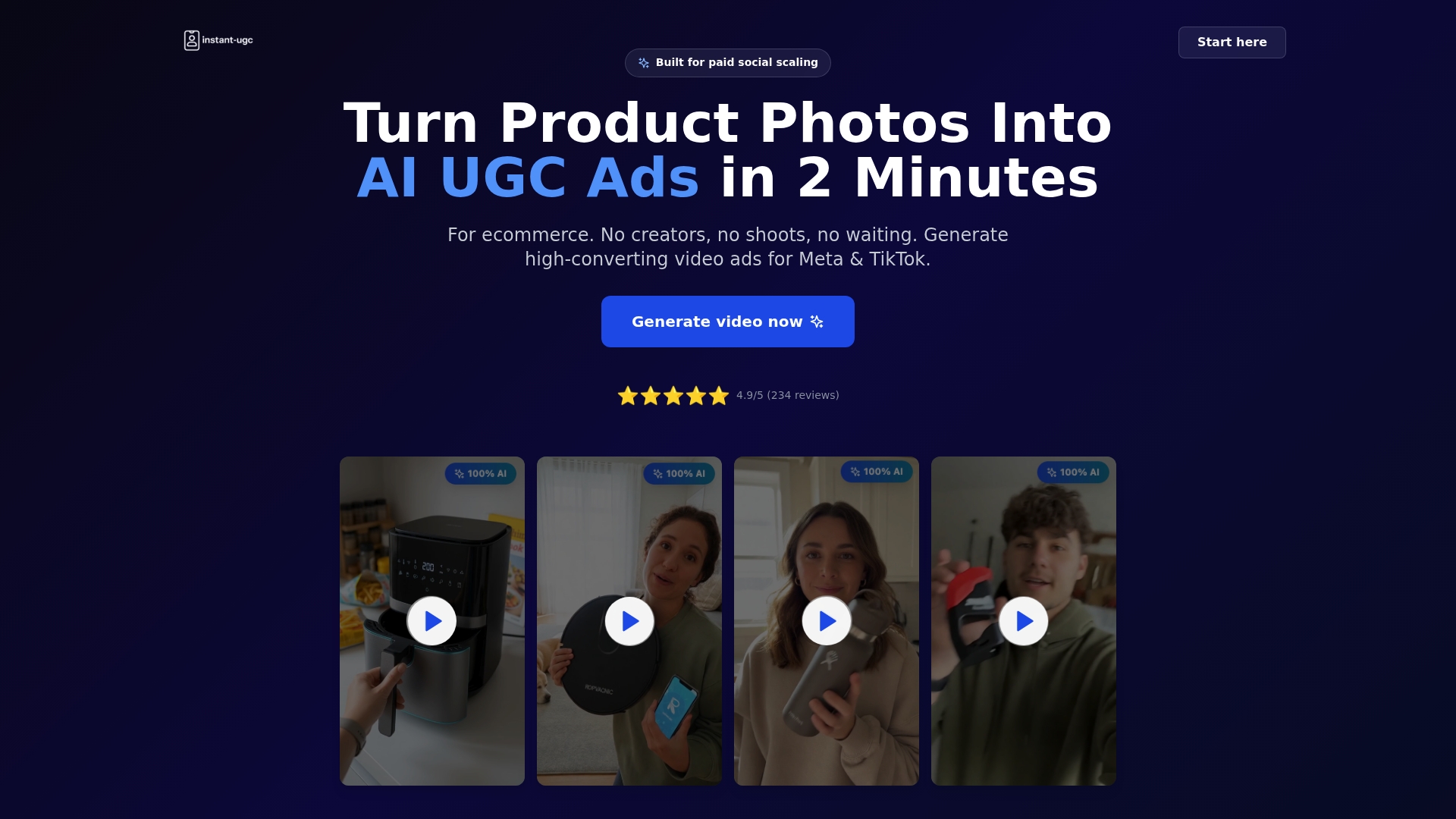
Feed your brief’s key messages and product details into the AI video generator, pick from more than 10 customizable AI avatars, and get a 9:16 video ready for Meta or TikTok without waiting on a creator’s calendar. One brand that shifted its testing this way saw ROAS climb from 2.1x to 4.8x after running more hook variants than a traditional shoot budget would have allowed. If your brand sells across borders, the multilingual video ads workflow supports 17 languages from the same brief.
Start with a small test: run your next brief’s three hook options through the Test plan at $9 one-off, or commit to the Starter plan at $19 a month if you’re planning to batch multiple products.
Sources
- Federal Trade Commission (FTC) — advertising and endorsements guidance
- UGC Brief Template: How to Brief Creators (2026) — Conversion Studio
- UGC Brief Template - Scale Growth Digital
FAQ
What Is a UGC Ad Brief?
A UGC ad brief is a short document, usually one to two pages, that tells a creator what to film, why, and how it will be measured. It covers the objective, hook direction, technical specs, and usage rights so the footage arrives ready to run as a paid ad.
How Long Should a UGC Brief Be?
One to two pages is the target length recommended by Conversion Studio, since longer briefs tend to produce over-scripted, less authentic footage. Focus the length on the hook, the objective, and the Must vs. Maybe list rather than exhaustive scene-by-scene instructions.
How Many Hook Variations Should I Request?
Request three to five hook variants per creator so you can run genuine A/B tests instead of judging one video in isolation. Reshooting just the opening lines against existing body footage is the cheapest way to expand a test batch.
Do I Need FTC Disclosure for UGC Ads?
Yes, any UGC ad involving a material connection, payment, free product, or partnership, requires clear and conspicuous disclosure under FTC guidance, with penalties reaching $50,120 per violation. Use plain words like “ad” or “sponsored” placed in the video itself, not just the caption.
How Fast Can I Test a New Hook With Instant-ugc?
Instant-ugc generates a finished, platform-ready video from your brief in 90 to 120 seconds, at a cost as low as $4 to $7 per video. That lets you test several hook variants for less than the cost of commissioning a single traditional creator shoot, which typically runs $500 to $2,000 and takes two to three weeks.
Recommended
- TikTok UGC Hooks 2026: The Ultimate Guide to Creating Scroll-Stopping Ads That Convert
- AB Testing UGC Ads: A Complete Guide to Data-Driven Campaign Optimization
- How to Brief UGC Creators: The Complete Guide for Brand Success
- High Converting UGC Ads: The Complete Guide to Testing, Optimization, and Scaling Performance
