
Make 8–12 Talking Head Ads a Week for Performance Marketers
Batch-test AI talking-head ads for fast top-of-funnel signal, then reshoot winners. Includes scripts, testing matrix, production checks, and disclosure rules.
Talking head ads are short, direct-to-camera videos where a spokesperson speaks straight to the viewer, and they remain the single most reliable format for stopping the scroll on Meta and TikTok. Use AI spokesperson video ads for fast, cheap top-of-funnel testing on offers under $200; save live-action for warm audiences and high-ticket products. One catch: FTC and platform rules require you to disclose AI-generated spokespersons inside the ad itself.
TL;DR:
- Use AI spokesperson videos for fast, low-cost testing on offers under $200 targeting cold audiences, but disclose AI use clearly in ads.
- Test different talk head ad formats, including testimonials, product demos, apps, personal pitches, and onboarding snippets, based on funnel stage.
- Prioritize high-quality production and technical accuracy, especially lip synchronization and disclosures, to avoid ad rejection and loss of effectiveness.
- Run split tests on avatar types, hooks, CTAs, and backgrounds with at least 1,000 impressions per variant, tracking hook rate, view-through, click-through, and CPA.
- Rapidly iterate through AI avatar variants to identify winning angles before reshooting with live spokespeople for warm audiences and higher ticket offers.
Table of Contents
- Talking Head Ad Formats You Can Copy Today
- AI Avatars or Live-Action: A Decision Framework
- The Script Template That Keeps Viewers Watching
- Building a Creative Testing Matrix That Actually Tells You Something
- Production Checks That Save an Ad Campaign
- Why Speed and Iteration Beat One Perfect Ad
- Instant-UGC: Built for the Test-Then-Film Playbook
- Sources
Talking Head Ad Formats You Can Copy Today
Every high-performing spokesperson ad fits one of five buckets. Pick the one that matches your funnel stage, then swap in your own hook.
UGC testimonial. Best for cold Meta and TikTok prospecting. Hook idea: “I returned three of these before I found the one that actually worked.” Place it as an in-feed video ad, not a Story, since testimonials need the extra seconds viewers give in-feed placements.
Product demo. Pair the talking head with two or three quick proof beats, then cut to B-roll showing the product in use. A skincare brand might say “watch this absorb in real time” and cut straight to a close-up application shot.
App or SaaS testimonial. Overlay an app screenshot behind a talking head delivering a testimonial style pitch. This format converts especially well for App Store and Google Play campaigns because it mimics a real user showing their screen.
Social short or personal pitch. One bold line, under 15 seconds, shot 9:16. No warm-up, no logo intro. The TechSmith breakdown of talking head videos notes this direct-address format works because it mimics a one-on-one conversation rather than a broadcast.
Training or onboarding snippet. Not every talking head ad sells. A 30 to 60 second walkthrough of “how to set up your account” retains new users and reduces support tickets, which matters if you run a SaaS or app product alongside your acquisition ads.
Common threads across all five:
- The spokesperson faces the camera directly, never in three-quarter profile.
- The hook lands in the first sentence, not after a greeting.
- Proof (a screenshot, a before/after, a stat) appears within the first 10 seconds.
AI Avatars or Live-Action: A Decision Framework
AI avatars win on cold traffic, low-ticket offers, and new-market entry, because you can generate ten script variants before a live-action crew finishes lunch. A 2025 study in the Journal of Research in Interactive Marketing found AI spokespersons generally create more psychological distance than humans and score lower on empathy, but that gap narrows sharply when the avatar shows natural facial expressions and gestures. Translation: cheap AI avatars work for testing volume, but production quality still decides whether they convert.
Live-action holds the edge for warm retargeting audiences, brand continuity campaigns, and high-ticket offers where buyers want to see a real human standing behind the product.
Run this checklist before choosing:
- Is the offer under $200 and the audience cold? Use AI avatars.
- Is the audience warm, or the price point above $500? Use live-action.
- Are you entering a new language market? Use AI avatars with native-language voice cloning.
- Do you need brand consistency across dozens of SKUs? Hybrid: test with AI, film the winners.
Pro Tip: Run the exact same script through three avatar personas before you touch live-action. If one persona consistently beats the others, that tells you something about your audience’s preferences you can carry straight into casting a human spokesperson.
The Script Template That Keeps Viewers Watching
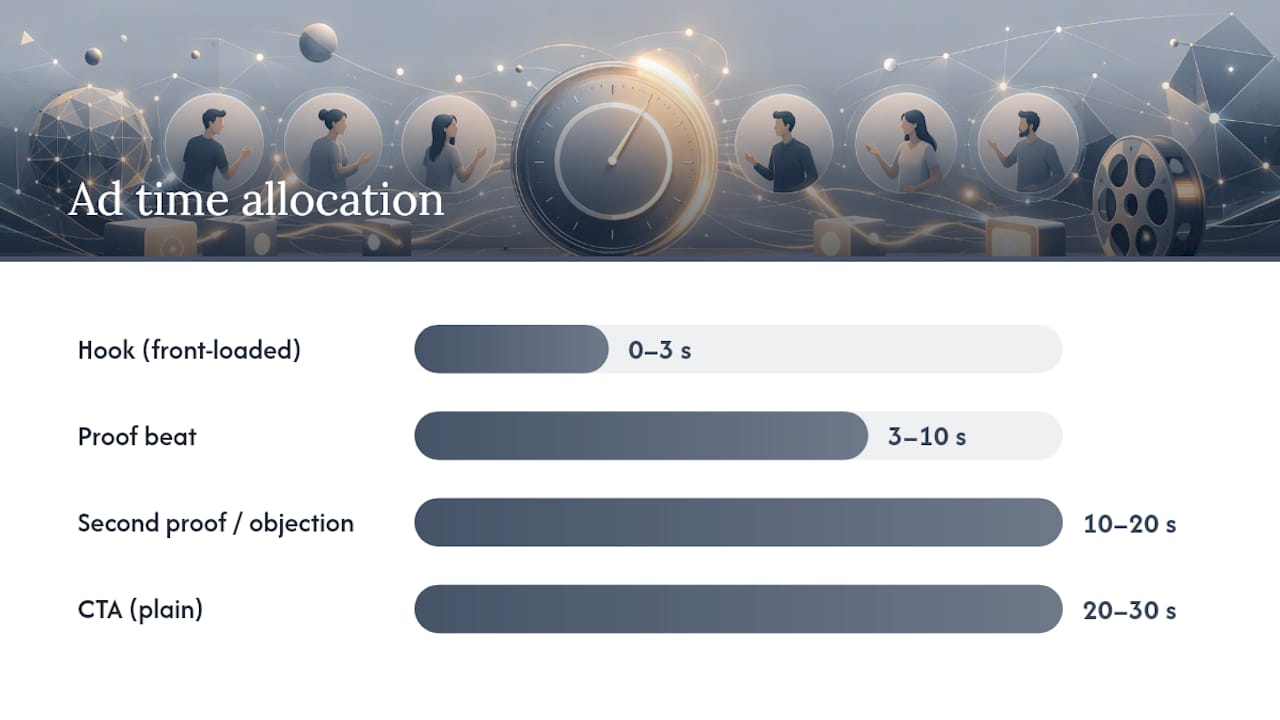
Every winning talking head script follows a beat structure, not a monologue. Practitioners who run performance campaigns at scale build ads around a complaint or contrarian hook, quick proof beats, and an emotional shift, rather than one continuous take.
Three hook types that work in the first 3 seconds:
- Complaint hook: “Why does every [product category] break within a month?”
- Contrarian hook: “Stop buying [common product] until you see this.”
- Benefit-plus-proof hook: “This cut my [pain point] in half, and here’s the receipt.”
Template for a 15 to 30 second ad:
- 0 to 3 seconds: hook, delivered mid-sentence, no intro
- 3 to 10 seconds: proof beat (screenshot, demo cutaway, stat)
- 10 to 20 seconds: a second proof beat or objection handled
- 20 to 30 seconds: CTA, stated plainly, no soft close
Keep delivery conversational. Contractions, pauses, and slightly imperfect phrasing read as credible; overly polished script-reading reads as an ad. Adstellar’s guidance on AI talking head ads backs this up: front-loading the hook in the first three seconds is the highest-leverage change you can make to any script.
Building a Creative Testing Matrix That Actually Tells You Something
Isolate one variable per test batch: avatar persona, hook type, CTA phrasing, or background setting. Testing all four at once just produces noise you can’t act on.
Track metrics in this order, because each one filters out the ads that fail earlier:
- Hook rate (3-second view rate): filters out weak openers before you spend on the rest of the funnel.
- 50% view-through rate: tells you whether the middle of the ad holds attention.
- Click-through rate: measures whether the CTA and offer actually land.
- Cost per acquisition: the only number that decides whether you scale or kill the ad.
Don’t call a winner on fewer than 1,000 impressions per variant, and give each test at least 48 hours to clear the learning phase. A variant that wins on hook rate but dies on CPA isn’t a winner. It’s a lesson about your landing page.
Production Checks That Save an Ad Campaign
Before any talking head ad goes live, run through the technical and compliance checks that separate a scaling campaign from a rejected one.
- Check lip-sync frame by frame, especially on multi-language versions. Drift shows up fastest around consonants.
- Review micro-expressions for stiffness. Uncanny valley problems usually show up around the eyes, not the mouth.
- Test caption and disclosure contrast against every background color in the ad, not just the default one.
- Confirm the AI disclosure appears in the first 3 seconds, in the same language as the ad, with a phrase like “AI-generated spokesperson.”
Well-produced avatar ads report 28 to 34% hook rates on cold prospecting when production quality is high, but that number collapses fast if lip-sync drifts or the disclosure gets buried in low-contrast text.
The most common failure modes: reusing the same avatar until audiences recognize it and sentiment turns negative in the comments, skipping disclosure and risking account penalties, and mistaking a single successful angle for a permanent creative. Rotate avatars and hooks on a fixed schedule, not when performance already drops.
Why Speed and Iteration Beat One Perfect Ad
Marketers who treat talking head ads as a testing pipeline, not a single production event, consistently outperform those chasing one perfect video. The winning rollout is simple: batch-test AI avatar variants for cheap signal, then reshoot the winning angles with a live spokesperson for warm-funnel continuity. Iteration finds winners; polish alone rarely does.
— Syno
Instant-UGC: Built for the Test-Then-Film Playbook
Instant-ugc turns a product photo or app screenshot into a finished 9:16 talking head ad in 90 to 120 seconds, with 17 languages and more than 10 customizable avatars to run persona tests without booking a single shoot. That speed is the entire point of the testing matrix above: instead of producing one script and hoping, you generate 8 to 12 variants in a week, run them against the hook-rate and CPA sequence, then move only the winners into live-action production.
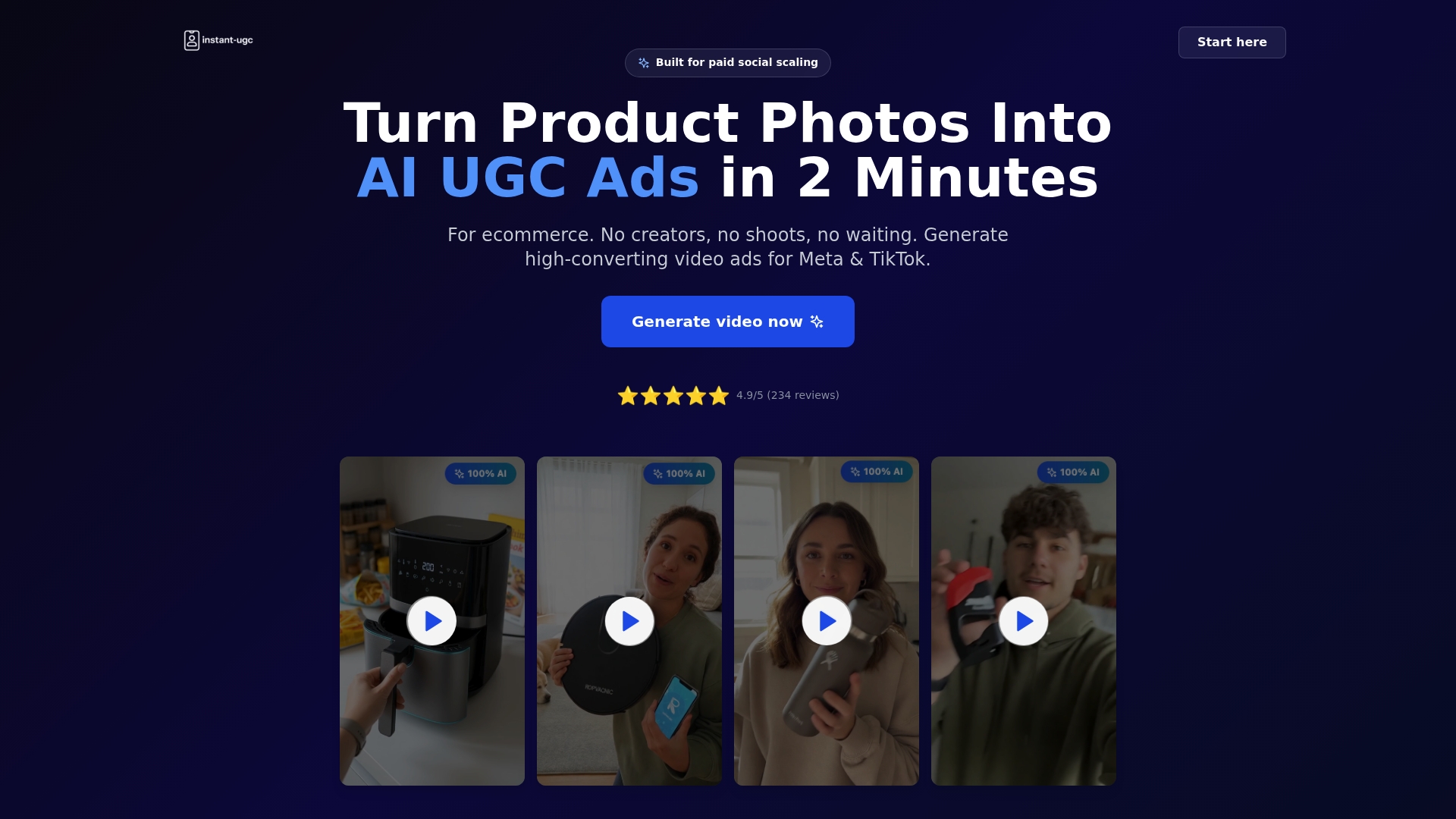
Brands using the AI product video generator report ROAS climbing from 2.1x to 4.8x after switching from slow, expensive UGC production to this rapid-test approach. If you’re running app or SaaS testimonials, the talking avatar workflow generates App Store-ready variants without hiring a single creator. Start a batch of script variants this week, test them against your CPA benchmark, and reshoot only the ones that earn it.
Sources
- I feel no empathy toward AI: the effects of AI vs human spokespersons on advertisement effectiveness
- AI Spokesperson Video Ads in 2026: Performance Data, Failure Modes & FTC Rules
- What Are Talking Head Videos?
