
Performance Marketers: Test 5 Social Proof Video Ads in an Afternoon
Create, test, and scale social proof video ads fast. Three sourcing paths, a two phase test plan, and Instant-ugc for rapid iteration.
The fastest way to boost ad trust is to run short social proof video ads that show a real customer’s reaction or result inside the first three seconds. Test a 15 to 30 second vertical testimonial with captions and a problem solution hook before touching a bigger budget. UGC-style posts convert more than 10 times higher than posts without them, which is reason enough to make this your next test.
TL;DR:
- Short social proof video ads showing genuine customer reactions within the first three seconds significantly boost ad trust and conversion.
- Using real customer clips, unboxing reactions, or before-and-after visuals tailored to funnel stages improves engagement over generic brand messaging.
- Aspect ratio and length must match platform requirements, with 9:16 vertical videos for TikTok and Reels being most effective for short attention spans.
- Rapid testing of multiple hook variants and A/B testing with low budgets outperform producing a single polished ad, especially when using AI-assisted content generation.
- Securing explicit rights and transparent AI disclosures is essential, as inauthentic or non-disclosed content reduces ad effectiveness by roughly 19 percent.
Table of Contents
- What Are Social Proof Video Ads, Exactly?
- Real Creative Patterns That Convert
- Which Format Fits Which Platform?
- How to Build a Social Proof Video Pipeline
- Hooks and a Script Skeleton You Can Reuse
- Which Metrics Actually Tell You It’s Working?
- Usage Rights and AI Disclosure You Can’t Skip
- What Actually Separates the Winners
- How Instant-ugc Fits Into Your Testing Plan
- Sources
- FAQ
What Are Social Proof Video Ads, Exactly?
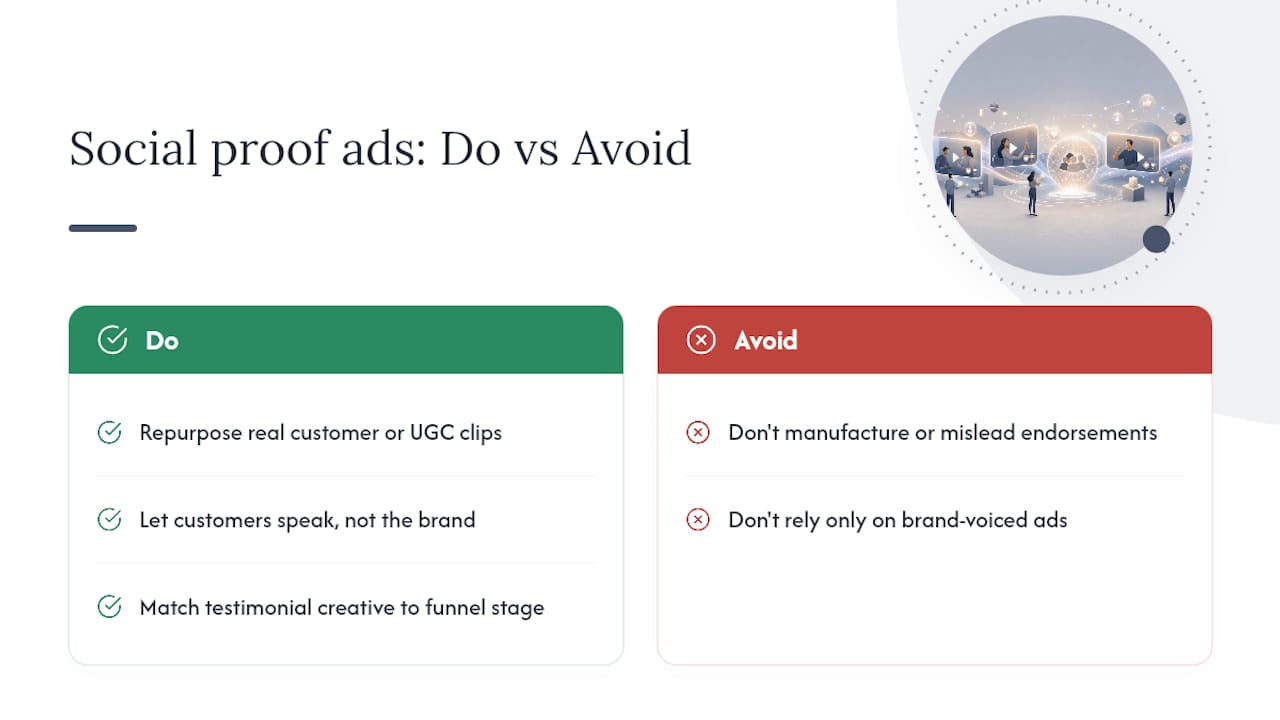
Social proof video ads are testimonial or review footage, either real customer clips or UGC-style recreations, repurposed into paid video creative. Instead of a brand narrating its own benefits, a customer, reviewer, or influencer does the talking, and the ad borrows the credibility of a peer instead of a marketing department.
The mechanism behind this is not new. Social proof works because people look to others’ behavior and endorsements to reduce their own uncertainty, a psychological pattern that Harvard Business Review has documented as one of the most reliable levers in persuasion, and one of the most easily abused. That second half matters as much as the first: the same research warns that misleading or manufactured endorsements erode the very trust marketers are trying to borrow. A social proof video ad only works when the proof is real.
Testimonial-style creative tends to beat brand-voiced ads on both click-through rate and cost per acquisition when it’s matched to the right funnel stage, according to ConversionStudio’s analysis of testimonial formats. That’s the standard industry term worth knowing: UGC advertising, or user-generated content advertising, covers this entire category, and social proof video ads are simply the trust-driven subset of it built around testimonials, reviews, and endorsements rather than lifestyle or demo footage alone.
Real Creative Patterns That Convert
Not every testimonial ad looks the same, and the format you pick should match where the viewer sits in your funnel. Here are the patterns worth testing first.
- Talking-head testimonial. A customer speaks directly to camera about their experience. Works at every funnel stage, especially retargeting, because it feels like a friend’s recommendation rather than an ad.
- First-reaction / unboxing. The camera catches a genuine reaction to a product arriving or working. Strong for top-of-funnel cold audiences on TikTok and Instagram Reels, where curiosity drives the scroll-stop.
- Before-and-after. Visual proof of transformation, common in beauty, fitness, and home categories. Format-specific data shows before-and-after clips are among the strongest performers when the contrast is shown, not just described.
- Screenshot review. A phone-recorded scroll through a five-star review or DM thread. Cheap to produce and effective for app and SaaS products where trust in the interface matters more than trust in a face.
- Influencer endorsement. A creator with an established audience vouches for the product in their own voice. Works well mid-funnel, when the audience already recognizes the creator.
- Side-by-side comparison. The product next to a competitor or an old habit, letting the viewer draw their own conclusion.
- Customer story mini-doc. A longer, narrative arc following one customer’s problem to resolution. Suited to high-consideration purchases and B2B, where a quick clip won’t carry enough weight.
Whatever pattern you pick, avoid the two cues that instantly signal a fake: scripted-sounding dialogue and studio-perfect lighting on someone claiming to film from their living room. MAGNA’s research, cited by Shopify, found inauthentic ads run roughly 19% less effective at driving purchase intent. Polish is not the enemy, but polish that contradicts the “real customer” premise is.
Which Format Fits Which Platform?
Aspect ratio and length are not stylistic choices. They’re compatibility requirements, and getting them wrong quietly caps your reach before the creative even gets judged on merit.
| Format | Best for | Notes |
|---|---|---|
| 9:16 vertical, 15 to 30 seconds | TikTok, Reels, Stories | Sound-on hook expected; front-load the proof |
| 1:1 square, 15 to 30 seconds | Facebook and Instagram feed | Works with sound off; captions carry the message |
| 16:9 horizontal, 2 to 3 minutes | YouTube, LinkedIn | Room for a full customer story or case study |
A few platform habits are worth building in from the start:
- Caption everything. Most feed placements default to silent autoplay, so the hook has to land visually even before sound kicks in.
- Put visual proof in frame within the first two seconds on TikTok. Roughly 90% of ad recall gets decided in the first six seconds, so a slow open is a wasted impression.
- Save the long-form testimonial for YouTube and LinkedIn, where viewers arrive with more patience and higher purchase consideration. A three to five minute mini-documentary style testimonial fits a $2,000 SaaS contract far better than a $20 impulse buy.
How to Build a Social Proof Video Pipeline
Scaling this format comes down to sourcing, briefing, and assembly, done as a repeatable process rather than a one-off shoot.
1. Pick a sourcing strategy. You have three real options, and most mature accounts end up blending all three:
- Repurpose organic customer clips from reviews, unboxing videos, or social mentions. Cheapest option, but volume is unpredictable and rights need explicit confirmation.
- Brief paid UGC creators for custom footage. Gives you control over message and pacing, but a single video can take two to three weeks and run $500 to $2,000 through traditional creator marketplaces.
- Use AI-assisted generation when you need speed and volume, particularly for early-stage testing where you’re not sure which hook or angle will land.
2. Write a tight brief. At minimum, specify the target audience, the exact hook line, deliverables and format, usage rights and duration, and caption requirements. A vague brief is the number one reason a $50 creator video comes back unusable.
3. Edit for the platform, not the story. Trim to the hook first, then build the story around it, not the reverse. Add captions, generate a scroll-stopping thumbnail frame, export in the platform’s native ratio, and cut at least two hook variants for A/B testing before you ever spend a dollar on media.
Pro Tip: Keep a swipe file of every hook line that’s tested well, even from failed ads. A hook that underperformed on one product angle often becomes a winner once you pair it with a different proof point.
Hooks and a Script Skeleton You Can Reuse
Three hook types consistently earn attention in the first three seconds: the problem callout (“If your skin does this every winter…”), the surprise or result reveal (“I didn’t expect this after one week”), and the peer identity trigger (“As a busy parent, I needed something that just works”). Each one works because it makes the viewer feel personally addressed before the brand is even mentioned.
For structure, a 30 to 60 second testimonial holds up well against this skeleton:
- Hook (0 to 3 seconds): state the problem or the surprising result up front.
- Problem: describe the pain point in the customer’s own words, not marketing language.
- Discovery: how they found the product, kept brief and casual.
- Proof: one specific metric or vivid detail, not a vague compliment.
- CTA: a natural, spoken nudge toward the next step, not a hard sell.
Pro Tip: Leave in one small verbal stumble or filler word during editing. A slightly imperfect delivery reads as more credible than a line read with zero hesitation, which is exactly the “deliberate amateur” zone that keeps ads from feeling scripted.
Which Metrics Actually Tell You It’s Working?
Run a two-phase test before scaling anything. Phase one is discovery: launch several hook variants at low spend to see which one earns attention. Phase two is scale: take the winner and iterate with small edits rather than starting over.
The metrics worth watching, roughly in the order they matter:
- Hook rate (percent who watch past 3 seconds): tells you if the opening line works at all.
- Hold rate and video completion: tells you if the middle of the video still holds attention once the hook lands.
- CTR: measures whether the proof translates into intent to click.
- CPA and ROAS: the numbers that decide whether this creative earns its keep.
Refresh creative once hook rate or CTR starts sliding week over week, a common fatigue signal on accounts running heavy frequency. Running many low-budget variations and killing losers early consistently outperforms waiting to produce one polished “hero” ad.
Usage Rights and AI Disclosure You Can’t Skip
Before any testimonial or reviewer clip goes into a paid ad, collect written permission covering the platforms, regions, and duration you intend to run it. For anyone shown or heard, get a model release. If you’re paying a creator, confirm the license terms explicitly cover paid media use, not just organic posting.
- Get written permission scope: platforms, regions, and how long the ad will run.
- Secure a model release for any identifiable face or voice.
- Confirm paid creator contracts explicitly license paid media, not organic-only use.
- Label AI-generated presenters honestly, and check local advertising rules on disclosure.
- Store every permission file where it’s tied to the specific ad account and campaign that uses it.
On AI presenters specifically: industry testing suggests well-disclosed AI UGC performs within a small margin of real customer footage while enabling far faster iteration, so disclosure protects trust without meaningfully costing you performance.
What Actually Separates the Winners
Most teams over-invest in production polish and under-invest in testing volume. The accounts that consistently find winning social proof creative run daily creative sprints, testing several hook variants against a small budget, and check weekly that ad angles still route to a matching pre-sell page rather than a generic homepage. That routing check gets skipped constantly, and it quietly kills conversion on ads that otherwise hooked well. If you do nothing else this month, run five hook variants against $20 a day each before spending anything on a single “perfect” version.
— Syno
How Instant-ugc Fits Into Your Testing Plan
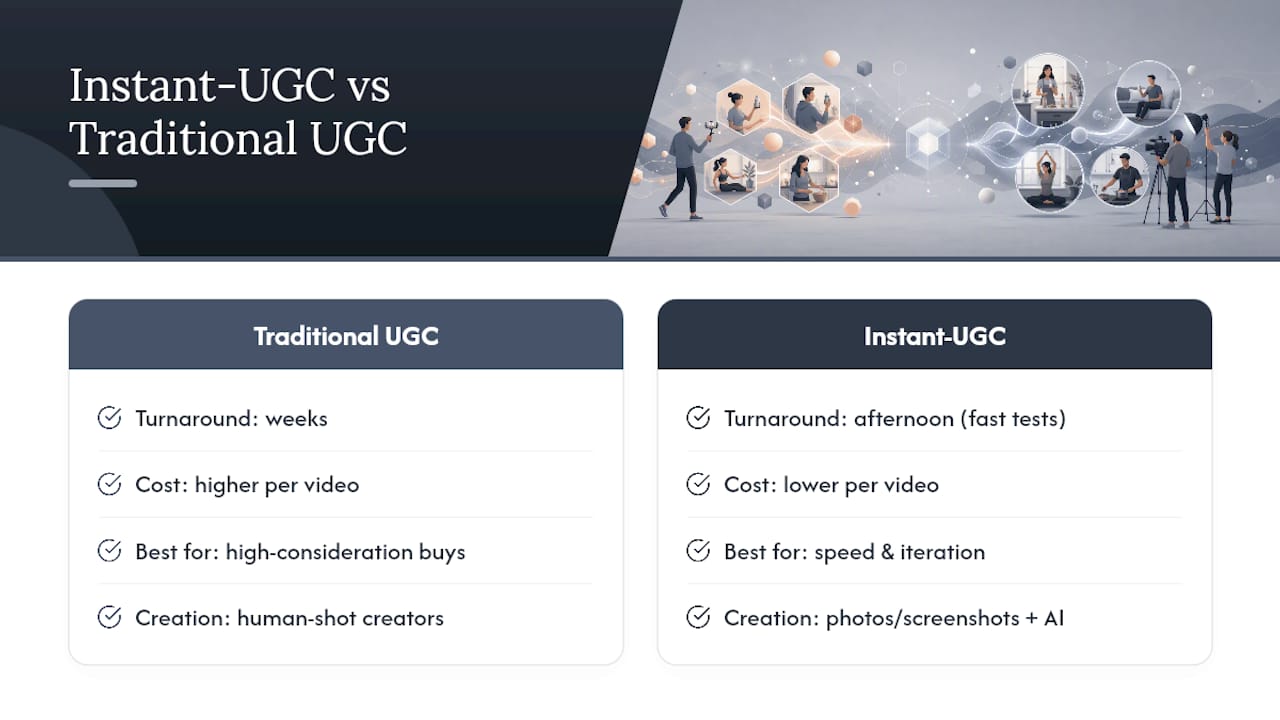
Traditional UGC creators can take weeks and can be costly per video, which makes rapid hook testing expensive before you’ve even proven an angle. Some AI platforms can turn product photos or app screenshots into finished video ads quickly, using automatic script generation and customizable AI avatars across multiple languages.
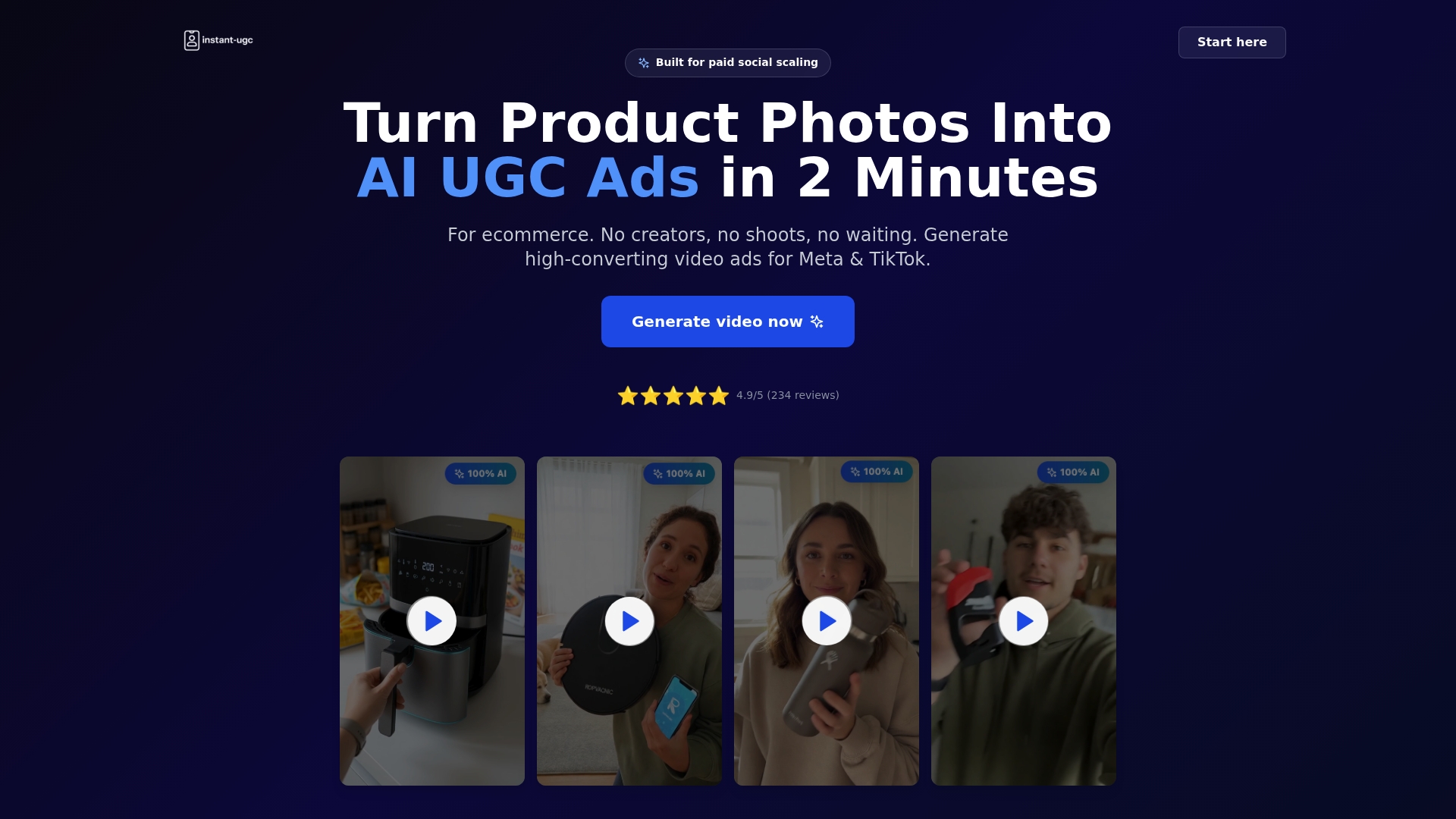
Choose real customer clips when you already have strong organic reviews or need a specific, verifiable story for a high-consideration purchase. Choose Instant-ugc when speed and iteration matter more, such as testing five hook angles in an afternoon instead of a month, or launching the same ad across multiple languages without booking separate creators for each. The platform runs a dedicated workflow for physical products (built for Shopify, Amazon FBA, and dropshipping brands) and a separate one for AI-generated product videos suited to mobile apps and SaaS, delivering everything in 9:16 format ready for Meta, TikTok, or the App Store.
If your current testing cycle is bottlenecked by creator turnaround, start with a single test video to see how it performs against your existing creative before committing to a subscription tier.
Sources
- User-generated content (UGC) ads — Shopify
- The uses and abuses of influence — Harvard Business Review
- Testimonial ad examples — ConversionStudio
FAQ
What Are Social Proof Ads?
Social proof ads are advertisements built around real or realistic customer endorsements, reviews, or testimonials rather than brand-written copy. They borrow credibility from a peer’s voice, and UGC-style posts convert more than 10 times higher than ads without that element.
Can You Give Examples of Social Proof Video Ads?
Common examples include talking-head testimonials, unboxing first-reactions, before-and-after transformations, screenshot reviews, and influencer endorsements. Each fits a different funnel stage, with talking-head testimonials working well for retargeting and unboxing clips performing best with cold, top-of-funnel audiences.
What Is the 3-3-3 Rule in Marketing?
Definitions of the 3-3-3 rule vary across marketers, so treat it as a rough guideline rather than a fixed standard. One common version ties to hook discipline: grab attention in the first 3 seconds, state the problem or benefit within the next 3, and deliver proof within the following 3, which lines up with the 90% recall impact tied to the opening seconds of a video ad.
What Are Some Examples of Social Proof Marketing?
Beyond video ads, social proof marketing includes customer review widgets, star ratings on product pages, “as seen in” press logos, and influencer partnerships. Video versions of these, like a screenshot review turned into a short ad, tend to outperform static formats on click-through rate according to ConversionStudio’s format analysis.
How Much Does Instant-ugc Cost?
Instant-ugc offers a one-time $9 test video, plus subscription plans starting at $19 per month for the Starter tier, $39 per month for Growth, and $99 per month for Pro. Full plan details are available on the Instant-ugc pricing page.
