
ROAS vs CPA: Which Metric Should Marketers Prioritize?
Discover whether to prioritize ROAS or CPA for your marketing strategy. Maximize your profits based on your business model and goals.
Prioritize ROAS if you run ecommerce or any business with variable order values. Prioritize CPA if you sell a fixed-value product, run lead generation, or track early-stage trial signups. Most mature accounts eventually run both as guardrails against each other.
- Pick ROAS when: revenue per order varies and you can attribute sales cleanly (product catalogs, subscription upgrades, multi-SKU stores).
- Pick CPA when: every conversion is worth roughly the same (form fills, app installs, free trials) or your revenue data is not yet mature.
- Pick both when: you’re scaling spend and want a CPA ceiling plus a ROAS floor before increasing budget. A typical ecommerce ROAS benchmark sits around 3.0 to 4.0, while Google Ads’ Target CPA and Target ROAS bidding strategies let you build either guardrail directly into automated bidding.
Key Takeaways
ROAS and CPA measure different things, revenue efficiency versus acquisition cost, and combining both as guardrails prevents either one from being optimized in isolation.
| Point | Details |
|---|---|
| Match metric to business model | Use ROAS for variable order-value ecommerce and CPA for fixed-value lead gen or early-stage funnels. |
| Set a CPA ceiling and ROAS floor | Scale spend only when both thresholds hold, since the metrics can disagree on the same campaign. |
| Convert CPA to ROAS with AOV | Divide average order value by CPA to translate a cost target into a revenue efficiency target. |
| Bidding objective shapes results | Target CPA can favor cheap, high-volume items; Target ROAS favors high-value conversions instead. |
| Creative moves ROAS fastest | Platforms like Instant-ugc let marketers test UGC-style video variations in minutes, with reported ROAS gains from 2.1x to 4.8x. |
Table of Contents
- ROAS vs CPA: Definitions, Formulas, and Worked Examples
- When Should You Use ROAS Versus CPA?
- How ROAS and CPA Connect: Setting Real Targets
- Target CPA vs Target ROAS Bidding: What the Algorithm Optimizes
- Tactics That Actually Move ROAS and CPA
- Does Better Creative Actually Improve ROAS?
- Test Creative Faster Than You Can Adjust Bids
- Frequently Asked Questions
- Sources
ROAS vs CPA: Definitions, Formulas, and Worked Examples
ROAS (return on ad spend) equals revenue divided by ad spend. CPA (cost per acquisition) equals ad spend divided by number of conversions. They answer different questions: ROAS tells you how much revenue each dollar generates; CPA tells you how much each customer or lead costs to acquire.
- ROAS example: An ecommerce campaign spends $2,000 and generates $7,400 in revenue across a mixed order catalog. ROAS = $7,400 ÷ $2,000 = 3.7x, comfortably inside the common 3.0 to 4.0 benchmark range.
- CPA example: A B2B lead-gen campaign spends $1,500 and generates 60 qualified leads. CPA = $1,500 ÷ 60 = $25 per lead.
How these relate to other metrics you already track:
- ROI measures profit relative to total investment, including product cost and overhead, not just ad spend. ROAS ignores margin entirely, which is why a “great” ROAS can still lose money, as the Corporate Finance Institute points out when comparing the two.
- CAC (customer acquisition cost) is CPA’s cousin, usually including non-ad costs like sales labor.
- ACOS (advertising cost of sale), common in Amazon Ads, is essentially the inverse of ROAS expressed as a percentage.
When Should You Use ROAS Versus CPA?
Your choice depends less on personal preference and more on five concrete signals in your business.
- Price variability: wide order values push you toward ROAS; a single fixed price points to CPA.
- Conversion equivalence: if every conversion carries the same value (an app install, a demo request), CPA is simpler and just as accurate.
- LTV visibility: if you already know customer lifetime value, you can translate CPA into ROAS territory with confidence.
- Funnel stage: early-stage campaigns with thin conversion history often lack the revenue data ROAS needs, so CPA becomes the practical default.
- Attribution quality: if your revenue tracking is unreliable (multi-device purchases, offline sales), ROAS numbers will mislead you before CPA will.
Ecommerce catalogs with strong revenue attribution almost always favor ROAS. Lead generation, SaaS trials, and early-funnel campaigns with sparse conversion data favor CPA, at least until enough volume accumulates to trust value-based bidding. HubSpot’s guidance backs this pattern directly: early-stage teams tend to lean on CPA, while established businesses shift focus to ROAS as revenue efficiency becomes the priority.
Pro Tip: Run ROAS as your primary metric but keep a hard CPA ceiling active underneath it. If a campaign’s CPA blows past that ceiling even while ROAS looks healthy, you’re likely buying revenue with an unsustainable acquisition cost.
How ROAS and CPA Connect: Setting Real Targets
The two metrics aren’t rivals. They’re translations of the same underlying question: is this spend profitable? Here’s how to move between them.
- Calculate your break-even ROAS. Break-even ROAS = 1 ÷ gross margin. A 40% margin business needs a ROAS of at least 2.5x just to cover the cost of goods sold.
- Convert CPA into a ROAS equivalent. Divide your average order value by your CPA. A $25 CPA against a $95 average order value implies a ROAS of 3.8x.
- Incorporate LTV for lead gen. Multiply lead value by close rate to get a target CPA. A $4,000 average deal size with a 15% close rate supports a lead value of $600, meaning a $150 CPA still leaves a 4x return on acquisition cost before any other overhead.
For ecommerce, add a safety margin: set your target ROAS at roughly 1.5 times your break-even point to absorb shipping, returns, and platform fees. A store with a 2.5x break-even ROAS should generally target closer to 3.5x to 4x before calling a campaign healthy, which lines up with the benchmark range most ecommerce teams already track against.
Target CPA vs Target ROAS Bidding: What the Algorithm Optimizes
Choosing a bidding objective doesn’t just change your reporting. It changes what the algorithm chases.
- Target CPA tells the algorithm to maximize conversion volume at or below a set cost, regardless of what each conversion is worth.
- Target ROAS tells the algorithm to maximize conversion value relative to spend, which can mean fewer total conversions if it finds higher-value ones.
This distinction matters more than most marketers realize. In multi-price ecommerce catalogs, Target CPA can quietly push spend toward your cheapest, highest-volume products, since it treats a $12 sale the same as a $200 sale, according to platform-level bidding analysis. Google Ads documents specific requirements before either strategy performs well, including active conversion tracking and minimum conversion history.
Before switching bidding strategies, confirm:
- Conversion tracking fires correctly across all relevant actions
- Conversion values are mapped accurately (not just “yes/no” conversions)
- You have enough historical conversions for the algorithm to learn from
- Offline conversions or CRM data import into the platform if your sales cycle extends beyond the click
Pro Tip: For lead gen accounts without ecommerce-style revenue data, assign an estimated dollar value to each lead based on historical close rate and deal size. Feeding the algorithm a realistic value, even an estimate, unlocks Target ROAS bidding for businesses that otherwise couldn’t use it.
Tactics That Actually Move ROAS and CPA
Bidding adjustments only get you so far. The bigger wins usually come from creative and measurement fixes.
- Creative A/B testing: test message angles, not just images, since messaging usually moves conversion rate more than visuals alone.
- Value-based bidding: shift budget toward campaigns and audiences generating higher average order value, not just more clicks.
- Landing page CRO: a five-point lift in landing page conversion rate can lower CPA more reliably than any bid adjustment.
- Audience segmentation: separate high-LTV segments from bargain shoppers so ROAS reporting doesn’t average away your best customers.
- Attribution hygiene: clean UTM tagging and consistent attribution windows prevent both metrics from drifting due to measurement noise rather than real performance.
Improving CPA usually comes down to raising conversion rate and fixing friction in the landing experience, while improving ROI requires margin work alongside revenue growth, a distinction worth keeping separate when you diagnose a weak campaign.
Pro Tip: Prioritize creative variations that raise average order value or conversion value, not just click-through rate. A high-CTR ad that attracts bargain hunters can tank your ROAS even as your CPA looks great.

Does Better Creative Actually Improve ROAS?
Yes, and often more reliably than bid strategy changes alone. One agency case documented a 32% increase in ROAS after reallocating spend and optimizing creative and channel mix, not by adjusting bids. Creative-focused testing tends to work by raising baseline conversion value rather than by changing what the algorithm bids.
Results vary by category, audience, and starting point, so treat any single case as directional. Worth testing first:
- Product-focused UGC-style ads versus polished studio creative
- Value-based CTAs tied to outcomes, not generic “shop now” language
- Message variations tested against a stable landing page to isolate the creative’s effect
Connect every creative win back to revenue tracking, not just click-through rate, or you’ll mistake attention for profit.
A Practical Recommendation
For most ecommerce and DTC brands, prioritize ROAS with a CPA ceiling underneath it. Run creative experiments continuously since they tend to lift ROAS faster and cheaper than bid tweaks alone, especially once your conversion value mapping is solid.
Test Creative Faster Than You Can Adjust Bids
Bidding strategy changes take weeks to prove out because the algorithm needs conversion volume to relearn. Creative changes can shift ROAS within days if the variation actually raises conversion value. That’s the gap Instant-ugc is built to close: instead of waiting on a Target ROAS campaign to mature, you generate new UGC-style video ad variations from existing product photos in minutes and get real performance signal while your bidding strategy is still stabilizing.
Instant-ugc turns product photos or app screenshots into 9:16 video ads with AI avatars, automatic scripts, and support for 17 languages, so testing five creative angles costs a fraction of commissioning five UGC shoots. Brands using the platform have reported ROAS climbing from roughly 2.1x to 4.8x as creative volume increased. If you’re optimizing for ROAS and want more variations in the rotation this week, start with the AI video ad generator and test your next creative angle before your next bid adjustment even has time to mature.
Frequently Asked Questions
Is ROAS better than CPA? Neither is universally better. ROAS reflects revenue efficiency and suits variable-priced catalogs; CPA reflects acquisition cost and suits fixed-value conversions like leads or signups. Most accounts benefit from tracking both.
What is a good ROAS? Ecommerce benchmarks commonly fall between 3.0 and 4.0, but your real target depends on gross margin. A low-margin business needs a much higher ROAS to break even than a high-margin one.
Can I use Target CPA and Target ROAS at the same time? Not on the same campaign in most platforms, since each tells the bidding algorithm to optimize for a different outcome. You can run Target CPA on lead-gen campaigns and Target ROAS on ecommerce campaigns within the same account.
Why would CPA go up while ROAS stays flat? This usually signals rising competition or auction costs paired with stable or improving order values. Diagnose it by checking whether conversion rate or average order value shifted alongside the CPA increase.
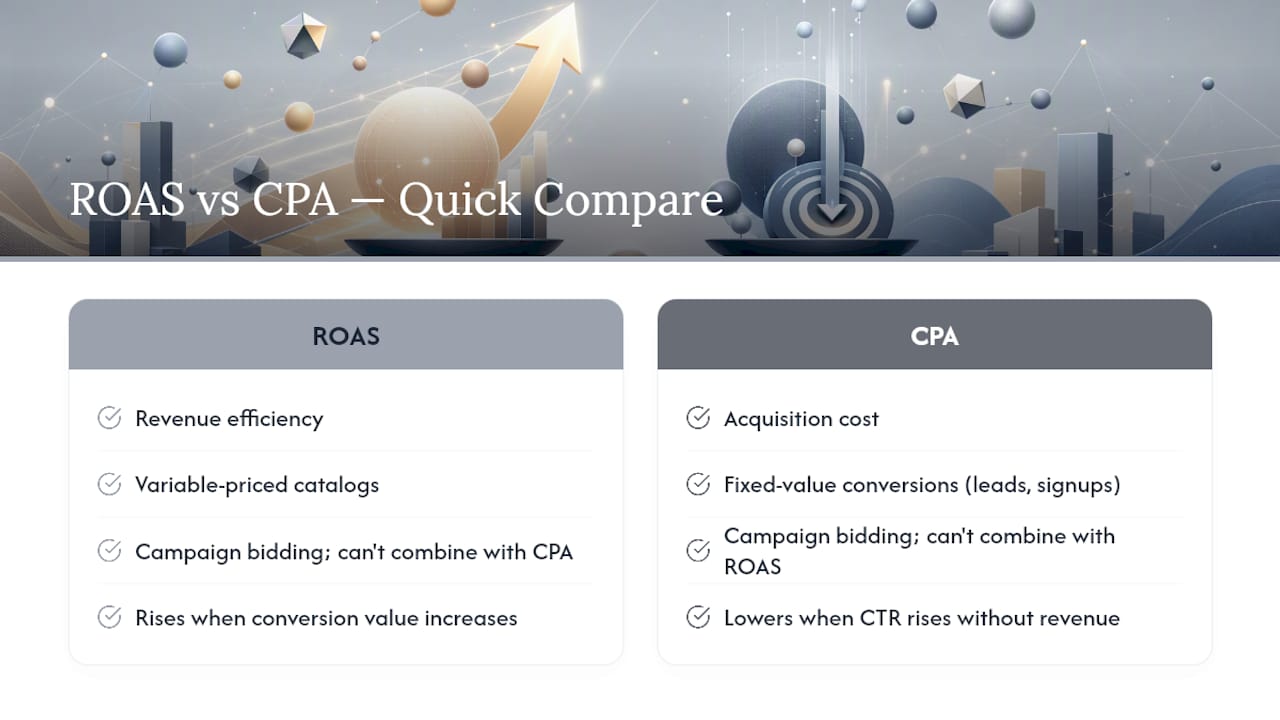
How does creative testing affect these metrics? Creative changes that raise conversion value or average order value tend to lift ROAS without touching bids at all, while creative changes that simply raise click-through rate can lower CPA without improving revenue, so track both effects separately.
Sources
- Understanding Return on Ad Spend (ROAS)
- Return on Ad Spend – Definition, FAQs & How HubSpot Helps
- Return on Ad Spend – Guide (Corporate Finance Institute)
- Google Ads support: Smart bidding (Target CPA, Target ROAS) documentation
- CPA vs ROAS: Which Metric Should You Optimise? (2026)
