
Reduce Video Ad Costs in Weeks for Marketers With GenAI and Better Measurement
Combine GenAI UGC, tighter bidding, audience pruning, and cleaner attribution to cut cost per result within weeks and protect your campaign ROI.
The fastest way to reduce video ad costs is to combine four levers: rapid UGC and GenAI creative testing, tighter bidding and cost-cap controls, audience and placement pruning, cleaner attribution. Together, these changes cut wasted spend and lower cost-per-result within weeks, not months. Creative refresh and format mix drive most of the efficiency gains, while bidding and targeting fixes protect the budget you already have. The checklist below turns this into steps you can start today.
TL;DR:
- Reducing placements with low conversion or view-through rates can significantly cut wasted spend within days.
- Employing cost-cap bidding strategies and properly funding the learning phase helps stabilize costs and improve ad efficiency over time.
- Creative testing using fresh UGC-style videos and multiple formats boosts relevance and lowers cost-per-result more effectively than bidding tweaks alone.
- Audience and placement pruning, including frequency caps and content relevance, can eliminate impressions that do not convert, maximizing value.
- Using attention and conversion measurement, along with fast AI-generated creatives, ensures real results guide ongoing cost-saving efforts.
Table of Contents
- Seven immediate actions to lower video ad spend this week
- Which bidding strategies and budget rules lower unit costs
- Why creative quality beats platform tricks for cutting costs
- How to prune audiences and placements so every dollar buys value
- The measurement changes that reveal true costs
- The experiment cadence to find cost-saving winners
- Practical, channel-specific tactics for YouTube, Meta, TikTok, and CTV
- What it takes to make these savings last
- How Instant-UGC helps you cut production and ad costs
- FAQ
- Sources
Seven immediate actions to lower video ad spend this week
Before testing anything new, stop the bleeding. A short audit followed by a handful of settings changes typically recovers budget within days.
- Pause or reduce spend on placements and ad sets with the weakest conversion or view-through rates over the last 30 days.
- Switch view-focused campaigns to CPV bidding, or set a conservative cost cap on conversion campaigns to stabilize average price.
- Rotate in fresh UGC-style creative or quick GenAI-generated variants to fight fatigue and lift relevance scores.
- Confirm your conversion API or pixel events are firing correctly so bidding algorithms get clean signals.
- Apply frequency caps and check for audience overlap across ad sets that could be bidding against each other.
- Launch a 7 to 14 day test comparing attention-weighted placements against your current mix, with a held-out control group.
- Restrict delivery to the dayparts and days that historically convert best, rather than running flat 24/7 delivery.
Pro Tip: Run the audit and the creative refresh in the same week: new assets perform better immediately after you’ve cut the placements that were dragging down your average cost.
Which bidding strategies and budget rules lower unit costs
Picking the right bid type matters as much as the budget behind it. Cost per view (CPV) charges you only when someone watches or interacts, which suits awareness and consideration goals. Target CPM (tCPM) sets a ceiling on what you pay per thousand impressions, useful once you know your audience is primed and you want predictable reach costs. Cost caps (including target CPA) let automated bidding chase conversions while keeping your average price close to a number you set, which protects margins during scaling.
Google’s own guidance for smart bidding is specific: start with a strategy like maximize conversions, then graduate to target CPA once you have enough data, and size the daily budget so the campaign can generate roughly five conversions a day for about two weeks, a rule of thumb close to ten times your target CPA. Underfund that learning phase and the algorithm never gets enough signal to find efficient inventory, which drives costs up rather than down.
Common budget mistakes that quietly inflate costs include:
- Setting a daily budget too small to exit the learning phase, forcing the algorithm to bid erratically.
- Overbidding early to “win” auctions instead of letting cost caps do the work.
- Running a single bidding tactic across every campaign instead of matching CPV, tCPM, or cost caps to each goal.
- Ignoring platform and measurement fees in programmatic or CTV buys, which raise effective CPM even when the line-item price looks competitive.
IAB’s 2026 reporting found that cost is the top reason buyers reduce spend with streaming partners, cited by 47% of buyers, alongside audience delivery and targeting capabilities. That means a bid strategy that looks efficient on paper but fails to deliver real audience reach is still a cost problem, not a savings win.
Why creative quality beats platform tricks for cutting costs
Bidding tweaks can trim a budget at the margins, but creative is where most of the savings actually live. IAB’s 2025 research found that generative AI already powers a significant portion of video ads, with adoption expected to continue growing by 2026, and smaller brands are adopting it fastest because it lets them produce far more creative without a bigger budget. Google’s own testing backs this up: adding just one video asset to a Performance Max campaign increased incremental conversions by about 12%, and supplying multiple aspect ratios further improved conversions compared with horizontal-only assets.
A repeatable workflow looks like this: write a short brief, generate asset variants in 9:16, 1:1, and 16:9, script several different first-second hooks, and ship them in batches for testing rather than one polished hero video at a time. UGC-style creative fits this model naturally because it’s quick to produce and tends to read as more authentic than a traditional studio ad, which helps increase reach per dollar when you’re testing multiple hooks at once.
This is the gap we built our platform to close. Instant-UGC turns product photos or app screenshots into UGC-style video ads in two minutes, with automatic script generation, over ten customizable avatars, and support for 17 languages, so a single brief can become a dozen testable variants instead of one.
A working asset checklist before you launch a batch:
- 6 to 15 second cuts for feed and Stories placements, plus one longer version for in-stream.
- Burned-in captions, since most video is watched with sound off.
- A hook in the first second that states the benefit or shows the product in use.
- A clear, single call to action repeated in both voice and text.
Pro Tip: Test hooks before you test full creative concepts. A new opening line is cheaper to produce than a new video and often moves cost-per-result just as much.
How to prune audiences and placements so every dollar buys value
Wasted impressions are the quietest cost leak in video advertising.
From there, placement exclusions matter almost as much as audience targeting. Reviewing placement-level reports to cut low-quality inventory, like apps or sites with abnormally high impression counts and near-zero engagement, routinely frees up budget for placements that actually convert. Contextual targeting, matching ad delivery to content relevant to your product, tends to outperform broad placement lists at a lower cost per view.
For programmatic and CTV buys, IAB’s 2026 findings point to consolidation as a cost lever: concentrating spend with one or two demand-side platforms improves frequency control and audience management compared with spreading budget thin across many partners.
Settings worth testing directly:
- A frequency cap of 2 to 4 impressions per user per week to avoid paying for fatigue.
- Daypart restrictions limiting delivery to the hours your conversion data shows actually convert.
- Placement-level bid modifiers that lower bids on marginal inventory instead of excluding it outright.
Agencies and in-house teams managing paid search alongside video often apply the same discipline to budget pacing; guidance on launching Google Ads with a limited budget covers similar pruning logic for search campaigns, and the principles translate directly to video line items.
The measurement changes that reveal true costs
You can’t fix what you’re measuring wrong. Four metrics deserve priority, depending on your goal: ROAS for overall budget defense, cost per acquisition (CPA) for direct-response campaigns, cost per completed view for awareness campaigns, and cost per attentive impression when you have attention data available. Leaning on a single metric like CPM in isolation hides whether that cheap impression ever reached a real, attentive person.

Two technical fixes matter most. First, implement a conversion API or confirm server-side event tracking so your bidding algorithm sees accurate outcomes rather than degraded signal from browser-based tracking alone. Second, pair that with incremental or marketing mix testing so you can validate that a channel is actually driving results rather than just claiming credit for them.
Attention measurement is the newer layer worth adding carefully. The CIMM and IAB attention playbook recommends testing attention-driven optimization on 10 to 20% of budget before scaling it, since attention scores correlate with performance but need validation against actual business outcomes through holdout tests rather than being trusted on their own.
- Pick one primary KPI per campaign objective and stick with it for the full test period.
- Validate any new attribution model or window change against a holdout group before rolling it out account-wide.
- Treat attention scores as a secondary signal to confirm, not replace, your conversion data.
The experiment cadence to find cost-saving winners
Cutting costs sustainably requires a testing rhythm, not a one-time audit.
- Test creative first: new hooks, formats, and UGC variants typically move cost-per-result more than any other lever.
- Test audience segments second, once you have a creative winner to hold constant.
- Test bidding strategy last, since it’s easiest to optimize once creative and audience are stable.
- Set a clear threshold before you start, such as a 15% improvement in CPA, so you scale winners on evidence rather than gut feeling.
- Automate the iteration loop where you can: generate several creative variants at once, launch them together, and let the data pick the winner within the test window.
Pro Tip: Keep one creative constant as your control in every test round. Without a stable baseline, you can’t tell if a win came from the new asset or from normal week-to-week fluctuation.
Practical, channel-specific tactics for YouTube, Meta, TikTok, and CTV
Each platform rewards a slightly different mix of format and bidding choices.
- YouTube: Mix skippable in-stream ads with bumpers. Google’s own research on the efficient reach mix shows this combination increases unique reach per dollar compared with a single format alone. Use CPV for consideration campaigns and tCPM once you’re sequencing toward purchase intent, and supply multiple aspect ratios rather than one horizontal cut.
- Meta and TikTok: Refresh creative on a tight cycle, since these feeds fatigue faster than search or display. Vertical, UGC-style assets consistently outperform repurposed TV spots here, and it’s worth testing cost-cap bidding against the platform’s lowest-cost default once you have strong creative rotation in place.
- CTV and programmatic: Favor transparent, biddable inventory over opaque packaged deals, and factor in non-working media fees and measurement costs when comparing effective CPM across partners. A small pilot using attention-driven buys, tested against a control, is a reasonable way to evaluate whether the premium is worth paying.
- Cross-channel: Repurpose the same core asset across multiple formats rather than producing separate videos for every placement, and sequence messaging so a viewer who saw your YouTube bumper sees a complementary Meta retargeting ad rather than the identical spot.
What it takes to make these savings last
Most teams treat creative as a cost center to minimize and measurement as a compliance checkbox. That’s backward. The data on GenAI adoption suggests the brands pulling ahead are the ones treating creative velocity as an operating capability, something they produce weekly, not quarterly, and measure continuously rather than reviewing after a campaign ends.
The honest tension in this playbook is that cheaper creative only saves money if your measurement is good enough to tell a winning variant from a losing one quickly. Skip the attribution and attention work, and faster creative just means faster waste. Invest in both at once: treat GenAI and UGC production as a standing part of your media plan, not a one-off experiment, and put real budget behind validating attention and conversion signals so you know which dollars to protect and which to cut.
— Syno
How Instant-UGC helps you cut production and ad costs
Traditional UGC production often takes two to three weeks and costs $500 to $2,000 per video. We built Instant-UGC to collapse that into a two-minute process: upload a product photo or app screenshot, and our platform generates a UGC-style video ad with automatic scripting, a choice of ten-plus avatars, and support for 17 languages.
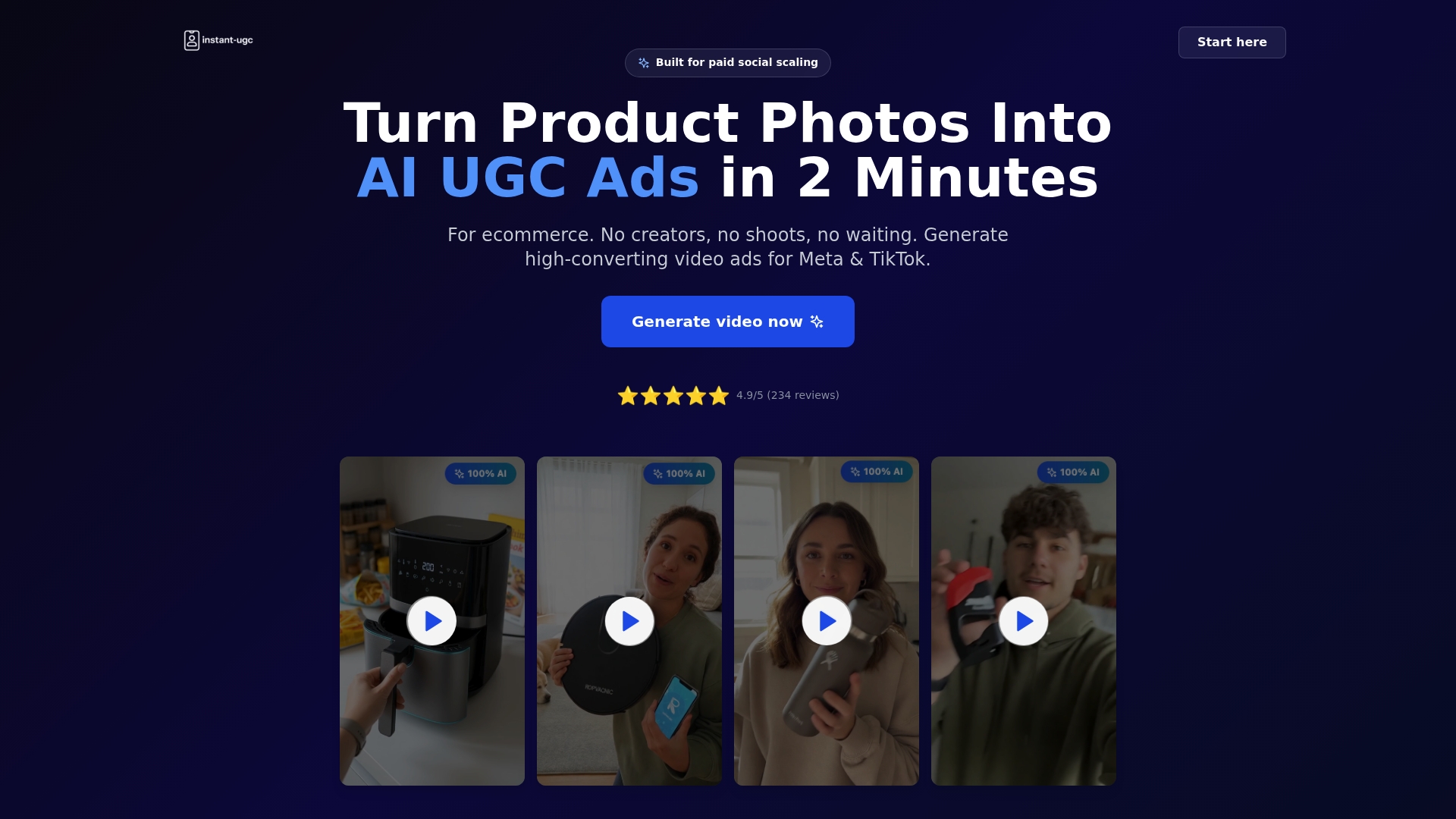
That speed changes what’s possible for the testing cadence described above. Teams use our AI video generator to produce a full batch of hook variants in an afternoon instead of a sprint, run multilingual campaigns without hiring local creators, and generate multi-format assets for YouTube, Meta, and TikTok from a single source image.
A practical way to start: run a $9 single-video test to see the output quality against your current creative, then move to the Starter plan at $19 a month if you like the results, measuring cost-per-result against your control over a two-week window.
- Starter: $19 per month, for teams testing regular creative refresh.
- Growth: $39 per month, for scaling multilingual or multi-format campaigns.
- Pro: $99 per month, for high-volume testing across several brands or clients.
| Plan | Price | Best for |
|---|---|---|
| Test | $9 one-off | Trying a single video before committing |
| Starter | $19 per month | Regular creative refresh |
| Growth | $39 per month | Multilingual, multi-format scaling |
| Pro | $99 per month | High-volume agency or multi-brand use |
Start with a test video on Instant-UGC and compare the cost-per-result against what you’re running today.
FAQ
What is the 3-3-3 rule for marketing?
Definitions of the 3-3-3 rule vary across marketing disciplines, and no single standardized version applies to video advertising specifically. In a video context, the closest useful practice is testing in short, structured cycles, such as three hooks across three formats over a short window, rather than relying on a fixed named rule.
How much does a 30 second TV ad cost?
Traditional 30-second TV ad costs vary enormously by market, network, and time slot, and no single universal figure applies globally. For digital video, costs are more commonly measured through CPV or CPM bidding rather than a flat per-spot rate, which is part of why many brands are shifting budget from TV toward measurable video formats.
What does the 70:20:10 rule mean in advertising?
Applied to video, that experimental slice lines up with the 10 to 20% test allocation recommended for attention-driven optimization and creative experimentation.
How much does CPM cost per 1,000 views?
CPM (cost per thousand impressions) varies widely by platform, audience, and season, so there’s no single figure that applies across the industry. Cost efficiency depends less on the raw CPM number and more on format mix and targeting quality, since Google’s own guidance shows mixing formats like skippable ads and bumpers lowers effective CPM while increasing unique reach.
Does using UGC-style video actually lower ad costs?
UGC-style video tends to cost less to produce than traditional studio shoots and often performs well in testing because it reads as authentic rather than polished. Brands using platforms like Instant-UGC report meaningful efficiency gains, though results depend on creative quality and targeting alongside the format itself.
Sources
- 2025 IAB Digital Video Ad Spend & Strategy Full Report_July 2025
- 2026 IAB Digital Video Ad Spend and Strategy Full Report
- ASC: Find Your YouTube Ads Mix
- YouTube practitioners guide (Google)
