
Performance Creative Strategy: A Data-Driven Playbook for Marketers
Unlock the power of a data-driven performance creative strategy. Achieve better CTR, ROAS, and conversions with actionable insights!
A performance creative strategy is a disciplined, data-informed system that treats every creative element as a measurable variable and iterates it against outcomes like CTR, ROAS, and conversion rate across platforms like Google Ads and Meta. To start within hours: (1) lock your primary KPI and guardrails before touching a brief, (2) launch one controlled test with a clear hypothesis and a defined sample window, and (3) produce assets copy-first using your platform’s native specs. From there, the loop is straightforward: test, measure, scale what wins, archive what you learn.
Key Takeaways
A disciplined performance creative strategy compounds value over time: the teams that tag, archive, and iterate systematically build a creative library competitors cannot replicate.
| Point | Details |
|---|---|
| Lock KPI before briefing | Define the primary outcome metric and guardrail before writing a single brief. |
| Use the 60-20-20 production mix | Allocate 60% to proven concepts, 20% to iterations, and 20% to net-new ideas. |
| Enforce sample-size discipline | Wait for 90–95% confidence before declaring a winner and reallocating budget. |
| Tag and archive every test | Record hook type, proof type, persona, format, and results for every concept run. |
| Use AI to accelerate iteration | AI-generated UGC reduces per-video cost and production time, enabling more tests per cycle. |
Table of Contents
- What is performance creative, and how does it differ from brand creative?
- How to build a performance creative strategy: an 8-step playbook
- How do you measure performance creative correctly?
- How should you organize rapid creative production without losing measurement fidelity?
- What does platform-specific creative look like on Meta, TikTok, YouTube, and Google Ads?
- How do you turn single wins into a repeatable creative library?
- What are the most common performance creative pitfalls, and how do you fix them?
- How does AI-driven UGC accelerate performance creative testing?
- The real priority most teams get wrong
- Sources
What is performance creative, and how does it differ from brand creative?
Performance creative is a data-informed approach that treats creative elements as measurable variables and iterates them against business outcomes. The goal is not aesthetic approval or brand consistency for its own sake. It is a measurable lift in CTR, conversions, CPA, or ROAS. That distinction changes everything: how briefs are written, how success is defined, and how quickly assets are retired or scaled.
Brand creative and performance creative are not enemies, but they operate on different logic.
| Dimension | Brand creative | Performance creative |
|---|---|---|
| Primary goal | Perception and recall | Measurable conversion outcome |
| KPI | Brand lift, awareness | CTR, CVR, CPA, ROAS, pipeline |
| Volume | Low, high-polish | High, iterative, test-ready |
| Evaluation | Qualitative review | Statistical analysis of platform data |
Funnel stage determines which creative goal takes priority. At the awareness stage, the job is stopping power: hook rate and CTR tell you whether the creative earns attention. At the consideration stage, message-fit matters most, and CVR on the landing page becomes the signal. At the conversion stage, the offer and proof elements drive CPA and ROAS. Aligning your creative brief to the funnel stage it serves is the first discipline most teams skip.
How to build a performance creative strategy: an 8-step playbook
The concept unit for any performance creative is persona × angle × offer × format. Every brief should name all four. The playbook below is repeatable across channels and team sizes.
-
Define your outcome and guardrails. Name the single KPI this test must move (e.g., CPA below $45, ROAS above 3.0x). Set a guardrail metric that triggers a pause if crossed (e.g., a high CPM signals audience saturation, not creative failure).
-
Mine insights. Pull platform creative reports, review customer support tickets, read review data, and interview sales or customer success. The best hooks come from the exact words customers use to describe their problem.
-
Form a measurable hypothesis. Use the template: “If we lead with [pain point] + [proof type], then [persona] will [action] at a rate above [benchmark].” A hypothesis without a benchmark is a guess.
-
Design the test. One variable per test. Control versus one variant. Set a minimum sample window before you look at results and ensure a statistically meaningful number of impressions or conversions. Allocate budget so both cells receive comparable delivery.
-
Produce assets copy-first. Write the hook and CTA before opening a design tool. Caption every video. Match platform specs: 9:16 for vertical placements, 16:9 for YouTube in-stream, square for feed fallbacks. The 60-20-20 production mix means 60% of your output replicates proven concepts, 20% iterates on a winning element, and 20% tests net-new ideas.
-
QA and launch. Verify pixel firing, UTM parameters, landing page alignment, and that each ad variant is tagged with its concept attributes before going live. A broken UTM invalidates the test.
-
Analyze by attribute. When results come in, do not just declare a winner. Tag what worked: was it the hook type, the proof format, the persona framing, or the offer structure? Attribute-level analysis is what turns a single win into a repeatable pattern.
-
Scale winners and archive learnings. Move budget to the winning variant. Document the winning attributes, the test conditions, and the audience segment in a shared library. That archive is your compounding asset.
Pro Tip: Test angle first, then offer, then persona, then format. Many teams do this in reverse and spend creative budget on low-leverage format changes while leaving the highest-impact variable, the angle, untested.
How do you measure performance creative correctly?
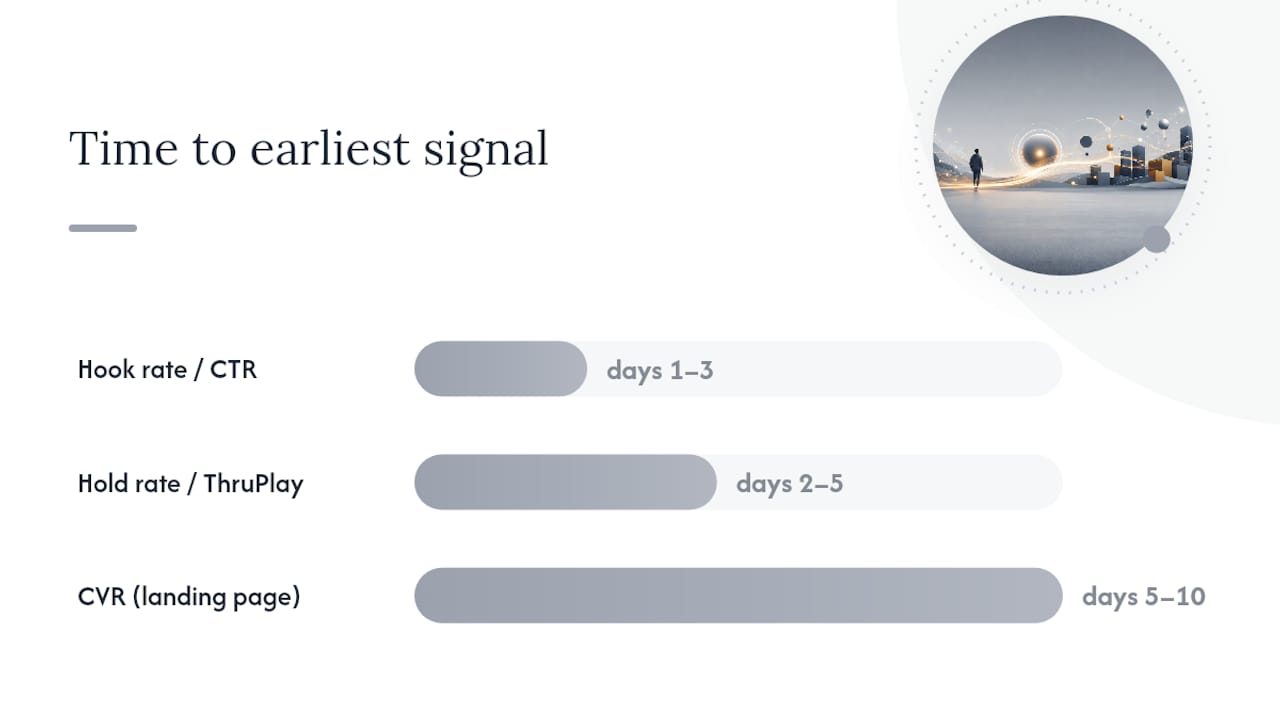
Measurement without a metrics ladder produces bad decisions. Leading indicators tell you whether a creative is earning attention before lagging KPIs have enough data to be reliable. Read them in sequence, not in isolation.
| Metric | Role | Where to measure | Timeframe |
|---|---|---|---|
| Hook rate / CTR | Stopping power | Platform ad manager | Leading (days 1–3) |
| Hold rate / ThruPlay | Attention retention | Platform video metrics | Leading (days 2–5) |
| CVR (landing page) | Message and offer fit | Analytics / landing page tool | Mid (days 5–10) |
| CPA | Cost efficiency | Platform + CRM | Lagging (days 7+) |
| ROAS / pipeline | Revenue impact | CRM / attribution tool | Lagging (days 10+) |
Statistic callout: Google Ads recommends focusing on both the quantity and quality of creative inputs so its AI systems can identify meaningful trends in creative performance. Supplying varied, high-quality assets is a prerequisite for platform-level optimization to work.
Statistical discipline: when to stop and when to scale
The most common measurement error is peeking: checking results after two days, seeing a lift, and reallocating budget before the test has reached a defensible sample size. A strong statistical confidence level is the standard threshold before declaring a winner. In practice, this means waiting until each variant has accumulated enough conversions for the confidence interval to be narrow enough to act on.
For mobile and app campaigns, connecting creative signals to downstream conversion events requires careful attribution setup. View-through windows, SKAdNetwork constraints on iOS, and multi-touch models all affect which creative gets credit. Align your attribution window to your actual purchase cycle before drawing conclusions.
For A/B testing UGC ads, the same statistical discipline applies: define the window, set the threshold, and resist the pull to call it early.
How should you organize rapid creative production without losing measurement fidelity?
Speed without governance produces untraceable results. The goal is a production system where every asset that goes live is tagged, tracked, and attributable to a specific hypothesis.
Roles and responsibilities
A lean RACI for performance creative:
- Creative lead: owns the concept brief, the hook, and the visual direction. Accountable for output quality and volume targets.
- Media owner: owns budget allocation, test structure, and platform setup. Responsible for UTM consistency and audience segmentation.
- Data analyst / data scientist: owns the measurement framework, confidence calculations, and attribute-level reporting. Consulted on test design.
- QA reviewer: checks pixel firing, UTMs, landing page alignment, and asset specs before launch. No asset goes live without QA sign-off.
- Project manager: tracks the production calendar, sprint cadence, and archive hygiene.
QA checklist before every launch
- Pixel fires on the correct conversion event for each placement
- UTM parameters match the naming convention (source / medium / campaign / content / term)
- Landing page URL is live, loads under 3 seconds, and matches the ad’s offer
- Each ad variant has a concept tag in the naming convention (persona, angle, offer, format)
- Creative specs match placement requirements (resolution, aspect ratio, file size, caption file)
Concept brief template
A one-page brief covers: Persona (who sees this and what they believe before clicking), Angle (the single tension or insight the creative exploits), Offer (what the viewer gets and why now), Format (placement, length, aspect ratio, caption requirement). Keeping briefs to this structure prevents scope creep and makes QA faster.
The 60-20-20 production mix gives teams a prioritization rule when capacity is constrained: replicate proven winners first, iterate on a winning element second, and invest in net-new concepts last. This protects revenue while still generating learning.
What does platform-specific creative look like on Meta, TikTok, YouTube, and Google Ads?
Each platform reads creative differently, and the same concept needs adaptation, not just resizing.
Meta (Facebook and Instagram)
The hook must do its work in the first 1–2 seconds of a video or the first line of copy. Meta’s algorithm uses engagement signals (saves, shares, early video retention) to decide delivery, so a weak hook suppresses reach before budget is even spent. For feed placements, 9:16 vertical video performs best. For Reels, native-feeling content with captions outperforms polished production. Measure hook rate and 3-second video views as your leading indicators in Meta Ads Manager. The Facebook AI ads generator can accelerate the production of hook variants at scale.
TikTok
TikTok’s For You Page rewards content that feels native, not advertised. The first frame must create immediate curiosity or pattern interruption. Text overlays, trending audio (where licensed), and a conversational tone outperform scripted spokesperson formats. Target 15–30 seconds for direct-response objectives. Measure In-View rate and video completion rate as leading signals. The TikTok AI ads generator supports the volume of variants TikTok’s algorithm needs to find its audience.
YouTube
YouTube in-stream ads give you 5 seconds before the skip button appears. The hook must name the viewer’s problem or desire before the skip option arrives. For non-skippable 15-second formats, every second carries weight. ThruPlay (watching 30 seconds or to completion) is the leading indicator for consideration-stage campaigns. Thumbnail and title matter for discovery ads. Landscape 16:9 is the primary format, though vertical 9:16 is increasingly supported in Shorts placements.
Google Ads
Google’s Performance Max and responsive search/display formats rely on asset diversity to optimize delivery. Google’s own guidance recommends supplying varied, high-quality creative inputs so the system can identify which combinations perform. Asset-level reporting in Google Ads shows “Low,” “Good,” or “Best” ratings for each headline, description, and image. Use these signals to retire underperforming assets and replace them with new hypotheses. For video assets in Performance Max, 6-second bumpers and 15-second non-skippable formats complement longer in-stream placements.
For format adaptation across all four platforms: always caption video, keep the offer visible within the first third of the creative, and never assume a concept that works on one platform will transfer without a hook rewrite.
How do you turn single wins into a repeatable creative library?
A single winning ad is a data point. A tagged, archived library of winning attributes is a strategic advantage that compounds over time. Competitors can copy your ad. They cannot easily replicate a year of disciplined testing encoded into a searchable library.
Attribute-level tagging
Tag every concept at launch with standardized fields:
- Hook type: pain-led, curiosity, social proof, statistic, question
- Proof type: testimonial, before/after, demo, data point, expert endorsement
- CTA: direct offer, urgency, soft ask, free trial
- Persona: job title or segment, awareness stage, platform
- Format: video length, aspect ratio, caption style, voiceover vs. text-only
Standardizing tags before production begins means your archive is searchable from day one, not retroactively organized after a quarter of messy naming.
Archive structure
- Concept folders: one folder per concept (persona × angle × offer × format), containing the brief, all variants, and the test results snapshot
- Winner metadata: for each declared winner, record the winning attribute, the audience segment, the platform, the test window, the confidence level, and the CPA or ROAS delta versus control
- Snapshot test conditions: log the budget, audience size, bidding strategy, and date range so future teams can replicate or challenge the conditions
Scale-decision rules
Rinse and repeat when a winner holds its performance across at least two audience segments and two budget levels. Re-test with a new audience when a winner plateaus in its original segment but the angle has not been validated elsewhere.
For high-volume operations, tools that scale video ads fast help maintain tagging discipline across large output batches.
What are the most common performance creative pitfalls, and how do you fix them?
Even well-resourced teams hit predictable blockers. Knowing them in advance cuts the recovery time significantly.
-
Creative fatigue: Frequency rises, CTR drops, and CPA climbs. The fix is not pausing spend. It is rotating concepts on a defined schedule, typically when frequency becomes high on Meta or when hook rate drops significantly from its peak. The 60-20-20 production mix exists precisely to keep fresh concepts in the pipeline before fatigue sets in.
-
Premature winner declaration: A variant looks 40% better after three days and $200 in spend. Teams scale it, performance reverts, and the learning is lost. Enforce the minimum sample window and confidence threshold before any budget reallocation. No exceptions.
-
Creative-media misalignment: The media team optimizes for delivery efficiency while the creative team optimizes for brand quality. Neither is tracking the same KPI. The fix is a shared brief that names the KPI, the hypothesis, and the measurement window before a single asset is produced. Weekly creative-media syncs with a shared dashboard prevent the drift from becoming structural.
-
Privacy and tracking degradation: iOS privacy changes, cookie deprecation, and evolving platform attribution models all reduce signal fidelity. Server-side tracking (via Conversions API on Meta, enhanced conversions on Google) partially restores lost signal. First-party data strategies, including email match lists and CRM-based audiences, reduce dependence on pixel-only measurement. Consult your legal and compliance team before implementing any new data collection method, as requirements vary by state and jurisdiction.
-
Siloed teams: When creative, media, and data science operate in separate sprints with separate OKRs, performance creative becomes a handoff process rather than an integrated flywheel. Cross-functional rituals, a shared Slack channel for test results, a weekly 30-minute review, and a single shared KPI dashboard are low-cost fixes that prevent months of misalignment. AI-driven social advertising workflows increasingly require this kind of integrated team structure to operate effectively.
How does AI-driven UGC accelerate performance creative testing?
The production bottleneck is real. Traditional UGC creators generally require multiple weeks and significant expense per video. At that pace, running a disciplined 60-20-20 production mix across three platforms is financially out of reach for most teams.
Instant-ugc addresses this directly. The platform converts product photos or app screenshots into UGC-style video ads in 2–5 minutes, using 10+ customizable AI avatars, automatic script generation, and support for 17 languages. Videos are delivered in 9:16 format in around 1.5 to 2 minutes, at a per-video cost notably lower than traditional production. Brands using the platform report ROAS improvements from approximately 2.1x to 4.8x, alongside a significant reduction in per-video cost versus traditional UGC creators.
A sample workflow for rapid concept validation:
- Upload product photos or app screenshots to Instant-ugc
- Select an AI avatar and language; the platform generates a script automatically
- Review and adjust the hook and CTA to match your current hypothesis
- Export in 9:16 format and tag with concept attributes before uploading to your ad platform
- Launch the variant alongside your control and begin tracking hook rate within 48 hours
Use cases where this workflow delivers the most leverage:
- E-commerce product ads: Test five hook angles for the same product in a single afternoon, rather than waiting three weeks for creator deliveries
- App and SaaS testimonial videos: Generate App Store-optimized, testimonial-style ads without recruiting or briefing human creators
- Rapid concept validation: Produce a low-cost “signal test” for a net-new angle before committing to a full production run
Pro Tip: Authenticity at scale requires variation. Rotate avatars, adjust the opening line, and change the background tone between variants. Audiences notice when the same face appears in every ad, and so does the algorithm.
The AI video generator supports the volume and speed that a disciplined performance creative system requires, without the production overhead that makes most teams under-test.
The real priority most teams get wrong
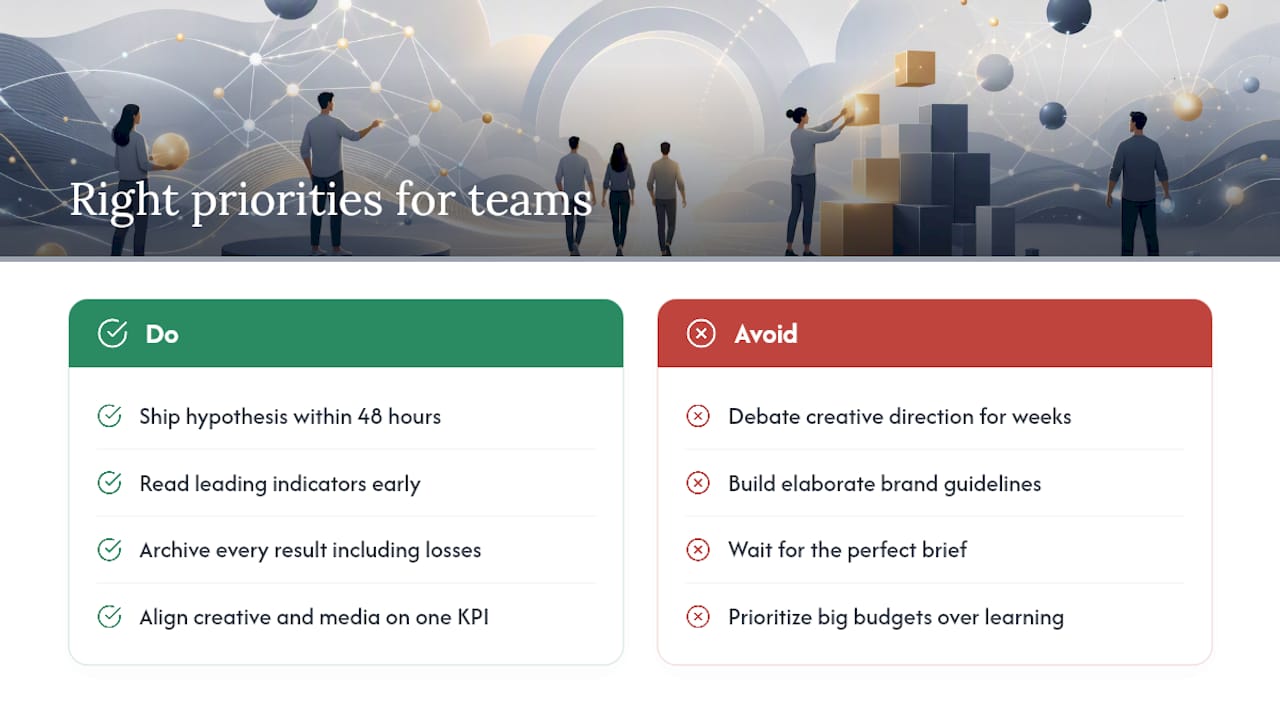
Most teams implementing performance creative for the first time focus on the wrong constraint. They spend weeks debating creative direction, building elaborate brand guidelines for ad formats, or waiting for the “perfect” brief before launching a test. The actual constraint is almost always measurement infrastructure and team alignment, not creative quality.
The teams that compound learning fastest are not the ones with the biggest creative budgets or the most polished assets. They are the ones that ship a testable hypothesis within 48 hours of identifying a question, read leading indicators before drawing conclusions, and treat every result, including a loss, as a data point worth archiving. Speed of learning beats quality of any single asset.
The cultural shift that matters most is not adopting a new tool or a new framework. It is getting creative and media to share a KPI before a brief is written. When those two functions operate from the same number, the flywheel starts. Everything else, the tagging, the archive, the 60-20-20 mix, follows naturally from that alignment.
Sources
The following sources informed this guide and are worth consulting directly for deeper methodology, platform guidance, and vendor detail.
- Support
- Performance Creative Explained: How to Get It Right - Directive
- What Is Performance Creative and How It Drives Better Marketing Results | Power Digital
- Performance creative measurement (AppsFlyer)
Recommended
- Scaling Gadgets Creatives on Snapchat Ads: The Complete AI & UGC Playbook for Gadget Brands | Instant-UGC Blog
- Snapchat Ads Strategy for Home Decor Brands: The Complete Playbook Using AI and UGC | Instant-UGC Blog
- Creative Testing Meta Ads 2026: The Complete Guide to Dynamic Strategy and AI UGC Scaling | Instant-UGC Blog
- Reducing Content Costs for Baby Products with AI: A Practical Playbook for Marketers | Instant-UGC Blog
