
UGC Ads: Test Dozens Cheaply, Scale Winners for Ecommerce SMBs
See how ecommerce SMBs use AI to produce dozens of low cost UGC video variants, then scale winners with creator reshoots where trust matters.
For most e-commerce SMBs, an AI-first, template-driven workflow delivers the lowest sustainable cost per UGC-style video, often under single-digit dollars per variant, while preserving test speed and scale. We recommend this route for high-volume testing, with Instant-UGC as a direct way to put it into practice. The trade-off is simple: AI variants win on cost and speed, while human creators still earn more trust in categories where authenticity carries extra weight.
TL;DR:
- Generate 20 to 50 AI variants weekly, run modestly funded tests, and commission creator reshoots only when a concept wins or needs more emotional depth.
- Use human creators for skincare, finance, and health, where credibility matters; AI avatars suit early tests, while proven concepts may need emotional reshoots.
- Disclose compensation clearly in video captions or on screen, and never present an AI avatar as a real customer without clarifying the content.
Table of Contents
- Overview of Low-Cost UGC Production Methods
- Cost Breakdown: What Low-Cost UGC Actually Costs
- Tactical Playbook: Lowering Your Per-Video Cost
- Scaling and Creative Testing Workflow for Volume
- Disclosure, Endorsements, and Advertising Rules You Must Follow
- How Instant-UGC Solves Low-Cost UGC Production
- When to Trust AI Variants and When to Hire a Creator
- Get Low-Cost UGC Ads Running Today
- FAQ
- Sources
Overview of Low-Cost UGC Production Methods
Four distinct methods dominate affordable UGC production today, and each fits a different job in your funnel. Freelance creators shoot custom content for a fee, marketplaces connect brands with a pool of creators at set rates, AI avatar generators produce video from text or photos without a shoot, and hybrid workflows blend the two for different stages of testing and scaling.
Freelance creators typically take one to three weeks per batch and work best for retargeting or final-scale ads where a recognizable face builds trust. Marketplaces compress that timeline somewhat by offering a roster of vetted creators, but briefing, revisions, and payment cycles still add days. AI avatar platforms compress turnaround into minutes rather than weeks, making them suited to cold prospecting, rapid hook testing, and app or SaaS testimonial videos where volume matters more than a single hero asset.
Here’s how the four methods map to typical use cases:
- Freelance creators: best for final-scale retargeting ads and categories where a known face builds trust.
- Marketplaces/self-service: useful for mid-volume campaigns needing creator variety without managing individual freelancers.
- AI avatar generators: ideal for cold prospecting, hook testing, and app or SaaS testimonial-style ads at volume.
- Hybrid workflows: combine cheap AI variants for testing with creator reshoots for winning concepts.
Platforms like Instant-UGC sit in the AI avatar category but extend into hybrid territory, since brands can generate dozens of cheap variants first and hand proven winners to a creator for a final human pass. That flexibility is what makes an AI-first approach practical rather than purely theoretical for teams with limited production budgets.
Cost Breakdown: What Low-Cost UGC Actually Costs
Cost ranges vary sharply by method, and understanding them is the first step to building a realistic UGC budget. Creator-made UGC commonly runs from roughly $100 to $500 per clip depending on experience tier, with higher-tier creators charging more and turnaround stretching into weeks rather than days. AI avatar and synthetic-video tools, by contrast, publish list prices that can put a single short clip in the low-dollar range, which is what makes high-volume testing financially realistic for smaller teams.

One in 2026 reality worth noting: consumers still largely prefer human-created content over AI-generated content in many contexts, according to Ipsos research. That preference gap is the reason cost alone should not dictate which method you use at every funnel stage.
A worked example makes the math concrete. Say you want to test 20 ad variants for a new product launch before committing budget to a winner.
- Script generation: using an AI-first workflow, scripts and hooks are generated automatically, with no separate copywriting cost.
- Video generation: at roughly $5 to $9 per clip using an AI platform’s per-video or credit-based pricing, 20 variants cost in the low hundreds of dollars total.
- Compare to creator-made: the same 20 variants sourced from freelance creators would cost several thousands of dollars, with a production timeline measured in weeks instead of hours.
- Net result: the AI-first batch lets you test ten to twenty times more creative concepts for a fraction of the spend, before you ever commit to a larger creator shoot for the winning concept.
This is the mechanism behind the entire low-cost UGC playbook: spend small amounts generating many variants, then reserve larger creator budgets only for validated winners.
Tactical Playbook: Lowering Your Per-Video Cost
Reducing cost per video is less about finding cheaper vendors and more about building a repeatable system. A handful of tactics consistently separate teams that run lean UGC operations from those that overspend on every batch.
- Batch and reuse templates: design a small set of reusable scripts and visual templates, then generate multiple product variants from each one instead of starting from scratch every time.
- Test hooks cheaply, scale winners with creators: generate dozens of opening hooks through an AI workflow, identify which ones convert, then invest in a creator reshoot only for the proven concepts.
- Repurpose and optimize formats: export every video in 9:16 for Meta and TikTok, add captions for sound-off viewing, and generate multiple thumbnail options from the same clip.
- Control production costs: keep creative briefs short and specific, fix deliverable specs up front (length, aspect ratio, caption style), and favor subscription or credit-based pricing over one-off project fees.
- Fix audio before worrying about visuals: a cheap lavalier microphone often does more for retention than better lighting, since poor audio is one of the fastest ways to lose a viewer in the first three seconds.
Pro Tip: Standardize your lighting and audio setup once, document it in a one-page brief, and reuse that brief for every creator or AI prompt so quality stays consistent without added cost.
These tactics compound. A brand that batches scripts, tests hooks cheaply, and fixes audio early typically needs far fewer total variants to find a winner, which lowers blended cost per successful ad even before you factor in raw per-clip pricing.
Scaling and Creative Testing Workflow for Volume
A reliable testing cadence is what turns cheap individual videos into a cost-efficient campaign engine. The core principle is “test many, scale few.” Generate a large batch of inexpensive variants, run short tests to find the handful that work, then pull the losers and replace them on a fixed schedule.
- Generate variants in batch: produce 20 to 50 AI-driven variants weekly, varying hooks, scripts, or avatars while keeping the core product message consistent.
- Run micro-tests: launch all variants with modest ad spend across Facebook Business Manager or TikTok Ads Manager, letting the algorithm surface early signal on click-through and conversion.
- Tag and promote winners: flag the top performers by hook type and claim, then shift budget toward them while pausing the rest.
- Queue human reshoots for standout winners: when a variant clears your conversion threshold or needs more emotional depth than an avatar can deliver, commission a creator reshoot of that specific concept.
- Repeat on a weekly cadence: treat this as an ongoing loop rather than a one-time project, replacing creative before performance decays rather than after.
Watching week-over-week CPM trends gives you an early signal that an asset is fatiguing, so you can queue a replacement before costs climb. For a deeper framework on structuring these tests, our guide to UGC testing platforms walks through how to set up ongoing creative pipelines, and our A/B testing guide covers how to read results with statistical confidence. One agency’s framework for linking creative testing rigor to platform wins offers a useful complement if you want a broader measurement lens.
This cull-and-replace rhythm is also what lets AI-first testing feed naturally into human production: the AI layer finds what works, and the creator layer executes it at a higher trust level for the audiences that need it.
Disclosure, Endorsements, and Advertising Rules You Must Follow
Low-cost production does not reduce your compliance obligations. The FTC’s Consumer Reviews and Testimonials Rule states that brands can be liable for fake or undisclosed endorsements and requires clear disclosure whenever an endorsement is compensated. Separately, CFR Part 255 explains that failing to clearly disclose a material connection in an endorsement or testimonial counts as a deceptive practice, with specific examples of required disclosure language.
A short checklist keeps your UGC program compliant:
- Add a disclosure line (“Paid partnership” or “Ad”) directly in the video caption or on-screen text, not buried in a bio or description.
- Record compensation or free-product exchanges in every creative brief and invoice, including for AI-generated testimonial-style content.
- Avoid presenting AI-generated avatars as real customer testimonials without clarifying the nature of the content.
How Instant-UGC Solves Low-Cost UGC Production
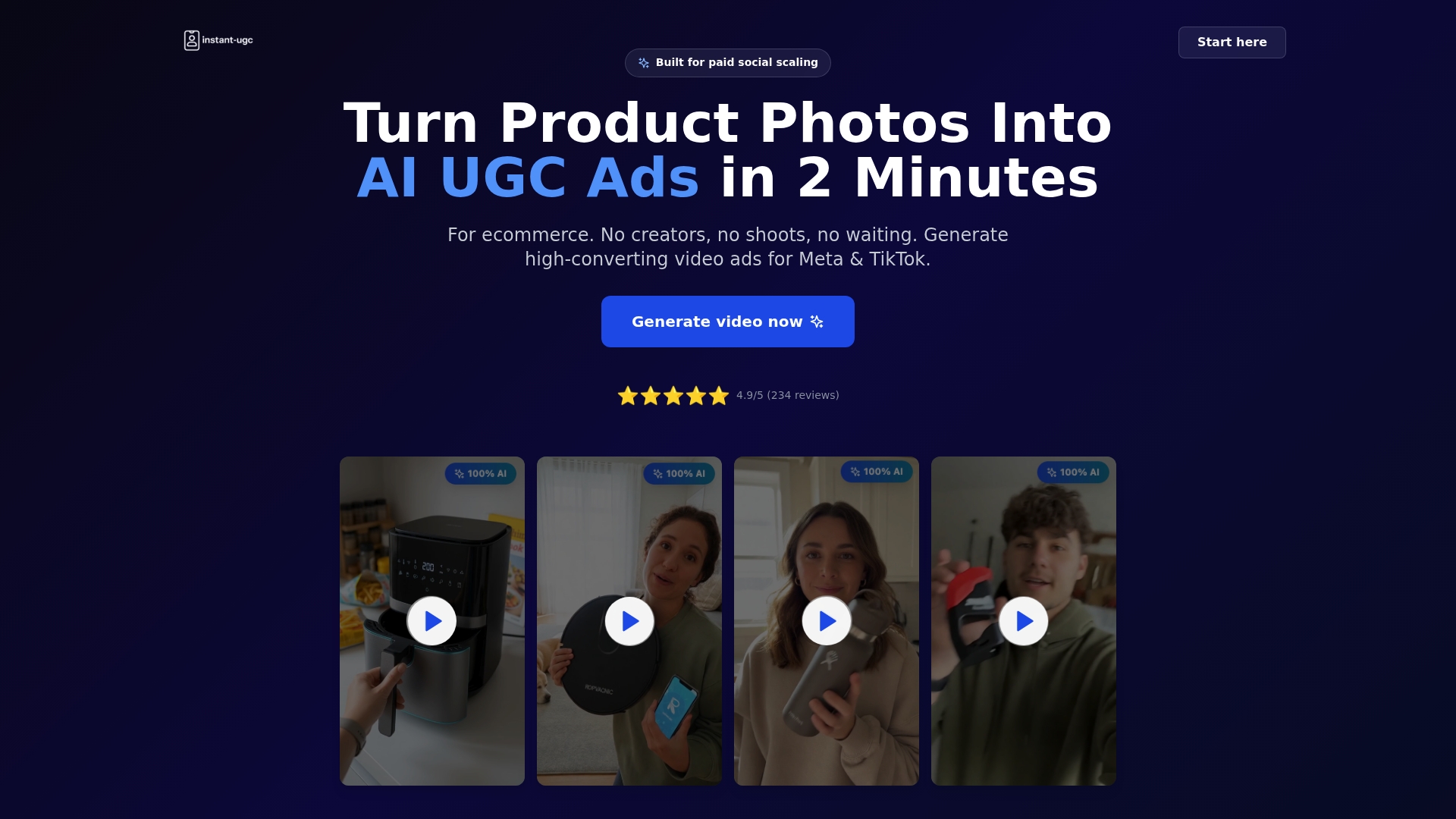
Instant-UGC offers a service that turns a single product photo or app screenshot into a finished video ad quickly, using customizable AI avatars and automatic script generation across multiple languages. Two dedicated workflows separate physical product brands (Shopify, Amazon FBA, dropshipping) from app and SaaS companies that need App Store-optimized testimonial-style videos.
- Speed: full video generation in under two minutes, versus weeks for a traditional creator shoot.
- Cost: videos priced in the low-dollar range each, compared with hundreds of dollars per clip for creator-made content.
- Reach: 17 supported languages and more than 10 avatars for testing across markets and audiences.
- Workflow fit: separate paths for physical products and app/SaaS testimonials, so the output matches the platform you’re advertising on.
To fit this into the testing cadence described above, generate your weekly batch of variants through such a platform, run micro-tests across your ad accounts, and route only the validated winners to a human creator for a final-scale version. For readers who want a closer look at the generation process itself, our page on AI UGC ads from one product photo walks through the mechanics.
When to Trust AI Variants and When to Hire a Creator
Our stance: run AI-first for every early test, but graduate your winning concept to a human creator once trust becomes the bottleneck, not volume. Two signals tell you it’s time: your category depends on visible personal credibility (skincare, finance, health), or your AI variant has already won its test and now needs an emotional reshoot to convert at the next funnel stage. Cost should drive testing. Trust should drive scaling.
— Syno
Get Low-Cost UGC Ads Running Today
We built Instant-UGC so you can generate dozens of inexpensive, on-brand video variants in minutes instead of weeks, then scale whichever ones convert.
| Plan | Price | Best for |
|---|---|---|
| Test | $9 one-off | Trying a single video before committing |
| Starter | $19 per month | Small, ongoing variant testing |
| Growth | $39 per month | Scaling winning concepts across markets |
Start your first batch of variants on the Instant-UGC plans page and see how fast a low-cost test can turn into a scalable campaign.
FAQ
How to make UGC ads for free?
You can shoot basic UGC-style content yourself with a smartphone and a lavalier microphone, which covers the production cost entirely. Free tools exist for editing and captions, but achieving scale without any financial cost usually means investing your own time, since someone still has to script, shoot, and edit each variant.
How much do UGC ads cost?
Creator-made UGC commonly runs from roughly $100 to $500 per clip depending on experience tier, while AI-generated video can cost as little as $4 to $7 per video on platforms like Instant-UGC. The right choice depends on whether you’re testing many concepts cheaply or producing a final asset for retargeting.
What is the cheapest platform to advertise on?
There’s no single cheapest ad platform across every market, since costs shift with audience, season, and bidding competition. What you can control directly is production cost: pairing a low-cost AI-first video workflow with whichever platform your audience already uses keeps your overall campaign cost down regardless of ad rates.
How much are Instagram ads per 1000 views?
Instagram ad costs per 1,000 views vary by audience, industry, and season, and no single rate applies across every campaign. Rather than chase a fixed benchmark, focus on lowering your cost per creative variant so you can test more and find efficient placements faster.
Do I need to disclose AI-generated UGC ads?
Yes, disclosure rules apply regardless of whether content is AI-generated or creator-shot. The FTC’s endorsement guidance requires clear disclosure of compensated endorsements and prohibits presenting fake endorsements as genuine customer experiences.
Sources
- The Consumer Reviews and Testimonials Rule: Questions and Answers | Federal Trade Commission
- PART 255—GUIDES CONCERNING USE OF ENDORSEMENTS AND TESTIMONIALS IN ADVERTISING
- People still largely prefer humans create content — not AI | Ipsos
