
Home Goods UGC Ads: Creator vs AI, From Brief to Launch
See how homeware brands use creator made and AI generated UGC, retailer results, platform specific formats, and a launch checklist to test ads faster.
UGC-style short video is the highest-leverage creative for home goods because it shows products in real rooms, closing the sensory gap that photos leave open. Sites with UGC galleries keep visitors on the page 90% longer, and tools like Instant-UGC let you test concepts in minutes. Below: formats, creator workflows, costs, and measurement.
TL;DR:
- For TikTok and Reels, use vertical clips lasting 3 to 15 seconds, show the room immediately, and establish scale with a person or moving hand.
- Use AI clips to test hooks and scripts cheaply, then ask real creators to remake winners; creator production can take weeks.
- Choose one primary metric before launch: view through rate for awareness or add to cart for direct response; change only the opening across variants.
- AI video plans cost $9 for a one time test, then $19, $39, or $99 monthly; creator videos also require shipping and management.
Table of Contents
- Why UGC works for home goods and what it fixes
- High-impact UGC formats for each platform
- Creator options and their trade-offs
- Brief, logistics, QA, and launch: a step-by-step checklist
- What creator-made and AI-generated UGC cost
- Measuring success: metrics and benchmarks
- Three rules we follow when building home UGC programs
- Why try Instant-UGC for fast ad production
- FAQ
- Sources
Why UGC works for home goods and what it fixes
Nobody can feel a sofa through a screen. Shoppers can’t judge scale, true color, fabric texture, or how a lamp looks in evening light. A customer filming her own living room answers those questions faster than any studio shot.
The evidence from home retailers points the same way:
- Retail video that shows products in context helps shoppers visualize them, and Wayfair and Sephora layered YouTube video with shopping features to drive sales and brand lift.
- Rivièra Maison put customer photos on product pages and collected over 50,000 images, with a 15.59% interaction rate on that content.
- Reviews matter most on big-ticket items: online reviews rank as the top purchase influence for furniture, per Provoke Insights.
UGC can help support conversions when it sits in the purchase path, according to Pressloft’s UGC principles for interior brands. That is the case for galleries on product pages, not just social posts.
The engine behind all of this is a flywheel. Prompt buyers through post-purchase emails, packaging inserts, and a branded hashtag, then repost what they create so the next buyer sees a real home, not a showroom.
High-impact UGC formats for each platform
Each channel rewards a different shape of video, so build to the platform instead of resizing one master file.
- TikTok and Reels: vertical clips of 3 to 15 seconds built for discovery. Land the hook in the first one to three seconds, and show the room, not just the product, so scale is obvious.
- Meta in-feed and Stories: pair short video with carousels for remarketing. Shoppers who already viewed a rug respond well to a customer clip of that same rug in a hallway.
- YouTube: longer how-to and haul formats with product cards suit consideration-stage buyers. Homebase worked with a creator on a “homehaul” and a shopping campaign, and sales of the showcased products increased.
- On-site: galleries and product-page embeds cut uncertainty right where the purchase decision happens.
Pro Tip: Open every vertical ad with a hand or a person moving through the room. Motion plus a human body gives instant scale cues.
Formats that work especially well for homeware include move-in vlogs, unboxings, before-and-after reveals, and styled customer galleries. Dash’s homeware roundup shows each in action.

Creator options and their trade-offs
Several workflows can suit home brands. Which one fits depends on how much you value authenticity, speed, and volume.
- Creator-produced UGC: the most authentic option, since real people film real homes. You manage briefs, shipping, revisions, and usage rights, so it takes the most coordination.
- Micro-influencers: best when your style is niche, such as Scandinavian minimalism or farmhouse decor. Their followers often live in similar homes. Repeat collaborations with the same creators and a shared hashtag feed your flywheel.
- Marketplaces and vetted creator pools: these give you curation and a faster start. The trade-offs are per-video fees and uneven quality, so plan on a review step before anything goes live.
- AI-generated UGC: the fastest and cheapest path, and the best fit for testing hooks, scripts, and angles before you commit real budget. We break down how it compares with human creators in our AI UGC vs real creators for home decor guide.
Most brands land on a mix: AI for rapid testing, creators for the concepts that prove themselves.
Brief, logistics, QA, and launch: a step-by-step checklist
You can run a first test by following a fixed order.
- Set the goal. Pick awareness or direct response, name your audience, and choose one primary metric: ROAS, add-to-cart, or view-through rate.
- Write a short brief. Require a few shots: a room-wide view, a product close-up, the product in use, and a before-and-after. Add optional lifestyle cuts and a line on tone.
- Handle logistics. Ship samples early, put licensing and usage terms in writing, set a review window, and cap the number of edit rounds.
- Run creative QA. Check framing, scale cues, product visibility, and that any voiceover or on-camera consent is documented.
- Test in volume. Launch a batch of creatives with rotating hooks, and set a clear time frame for keep-or-kill decisions.
Pro Tip: Change only the opening between variants. That isolates the hook as the variable and tells you what to scale.
For a deeper look at hook design, this UGC creative strategy for DTC brands walks through lowering acquisition cost with stronger hooks. If you want to compress the testing cycle, our page on accelerating ad creative testing covers how we approach it.
What creator-made and AI-generated UGC cost
Budget and timeline are the biggest practical differences between the two models.
- Creator-made: you pay per video plus shipping and management time, and delivery depends on creator schedules and revision rounds. Plan for weeks, not days.
- AI-generated: we deliver videos in minutes at a low per-video cost. Our Test plan is a one-time $9, Starter is $19 per month, Growth is $39 per month, and Pro is $99 per month.
- Splitting spend: put most early budget into testing cheap variants, then move spend to the winners, including creator remakes of top concepts.
Sites with UGC galleries see 90% more time on site (Pressloft), so even a modest content budget can pay back through on-site use alongside ads.
Measuring success: metrics and benchmarks
Match each metric to your goal, or you will optimize the wrong thing.
| Metric | Best for | What it tells you |
|---|---|---|
| View-through rate | Awareness | Whether the hook holds attention |
| Click-through rate | Consideration | Whether the concept earns interest |
| Add-to-cart | Direct response | Whether viewers want the product |
| ROAS | Scaling | Whether spend is paying back |
On site, watch time on page and gallery interaction. Rivièra Maison’s customer-photo program illustrates how UGC can support engagement.
UGC ads can help improve click-through rates, according to Pressloft. Treat that as a possibility, not a promise. Set your own baseline from your first test, then iterate until creative stops improving.
Three rules we follow when building home UGC programs
Most advice on UGC treats authenticity as a vibe. I think it is a mechanic: show scale early, or viewers scroll before they ever see the product. Rule two is to use AI-generated clips for test-and-learn, then hand the winning concepts to real creators, because cheap volume finds the idea and human footage earns the trust. Rule three is to tag every variant and rotate often, since fatigue hits fast on repeat audiences.
— Syno
Why try Instant-UGC for fast ad production
Home brands rarely lack ideas. They lack the volume of creative needed to find the winners. We built our platform to fix that: upload a product photo, and we render a UGC-style video in minutes, complete with customizable AI avatars, automatic script generation, and support for 17 languages.
That speed turns creative testing from a quarterly project into a weekly habit. Our home decor and furniture ad templates are built for exactly the room-context shots this guide recommends, and our AI video generator shows how the workflow runs end to end.
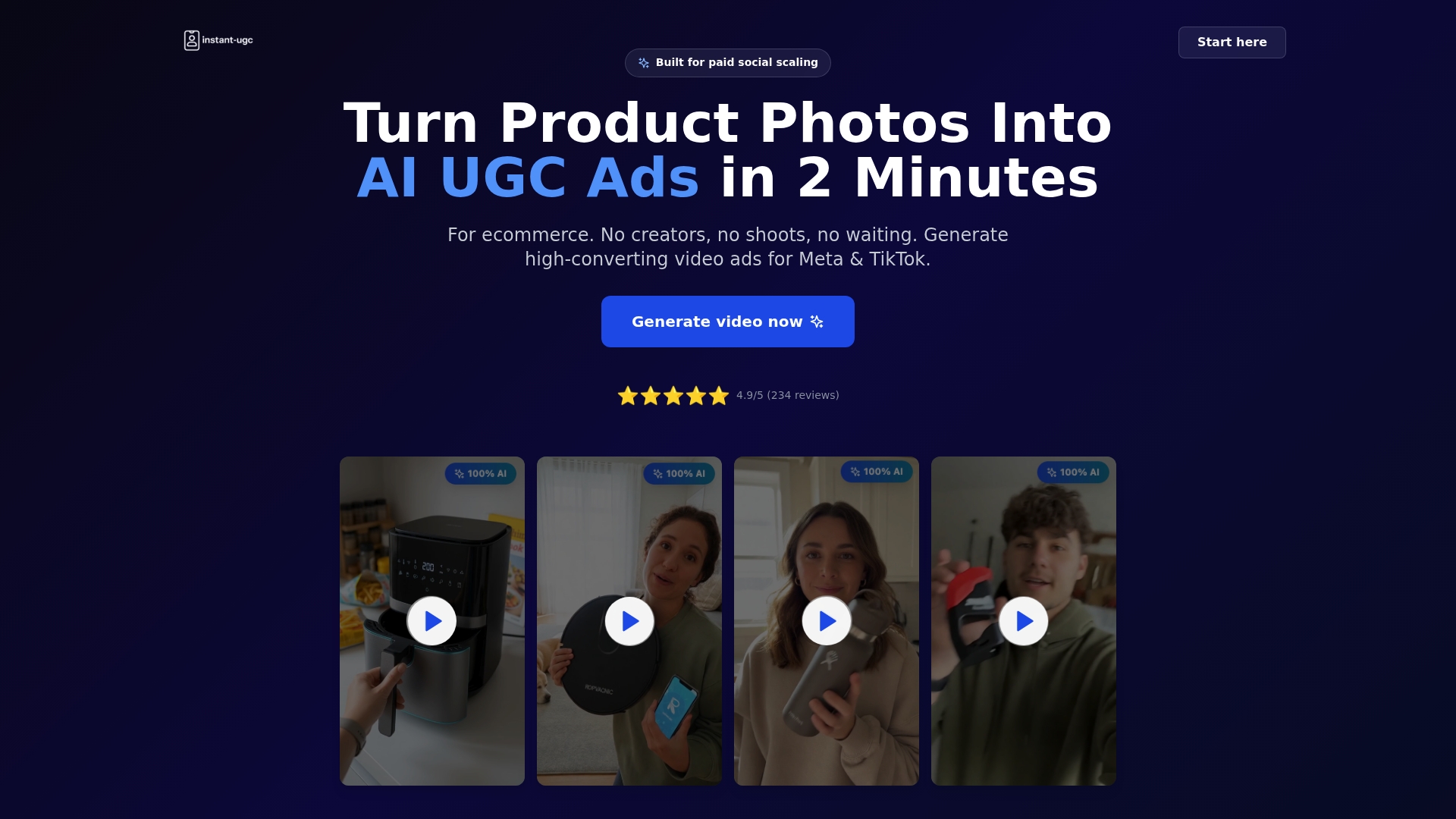
Start small: generate a batch of variants and see which hooks win. Test Instant-UGC on your own products.
FAQ
What brands pay for UGC content?
Home, beauty, apparel, and app brands all pay creators for UGC, usually per video, plus usage rights. Any brand running paid social needs a steady supply of fresh creative, so demand is broad.
How do I find brands that need UGC?
Look at who is running active video ads in your niche and which brands repost customer content. Home brands that use hashtags and customer galleries, as described in Bazaarvoice’s UGC guidance, are often open to creator partnerships.
Who are the biggest home decor influencers?
Rankings change quickly and no single list is authoritative. A better approach is to look for micro-influencers whose homes match your product style, since fit often matters more than follower count.
Is UGC better than studio content for home goods?
For showing scale and real-room context, UGC-style video usually does the job studio shots cannot. Many brands keep both: studio images for clarity, UGC for trust and inspiration.
Sources
- Wanting more from their YouTube videos, retailers Wayfair and Sephora layered them with TrueView for shopping, which drove sales and increased brand lift.
- User Generated Content Principles for Interior Brands & Blogs
- Casestudies
- The 10 best UGC examples from homeware brands
