Dropshipping Video Ads That Actually Convert in 2026
Learn how to create high-converting dropshipping video ads with AI tools in under two minutes. Boost your CTR and sales today!
The fastest path to high-converting dropshipping video ads is UGC-style short vertical video, produced at scale with an AI UGC tool like Instant-ugc. Skip the two-week creator turnaround. Upload your product photos, generate four variants in under two minutes, and run a $300–$500 validation test before you spend another dollar on inventory.
Every ad that works in 2026 earns its first three seconds. Your opening frame must deliver:
- A pattern-interrupt hook — movement, bold text, or a surprising visual that stops the scroll
- A product reveal — the item on screen within the first two seconds, not buried after a logo
- A quick demo or problem signal — show the product doing something, or name the pain it solves
- A clear CTA — one action, stated plainly (“Get yours for 50% off today”)
Video CTR for dropshipping ads runs 1.8–3.5% for top video creatives, compared to 0.6–1.2% for image ads — a gap wide enough to determine whether a product lives or dies in testing.
Key Takeaways
AI-generated UGC-style video ads, produced at volume and tested with a structured $300–$500 budget sequence, are the most cost-efficient path to finding a winning dropshipping creative in 2026.
| Point | Details |
|---|---|
| Video outperforms images | Video CTR runs 1.8–3.5% vs. 0.6–1.2% for image ads; prioritize video from day one. |
| Four variants, one test | Produce 2 hook × 2 style variants and validate with $300 over three days before scaling. |
| Specs matter | Export 9:16 primary, plus 4:5 and 1:1 crops as separate files for Meta and TikTok placements. |
| Hook rate is your first signal | A 3-second hook rate above 25% means the opening works; below 15%, kill the variant. |
| Instant-ugc cuts production time | Instant-ugc generates a 9:16 UGC-style video from a product photo in 90–120 seconds at $4–$7 per video. |
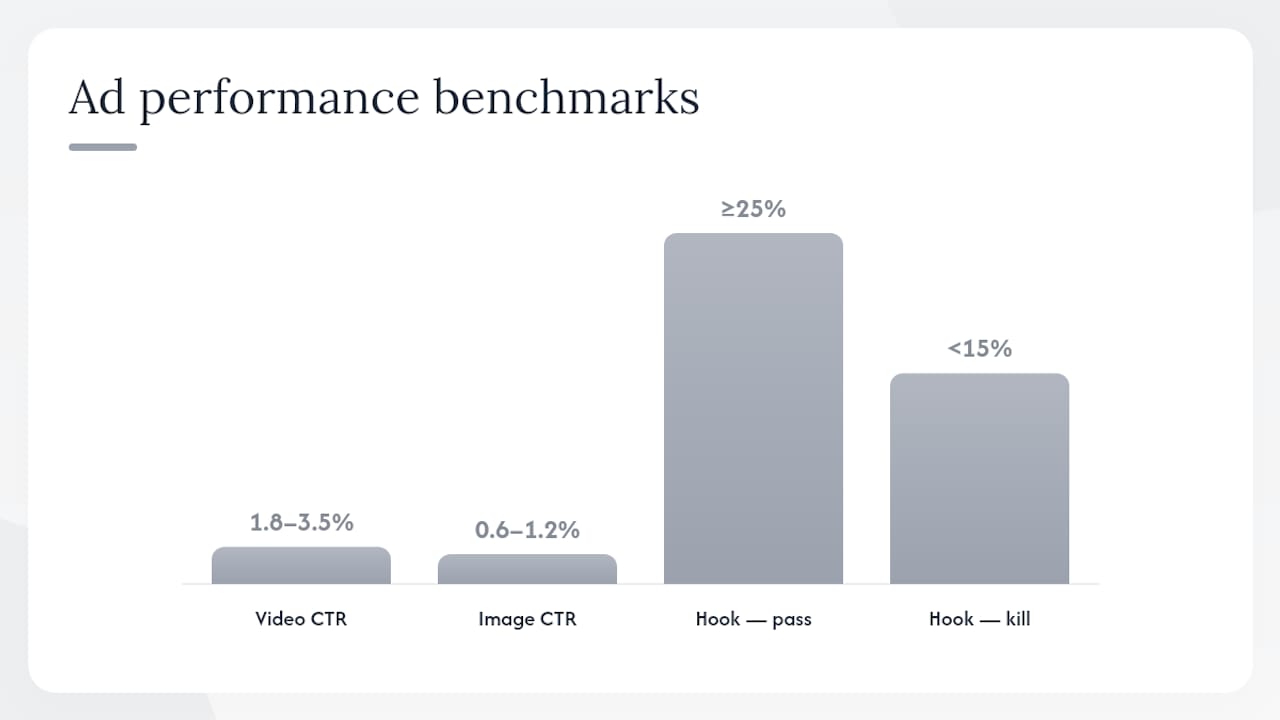
Table of Contents
- How to create and launch a dropshipping video ad fast
- Creative formulas and script templates that perform
- Platform specs and production rules for TikTok, Reels, and Meta
- How to test creatives, read early signals, and scale winners
- How Instant-ugc speeds production and the results it delivers
- Legal and copyright considerations for AI-generated and UGC content
- How to source authentic UGC for dropshipping products
- What top-performing dropshipping video ads actually look like
- When volume-first AI production beats a hero creative
- Instant-ugc gets your first dropshipping video ad live today
- Sources
How to create and launch a dropshipping video ad fast
Follow this sequence from brief to live ad. You can complete steps 1–5 in a single afternoon with AI-assisted production.
- Validate the product and offer. Confirm your margin covers a competitive CPM rate, your supplier ships within about one to two weeks to the US, and you have at least two product photos with clean backgrounds.
- Write a 15–30 second UGC-first script. Use the structure: hook (0–3s) → problem agitate (3–10s) → solution/demo (10–18s) → social proof signal → CTA. This four-part structure is the benchmark format across 2026 playbooks for TikTok and Meta.
- Gather your assets. Two to three product photos and one short clip (even a 5-second unboxing) are enough. If you have no clip, product images fed into an AI video generator work as a starting point.
- Generate four variants. Produce two hook variants (curiosity gap vs. problem statement) × two style variants (voiceover only vs. on-screen text overlay). Four videos gives you enough signal without diluting your test budget.
- Export to spec. Primary output: 9:16 at 1080×1920. Also export 4:5 for Meta feed and 1:1 for square placements. Add captions to every version — a large share of TikTok and Reels viewers watch without sound.
Pro Tip: Before uploading, run a 30-second preflight check: confirm the product is visible in the first frame, captions render correctly on a mobile screen, and the CTA text matches your landing page offer. Mismatched offers are one of the most common reasons a technically solid ad fails to convert.
Creative formulas and script templates that perform
The hook is the only part of your ad that is truly non-negotiable. Nail it, and the rest of the video has a chance. Miss it, and nothing else matters.
Five hook patterns worth testing:
- Curiosity gap: “I didn’t believe this $18 gadget could replace my $200 one — until I tried it.”
- Visual demo: Open mid-action (product already in use, no intro, no logo).
- Problem statement: “If your [problem] is ruining your [daily routine], watch this.”
- Before/after: Split-screen or rapid cut showing the before state, then the product result.
- Novelty discovery: “This just dropped and it’s already sold out twice — here’s why.”
Three script templates by length:
15-second script (TikTok/Reels impulse): Hook (0–3s): Visual demo, no words. | Problem line (3–7s): “Tired of [pain point]?” | Solution (7–12s): Product demo close-up, one benefit stated.
22-second script (Meta feed, mid-funnel): Hook (0–3s): Bold on-screen text + product reveal. | Problem agitate (3–10s): Voiceover names the frustration. | Demo (10–18s): Show the product solving it. | Social proof overlay (18–21s): “10,000+ sold.” | CTA (21–22s): “Shop now.”
30-second script (Meta feed, demo-heavy products): Hook (0–3s): Surprising visual or stat. | Problem (3–8s): Relatable scenario. | Demo (8–22s): Step-by-step product use. | Social proof (22–27s): Review quote or star rating overlay. | CTA (27–30s): Offer + urgency.
For caption testing, run two variants per ad: Caption A leads with the primary benefit (“Finally, a [product] that actually works”), while Caption B leads with scarcity (“Only 47 left — selling fast”).
Adapting scripts by niche: Tech gadgets respond to spec-forward hooks (“This charges your phone in 20 minutes flat”). Pet supplies perform best with emotional problem-first hooks (“My dog refused to eat — until we switched”). Baby products need trust signals early — a reassurance line in the first five seconds (“pediatrician-approved” or “BPA-free”) consistently lifts watch time.
Platform specs and production rules for TikTok, Reels, and Meta
Getting specs wrong wastes creative. Here are the non-negotiable numbers for each major placement.
A few rules that save wasted spend:
- Keep all text and faces within the safe zone — 14% from the top and bottom edges on TikTok, where UI elements overlap.
- Export each ratio as a separate creative file and upload them individually. Do not let the platform auto-crop your 9:16 for a 1:1 placement — the result almost always cuts the product out of frame.
- For Meta feed, 30–60 seconds works when your product genuinely needs a demo. For impulse items under $40, stay at 15–30 seconds.
- Sound-on is the TikTok default, but burned-in captions still lift completion rates. Silent-first viewing dominates Meta feed — design for both simultaneously.
Producing in 9:16 as your primary format and cropping down to 4:5 and 1:1 is the most efficient export workflow. Build your composition for 9:16 first, then verify the crop before uploading.
How to test creatives, read early signals, and scale winners
Testing without a framework is just spending. Use this structure to make decisions with confidence.
Validation sequence (Week 1):
- Run four videos at $25/day each for three days ($300 total).
- At day 2, check your 3-second hook rate — the percentage of viewers who watch past the three-second mark. A hook rate above 25% signals the opening is working. Below 15%, kill that variant.
- At day 3, compare CTR. Industry benchmarks for top video creatives range from 1.8–3.5%. Anything below 1% on a cold audience after 500+ impressions is a signal to pause.
Conversion test (Week 2):
- Take your top two performers and push $50/day each for two days ($200 total).
- Target a CPA at or below 30% of your product’s selling price. If your product sells for $49, a CPA above $15 warrants a creative revision before scaling.
- ROAS above 3.5x on a conversion test is a scaling signal. Top-performing dropshipping video creatives can reach 3.5–5.0x ROAS in the top 20% of campaigns.
Variant and scaling strategy:
- Change one variable per test: hook only, CTA only, or text overlay only. Changing multiple elements at once makes it impossible to know what moved the needle.
- Run one campaign per product, test 3–5 ad sets, and use Advantage+ Shopping Campaigns or broad targeting for cold audiences. Narrow targeting at the test stage wastes budget on audience-level assumptions.
- To scale a winner, duplicate the winning ad set and increase budget by 20–30%. Avoid editing a live winning ad set — the algorithm resets its learning phase.
- For multilingual expansion, generate the same script in additional languages using an AI video generator with multi-language support before duplicating ad sets into new markets.
A subtle sync error reads as fake to viewers and tanks trust.*
How Instant-ugc speeds production and the results it delivers
Instant-ugc takes the production bottleneck out of the workflow described above. Upload a product photo, select an AI avatar from 10+ options, and the platform auto-generates a script and outputs a platform-ready video in 90–120 seconds in 9:16 format.
Inside the workflow:
- Brief: Paste your product URL or upload photos. Add a one-line hook direction if you have one.
- Script generation: The platform generates a UGC-style script automatically. Edit it or accept it.
- Avatar selection: Choose from 10+ AI avatars. Match the avatar’s demographic to your target buyer.
- Generate and export: Produce your primary 9:16 version, then export 4:5 and 1:1 crops for Meta placements.
- Multilingual variants: Regenerate the same video in a second language for international ad sets. Instant-ugc supports 17 languages, so scaling to Spanish, French, or German markets adds minutes, not days.
AI ad creators perform best when briefed with structured competitive research and clear format specs — not just a product URL. Feed Instant-ugc a strong hook direction and a defined CTA, and the output quality improves substantially over a bare URL submission.
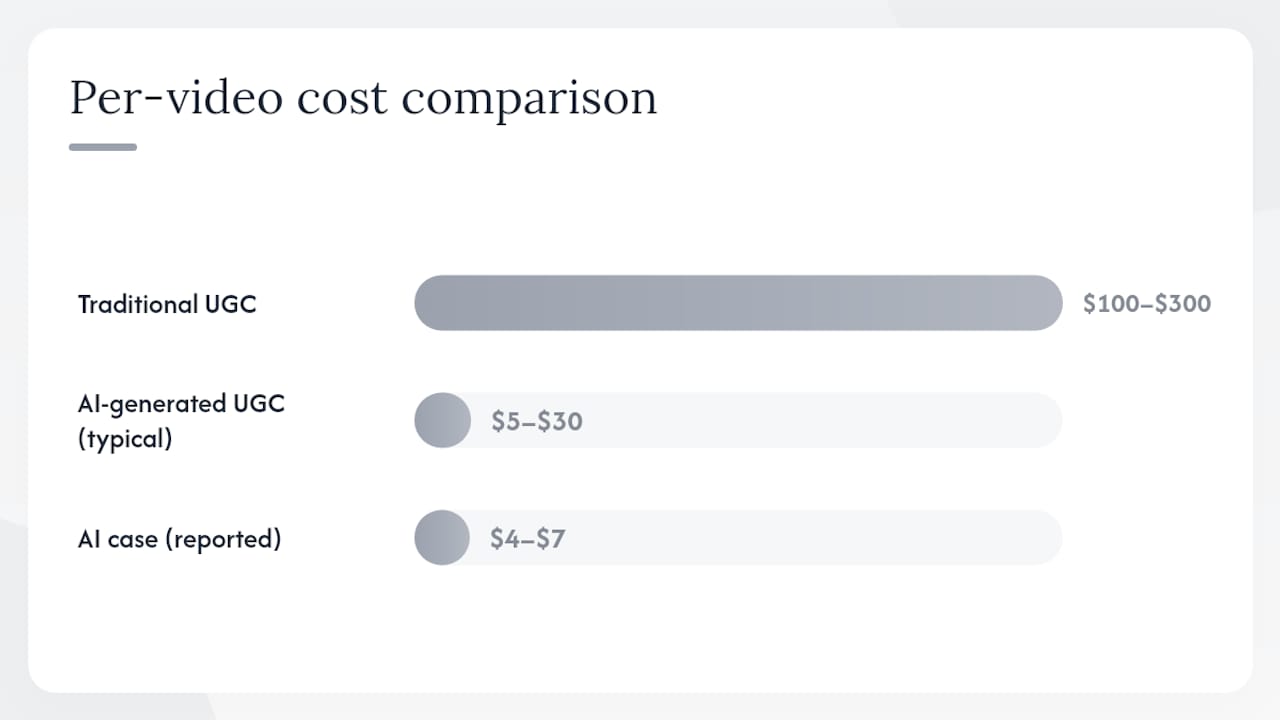
On cost: traditional UGC creators typically charge $100–$300 per video and take one to two weeks to deliver. AI-generated UGC runs $5–$30 per video and ships the same day. At that cost difference, you can produce 10–20 video variants per week instead of one or two, which is the volume the testing framework above actually requires.
Brands using Instant-ugc have reported measurable ROAS uplifts after switching to AI-generated UGC at scale — one documented case moved from 2.1x ROAS to 4.8x after adopting volume-first AI production. The per-video cost dropped to $4–$7, making weekly creative refreshes financially practical for the first time.
Hybrid vs. fully AI-generated: Use real product photos fed into Instant-ugc’s AI character workflow when your product has a distinctive physical appearance that needs to be shown accurately (textured materials, color-critical items). Fully AI-generated content works well for commodity products where the hook and offer matter more than photographic precision.
Legal and copyright considerations for AI-generated and UGC content
AI-generated video ads sit in a relatively clear legal space for commercial use, provided you own or license the inputs. A few rules apply consistently across US platforms and ad policies.
What you own and what you don’t: If you upload your own product photos to an AI platform, the output is generally yours to use commercially under the platform’s terms of service. Read those terms before publishing — some platforms retain a license to your outputs or restrict certain commercial uses.
Music: Never use copyrighted music in a paid ad without a sync license. Use royalty-free tracks from licensed libraries. TikTok’s Commercial Music Library and Meta’s Sound Collection are free options built for paid placements.
UGC from real customers: If you source video from actual buyers, get written permission before using it in a paid ad. A simple direct message confirmation is not sufficient for commercial use — use a short written release form. The FTC also requires that any material connection between your brand and a creator be disclosed, even in paid ads.
AI avatars and likeness: Platforms like Instant-ugc use purpose-built AI avatars, not real people’s likenesses, which avoids the consent issues that arise when brands use AI to replicate a specific person’s face or voice without permission. Stick to licensed avatar libraries and avoid any tool that clones a real individual’s likeness without documented consent.
Platform ad policies: Meta and TikTok both require disclosure when an ad uses AI-generated content in certain categories (financial products, political content). For standard e-commerce dropshipping products, no mandatory AI disclosure is currently required in the US, but policies evolve — check each platform’s current advertiser guidelines before launching.
How to source authentic UGC for dropshipping products
Real UGC, meaning video created by actual customers or creators who have used the product, still carries a trust signal that AI-generated content approaches but does not fully replicate. For dropshipping brands, sourcing it requires a deliberate process.
Order samples first. You cannot brief a creator on a product they have never held. Order two to three units, send them to micro-creators (10,000–100,000 followers) in your niche, and brief them on the hook structure you want. Nano-creators (under 10,000 followers) often charge nothing for a gifted product and produce content that reads as genuinely authentic.
Use post-purchase email flows. A simple automated email sent three to five days after delivery, asking buyers to share a short video in exchange for a discount on their next order, generates a steady stream of raw UGC. The production quality is uneven, but the authenticity is real.
Brief creators with a shot list, not a script. Giving a creator a word-for-word script produces stilted delivery. Give them the hook concept, the one benefit to demonstrate, and the CTA, then let them speak naturally. The result sounds like a real person, because it is.
Repurpose reviews as social proof overlays. If you have written reviews on your Shopify store or Amazon listing, pull the strongest one-liners and use them as text overlays in your AI-generated videos. This layers real customer language onto AI production without requiring a full UGC shoot.
What top-performing dropshipping video ads actually look like
Analyzing what works in practice reveals consistent patterns across product categories.
The “problem-first demo” format dominates impulse categories. A posture corrector ad that opens with someone visibly slouching, then cuts to the product being applied, then shows the person standing straight, follows a structure that requires no voiceover to communicate the value. The visual does the work.
The “unboxing reveal” format performs well for gadgets and accessories. The first frame shows a plain shipping box. The next three seconds are a fast unboxing cut. The product appears in use by second five. This format works because it mirrors the actual customer experience and triggers anticipation.
Social proof stacking is a technique where the ad layers multiple trust signals in the final five seconds: a star rating overlay, a “10,000+ sold” badge, and a single review quote, all in rapid succession. Each element alone is weak; together they create a credibility burst at the moment the CTA appears.
What separates winners from losers is almost always the first frame. Ads that open on a static product shot against a white background perform consistently below ads that open mid-action. The algorithm rewards watch time, and watch time starts at second zero. If your first frame could be a product listing photo, reshoot or regenerate it.
For tech gadgets, spec-forward hooks (“charges in 20 minutes, lasts 3 days”) outperform lifestyle hooks in cold-audience testing. For pet and baby categories, emotional resonance in the hook outperforms feature lists every time.
When volume-first AI production beats a hero creative
The conventional wisdom says you need one great ad. The data says you need many good ones.
For impulse products priced under $60, volume-first AI UGC production is the right default. Your buyer makes a fast decision, the creative’s job is to stop the scroll and communicate the offer, and the marginal value of a higher-fidelity production is low. Producing 10–15 variants per week and rotating them weekly prevents creative fatigue and keeps your CPMs from rising as the algorithm exhausts your audience.
For high-AOV products above $150, or for categories where trust is the primary purchase barrier (supplements, baby safety products, medical-adjacent devices), a single well-produced hero creative with a real person on camera often outperforms a stack of AI variants. The production cost is justified because the conversion rate difference at that price point is significant.
The volume tests find your winning angle; the hero production amplifies it.
One caution worth stating plainly: AI-generated video can drift from your brand over time if you generate without reviewing. An avatar that looks slightly different across three videos, or a script that gradually softens your offer, creates inconsistency that erodes trust. Build a 60-second review step into every generation batch before publishing.
Instant-ugc gets your first dropshipping video ad live today
Producing four test-ready video variants used to mean two weeks of creator coordination and $1,000+ in fees. With Instant-ugc, you upload a product photo and have a platform-ready Facebook or TikTok video ad in 90–120 seconds, at $4–$7 per video, in 9:16 and multi-aspect formats ready to upload.
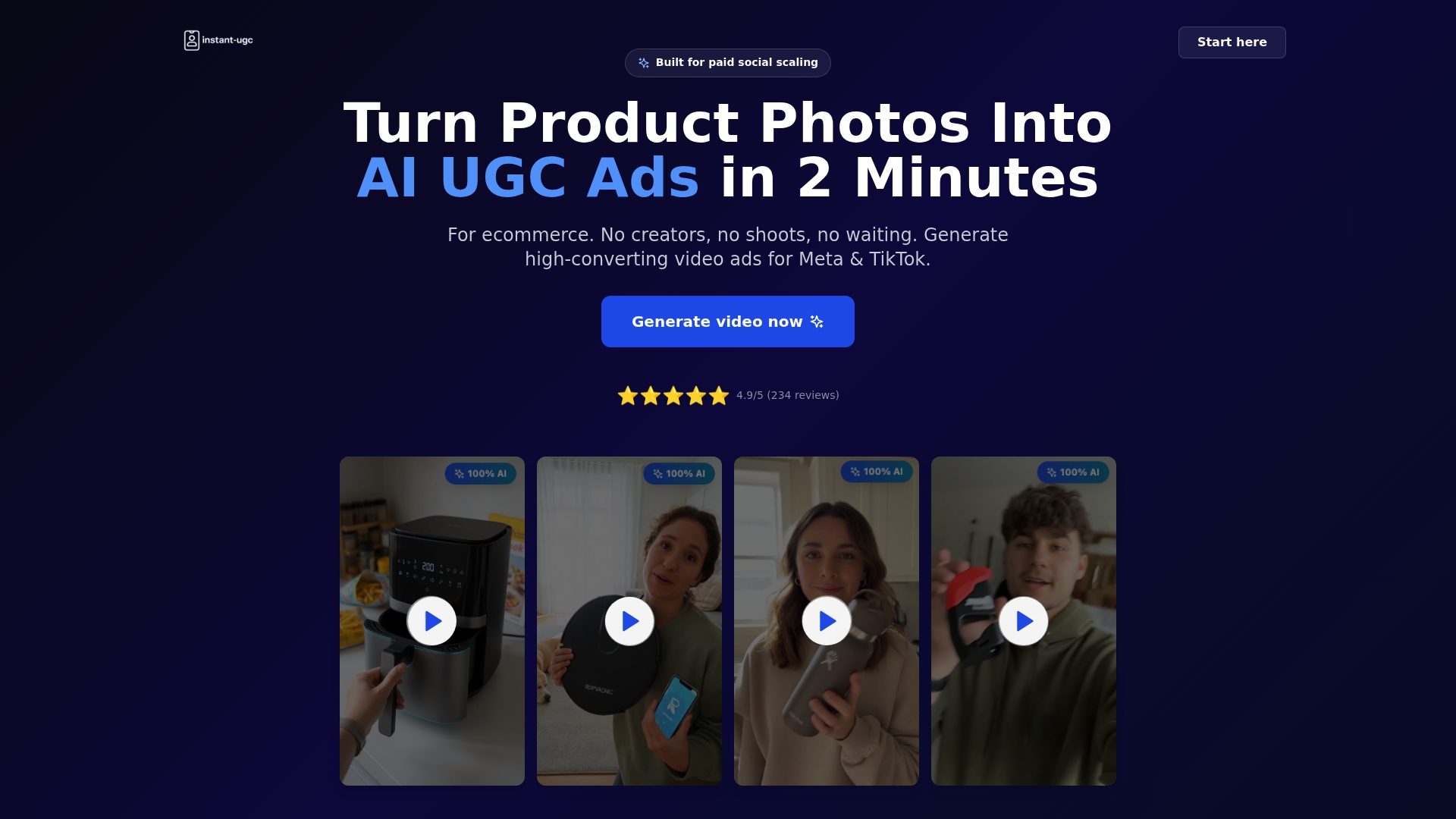
The workflow is direct: upload your product image, let the platform generate a UGC-style script, select an AI avatar that matches your buyer demographic, and export. For TikTok-focused campaigns, the AI TikTok ads generator produces vertical-first creatives built for in-feed and Spark Ads placements. You can generate four variants, run the $300 validation test from the workflow above, and have real performance data before the end of the week. Start your first video at Instant-ugc.
Sources
- Dropshipping Facebook Ad Creative 2026: What Works, What | EarnifyHub
- Dropshipping with Facebook Ads: The Structural Playbook for 2026
