
Fix Creative Fatigue Ads in a Week: Signal Playbook for Marketers
Spot the three signals that warn of creative fatigue, run low cost hook first tests, and deploy fast UGC to recover CTR and lower CPA.
Creative fatigue is the measurable decline in ad performance caused by repeated exposure to the same creative elements. Watch three compound signals: falling hook rate or CTR, a rising frequency trend, and climbing CPA or CPR against your baseline. When two or more move together, start by swapping the hook at a small test budget before touching anything else.
TL;DR:
- Creative fatigue signs include a 20% or more weekly decline in hook rate or CTR, and a rising frequency trend above 3.0 for cold audiences.
- Testing hook-only variants in new ad sets for seven to ten days helps determine if the opening is causing the decline before trying larger changes.
- Refresh cadences vary by platform and spend, with Meta campaigns lasting two to four weeks, while TikTok and Reels wear out within days to one week.
- Automated generation of multiple hook variants using AI can reduce production time to a few minutes, enabling faster testing and cycle management.
- Maintaining a library of tested hooks and documenting triggers improves response speed for future refresh cycles and prevents creative crises.
Table of Contents
- What creative fatigue really means and why it drains ROI
- Early warning metrics and thresholds worth tracking
- How to diagnose which creative element is actually failing
- A prioritized refresh playbook from micro-fix to full relaunch
- Setting refresh cadence by platform and spend level
- How to test and verify that a refresh actually worked
- How fast UGC generation shortens the whole refresh cycle
- What disciplined creative teams do before fatigue becomes a crisis
- Put the hook-first playbook into practice with Instant-UGC
- FAQ
- Sources
What creative fatigue really means and why it drains ROI
Creative fatigue describes the drop in engagement that happens when the same audience sees the same ad elements too many times. It differs from ad fatigue, a broader term that can include landing page or offer wear, and from audience saturation, which is about running out of new people to reach rather than wearing out a message with people already reached.
Academic work on ad repetition complicates the simple “more views equals worse results” story. Research on ad repetition effects found that initial annoyance from repeated exposure fades faster than memory decay, which can produce a time-dependent reversal: short-term preference drops, but brand memory in relevant categories can grow over time. Wear-out, the practical decline advertisers chase, is still common and varies by campaign and creative.
In a typical case, hook rate and CTR slide first as the scroll-stopping effect wears off. CPA often lags a week or two behind, climbing as the algorithm spends more to reach the same converters.
- Creative fatigue: decline tied to repeated exposure to the same visual or message.
- Ad fatigue: a broader decline that can include offer or landing page wear.
- Audience saturation: performance loss from exhausting new reach, not repetition.
Early warning metrics and thresholds worth tracking
Hook rate, the percentage of viewers who watch past the first three seconds, tends to move before anything else. It reflects whether the opening frame or line still earns attention, and a steady decline here is often the earliest sign that a creative is aging out.
Frequency matters more as a trend than as a fixed number. A frequency of 2.5 might be fine for a broad cold audience but could already be problematic for a much smaller retargeting list. Watch the slope, not just the figure, and adjust your read by audience size.
| Signal | Watch for | Typical trigger |
|---|---|---|
| Hook rate / CTR | Week-over-week decline | Roughly 20% drop, two weeks running, per creative refresh guidance |
| Frequency (cold audience) | Rising trend over time | Above 3.0 for cold prospecting, per the same playbook |
| CPA / CPR | Rising cost with stable targeting | Above baseline with no bid or targeting change |
Treat these as compound triggers rather than single alarms. One soft week in CTR with stable CPA might just be normal noise, but two signals moving the same direction at once is a stronger case for action.
- Confirm targeting and bids have not changed before blaming the creative.
- Compare performance across placements separately, since feed and Reels wear at different rates.
- Give any new test enough spend to clear the early noisy days before judging it.
How to diagnose which creative element is actually failing
Before you brief a full replacement, isolate the cause. A fatigued hook, a stale headline, thin social proof, and a flat offer all produce the same symptom, falling CTR, but they call for different fixes.
- Compare performance placement by placement: a decline isolated to Reels but not feed points to format fatigue, not message fatigue.
- Slice by audience segment: if only your warmest retargeting group is declining, frequency is likely the driver, not the creative itself.
- Run a hook-only swap: keep the body, offer, and landing page identical and change only the opening three seconds.
- Rule out auction and targeting shifts by checking CPM trends across your account, not just the one ad set.
- Check the landing page and offer separately, since a CTR that holds steady while conversion rate drops points downstream of the ad.
Pro Tip: Run the hook-only test in a brand new ad set at low budget, alongside the original, rather than editing the live ad: edits reset learning and muddy the comparison.
A quick decision rule helps here: if hook rate falls but post-click conversion rate holds, the opening is the problem. If both hook rate and conversion rate fall together, suspect the offer or the audience has genuinely moved on. Practitioners who build creative testing into Meta campaigns treat this diagnostic step as standard before any new production spend.

A prioritized refresh playbook from micro-fix to full relaunch
Fixing fatigue works best as an escalating sequence, the cheapest fix first.
- Hook-first micro-variants: launch three to five new hooks at 15% to 20% of your usual daily budget for seven to ten days, keeping body and offer untouched; a winning variant should beat the fatigued hook rate by a clear, consistent margin before you scale it.
- Angle change: if hook swaps do not recover performance, shift the angle itself, informed by how long competitors have run similar messaging, which signals whether an angle is genuinely tired across the category or just in your account.
- Full refresh: change format, spokesperson, or offer presentation entirely, and archive the fatigued creative rather than deleting it, since documented variants speed up future briefs.
- Launch replacement creative as new ads in a new or duplicated ad set instead of editing live ads, to avoid resetting the learning phase.
- Keep the original ad live at reduced budget until the replacement clears learning and proves itself.
- Log the trigger, the fix, and the result for every refresh so the next cycle moves faster.
This sequence mirrors what practitioner playbooks recommend: compound triggers drive the decision, and hook-first testing comes before any expensive reshoot. Guidance for designing high-converting UGC hooks is a useful reference when building the first round of variants.
Setting refresh cadence by platform and spend level
Cadence is not one number across every account. It shifts with platform, format, and how fast you are spending.
- Meta prospecting campaigns typically show fatigue over two to four weeks, faster at higher daily spend.
- TikTok and other short-form feeds often wear out within days to one week given the platform’s faster scroll behavior.
- Reels generally need a tighter refresh cadence than static feed placements because of similar fast-scroll dynamics.
- Accounts spending heavily per day burn through the same creative two to four times faster than lower-spend accounts, according to practitioner cadence notes, which makes a standing creative pipeline a practical necessity at scale.
- Warm retargeting audiences generally fatigue faster than broad cold prospecting, since the same smaller pool sees the ad repeatedly.
Treat these as starting windows, not fixed calendars. A signal-driven trigger, not a date on the calendar, should always be what actually prompts the swap.
How to test and verify that a refresh actually worked
Any valid read on a refresh depends on giving the algorithm enough data first. Platforms generally need around 50 optimization events per ad set before performance stabilizes enough to judge, and editing a live ad resets that clock, which is why new variants belong in new ad sets.
- Run the new hook or angle in a parallel ad set, not as an edit to the existing one.
- Keep a holdout or control ad set live at reduced spend so you can isolate the creative’s effect from seasonal or auction shifts.
- Measure over the full window needed to clear the learning phase before comparing CTR, CPA, and conversion rate against baseline.
A fatigue-aware selection model that weights exposure history by creative similarity improved CTR and CVR over standard selection methods in production testing, which supports automating the detection step rather than relying only on manual review. Recovery typically shows up as hook rate and CTR returning toward baseline within the first week of stable delivery, with CPA following a week or two later. Structured testing platform workflows and agency-level testing systems both reinforce holding a clean control group for every refresh.
How fast UGC generation shortens the whole refresh cycle
Hook-first testing only works if producing new hooks is cheap and quick, and that is where our platform fits directly into this playbook. We turn product photos or app screenshots into UGC-style video ads with automatic script generation and customizable AI avatars, delivered in 9:16 format within a couple of minutes, so running three to five hook variants in a week stops being a production bottleneck.
- Generate multiple hook-only variants from the same product asset without booking a new shoot.
- Support multiple languages, useful when a creative wears out in one market but not another.
- Export directly in formats built for Meta and TikTok prospecting as well as App Store testimonial-style videos.
Our tool for A/B testing many video variants at scale fits naturally into the diagnosis and micro-variant steps described above.
What disciplined creative teams do before fatigue becomes a crisis
Teams that rarely get caught off guard keep a standing inventory of tested hooks, angles, and formats ready to swap in the moment a signal trips, instead of starting production from zero. They review how long competitor ads have run before briefing a new angle, since a message that is fresh for them may already be worn out across the category. They also write down what triggered each past refresh and what fixed it, which turns every cycle into a faster decision the next time.
— Syno
Put the hook-first playbook into practice with Instant-UGC
Running this playbook well means producing hook variants faster than your creative wears out, and that is the gap we built our platform to close. Instead of waiting weeks and paying $500 to $2,000 per traditional UGC video, we generate testimonial-style and product demo videos from a single photo or screenshot, so testing five hooks costs a fraction of one traditional shoot.
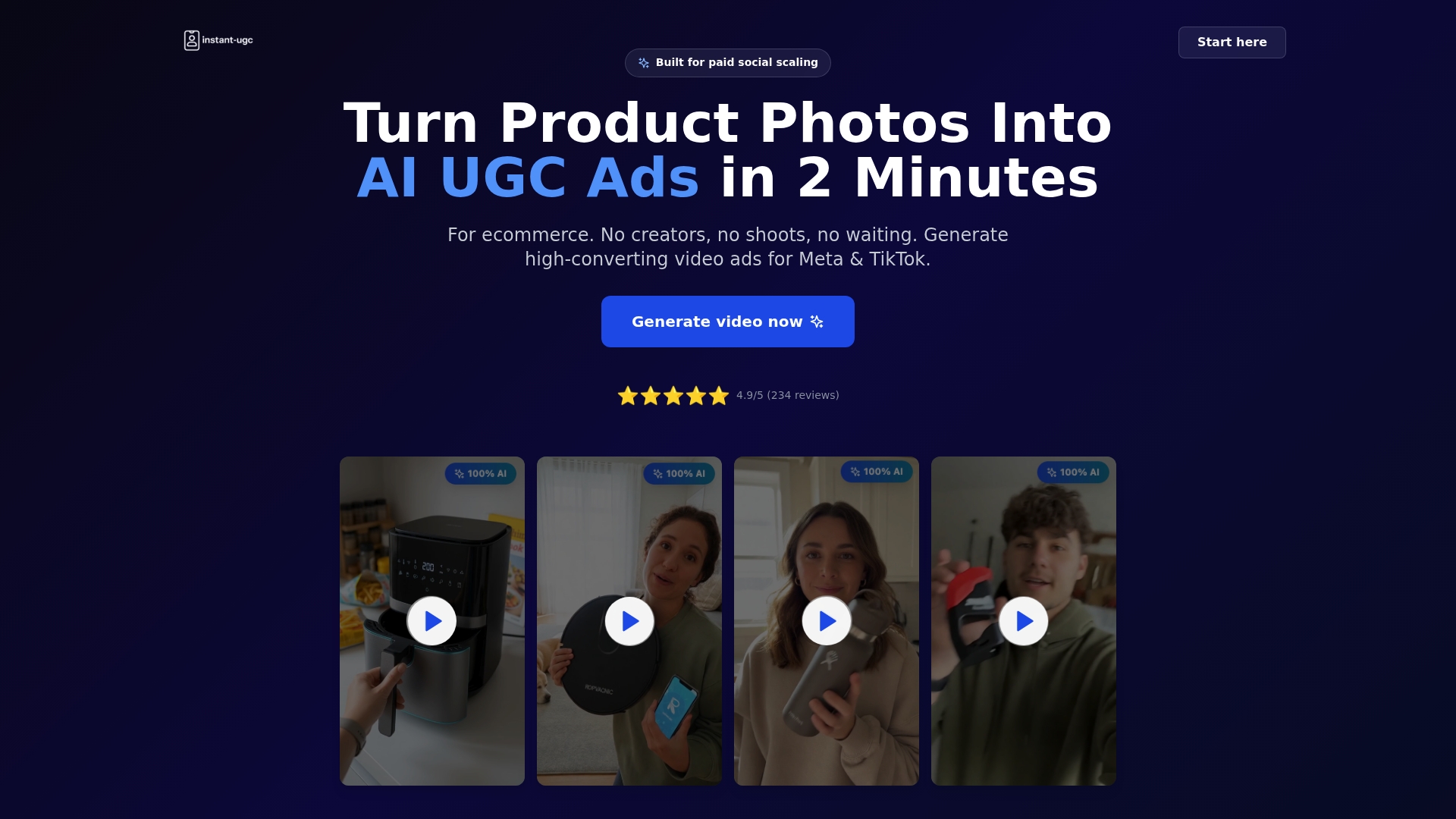
Our AI video generator suits e-commerce teams on Shopify or Amazon FBA running product-led hooks, and app or SaaS teams needing App Store-style testimonial clips. Start with our Test plan at $9 one-off to try a single hook variant, or move to Starter at $19 per month once you’re running a continuous refresh cycle.
FAQ
What does creative fatigue mean in Meta ads?
In Meta ads, creative fatigue means an audience has seen the same creative enough times that engagement drops and costs rise. It typically shows up first as falling hook rate or CTR, followed by frequency climbing above roughly 3.0 for cold audiences and CPA rising against baseline, per industry refresh guidance.
Can you give examples of creative ad variants worth testing?
Common variants include swapping only the opening hook line or visual, changing the on-screen spokesperson or avatar, testing a different social proof angle like a review quote versus a before-and-after result, and trying a new offer framing such as a discount versus a bundle. Our testimonial and review video format and before-and-after format cover two of the most common social proof swaps teams test first.
How do I deal with creative fatigue once I spot it?
Start with the cheapest fix: launch three to five hook-only variants in a new ad set at a reduced budget and compare performance against the original for seven to ten days. If hook swaps don’t recover performance, move to an angle change, and reserve a full format or offer refresh for when both of those fail.
How often should I refresh ad creative?
Refresh cadence depends on platform and spend rather than a fixed calendar: Meta prospecting often shows wear-out over two to four weeks, while TikTok and Reels can fatigue within days to one week. High-spend accounts burn through the same creative two to four times faster, according to practitioner cadence notes, so signal-driven triggers matter more than any set schedule.
Sources
- Fatigue-Aware Ad Creative Selection (arXiv)
- Kronrod & Huber — Ad repetition effects and time-dependent reversal (IJRM)
