
Scale B2B Video Ads for SaaS Marketers with 5 Hooks and Fast AI UGC
Practitioner guide for SaaS marketers: use the five hook system, platform-specific formats, and fast AI UGC production to scale B2B video ads and testing...
The best B2B SaaS video ad strategy in 2026 is not one hero video. It’s a rotating set of short, hook-driven variants paired with funnel assets and closed-loop attribution back to your CRM. Tools like Instant-UGC can produce testimonial-style clips fast enough to keep that rotation fresh, and most teams need 60 to 90 days of testing before performance and measurement stabilize.
TL;DR:
- A rotating set of short, hook-driven videos paired with funnel assets and proper attribution outperforms single hero videos for B2B SaaS in 2026.
- Most effective videos focus on specific reactions at each funnel stage, such as objections, quick demos, and customer proof, rather than comprehensive product explanations.
- Testing at least five distinct hook variations per campaign and adjusting based on performance metrics better than relying on a single creative or static approach.
- Multi-platform delivery and rapid testing are facilitated by AI platforms like Instant-UGC, which generate testimonial and comparison videos from product assets in minutes.
- Accurate attribution involves structured UTM tagging, offline conversion import, and CRM integration to measure pipeline impact over the long sales cycle.
Table of Contents
- What Makes B2B SaaS Video Ads Actually Work?
- Curated Examples of B2B SaaS Video Ads That Convert
- Which Video Format Works Best on Each Platform?
- What Creative Framework Should You Brief First?
- How Do You Measure and Attribute B2B SaaS Video Ad Performance?
- In-House, Agency, Freelancer, or AI Platform: Which Production Route Fits?
- What Legal and Compliance Rules Apply to B2B SaaS Ads?
- How Do You Target the Right Buyer Personas in B2B SaaS Video Ads?
- How Should Video Ads Fit Into Your SaaS Sales Funnel?
- What Are the Best Practices for Video Ad Lead Generation in B2B SaaS?
- What Should You Actually Prioritize Going Into Next Year?
- How Instant-UGC Helps You Produce B2B SaaS Video Ads at Scale
- Sources
- FAQ
What Makes B2B SaaS Video Ads Actually Work?
Marketers searching for “b2b saas video ads” usually already know the basics of video advertising. What they need is proof: real examples, the specific frameworks behind them, and a clear path from creative brief to pipeline revenue. That’s the gap this guide closes.
B2B video advertising differs from consumer video in one structural way: the buying committee is small, skeptical, and busy. A SaaS ad has roughly three seconds to convince a director of operations or a VP of marketing that the video is worth their attention, not their scroll. Sound-off viewing accounts for 85% of video views on LinkedIn and Meta, so a caption-free, hook-free video is functionally invisible to most of the audience it reaches.
That reality shapes everything else in this guide. SaaS video marketing that wins in 2026 treats each video as a disposable, testable unit rather than a polished brand film. The winning approach blends curated creative inspiration, platform-specific formatting, and a measurement system that actually reports back to sales, not just to the ad platform’s own dashboard.
Curated Examples of B2B SaaS Video Ads That Convert
Studying what already works beats guessing. Top-performing example roundups in this space typically feature 11 to 45 annotated ad breakdowns, because volume and variety reveal patterns that a single case study can’t. Below are ten formats worth studying and stealing, organized by the job each one does in the funnel.
-
Customer testimonial, cold audience (LinkedIn, 15 seconds). Opens with a customer saying, “I was skeptical about switching platforms.” No logo reveal until second 8. The specificity of the doubt is the hook; viewers who share that skepticism stay to see it resolved. Takeaway: open with the objection, not the solution.
-
Founder talking head, cold audience (YouTube pre-roll, 20 seconds). A visibly unscripted founder explains why they built the product after failing to solve the problem with existing tools. Works because founder-led ads read as lower production value, which paradoxically reads as more trustworthy in B2B. Takeaway: rough authenticity beats studio polish for founder content.
-
Stat-led hook, cold audience (Meta feed, 12 seconds). Text overlay reads “Teams waste 6 hours a week on manual reporting” before any voice or footage appears. The number does the work the visual would normally do. Takeaway: a specific, uncomfortable number is a stronger scroll-stopper than an aspirational one.
-
Demo screen-record, mid-funnel (LinkedIn, 30 seconds). A narrated cursor moves through the actual product interface, solving one narrow task end to end. No music, no branding overlay, just the software doing the job it claims to do. Takeaway: show one workflow completely instead of five workflows partially.
-
Before/after workflow, mid-funnel (YouTube, 25 seconds). Split screen contrasts a cluttered spreadsheet process against the same task inside the product. Visual contrast substitutes for a verbal pitch. Takeaway: comparison videos work best when the “before” is instantly recognizable to the viewer’s own routine.
-
Customer results montage, warm audience (retargeting, 15 seconds). Three customers, each on screen for five seconds, state one metric each: faster onboarding, fewer support tickets, higher retention. Rapid pacing keeps warm viewers from disengaging on a message they’ve already half-heard. Takeaway: stack short proof points rather than one long testimonial for retargeting.
-
Objection-handling direct response, warm audience (Meta retargeting, 20 seconds). Addresses “too expensive” or “too hard to migrate” head-on, then answers it with a concrete fact. This is the Problem, Agitate, Solve structure applied to price and switching-cost objections specifically. Takeaway: name the objection out loud before someone else names it in your comment section.
-
Confirmation/thank-you video, post-conversion (landing page, 10 seconds). Plays immediately after a trial signup or demo booking, reinforcing what happens next and reducing no-show rates for booked calls. Takeaway: the video after the conversion matters almost as much as the one before it.
-
App-store style testimonial, cold audience for SaaS apps (App Store feature placement, 15 seconds). A user describes a specific frustration solved by the app, filmed in a UGC-style, handheld aesthetic rather than a produced studio shoot. Platforms with AI-driven video generation can create testimonial-style videos directly from app screenshots in under two minutes, facilitating rapid testing of multiple hook variations before committing budget to any single one.
-
Comparison-style demo, mid-funnel (LinkedIn carousel-to-video, 30 seconds). Walks through switching from a generic alternative to the advertiser’s product, focused on one friction point resolved. Tools built for product comparison videos make this format faster to produce at scale, since the underlying structure repeats across multiple competitor angles.
Notice the pattern across all ten: none of them try to explain the entire product. Each earns one specific reaction from one specific funnel stage. That discipline is the actual skill in B2B SaaS video advertising, not production value.
Which Video Format Works Best on Each Platform?
Video ad strategies for B2B fail most often not because the message is wrong, but because the format is wrong for where it’s running. A 60-second LinkedIn video and a 6-second YouTube bumper serve completely different jobs, and treating them the same wastes both budget and attention.
LinkedIn rewards native, vertical or square video under 30 seconds for cold and mid-funnel placements, since most scrolling happens on mobile with sound off. Captions are not optional. Longer-form video, up to two minutes, can work for document ads or thought-leadership placements aimed at warmer audiences already engaging with your brand page.
YouTube splits cleanly by ad type. Skippable in-stream ads need a hook inside the first five seconds before the skip button becomes tempting. Bumper ads run six seconds flat and work best as a single, sharp idea, not a compressed version of a longer video. In-feed placements can run longer, closer to 60 to 90 seconds, since viewers opt in by clicking.
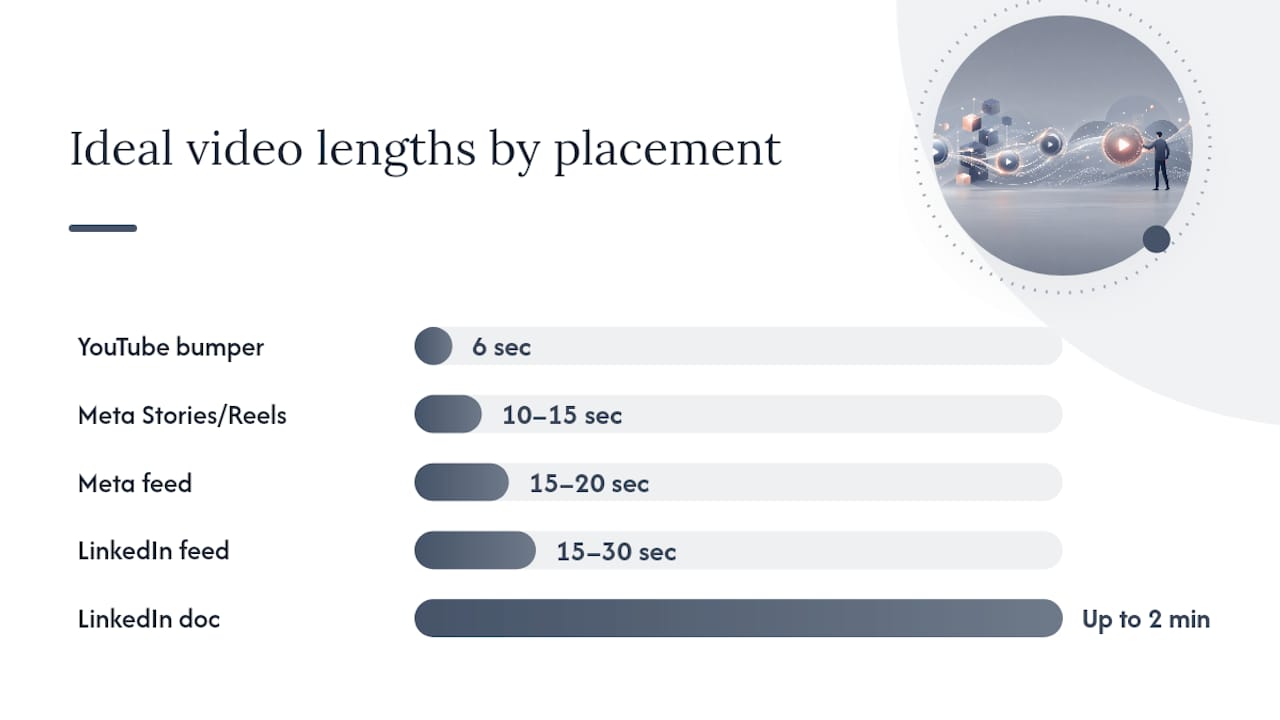
Meta (Facebook and Instagram) favors 9:16 vertical for Stories and Reels placements, and 4:5 or 1:1 for feed. Fifteen to twenty seconds is the sweet spot for cold audiences; retargeting sequences can run slightly longer since the viewer already has context.
CTV and programmatic display video behave more like traditional TV, with 15 and 30 second cuts dominating, horizontal 16:9 as the standard, and sound-on assumptions since living-room viewing rarely mutes the screen.
| Platform | Aspect ratio | Ideal length | Funnel stage | Sound guidance |
|---|---|---|---|---|
| LinkedIn feed | 1:1 or 9:16 | 15 to 30 sec | Cold to mid | Captions mandatory |
| LinkedIn document/thought leadership | 16:9 | Up to 2 min | Warm | Captions recommended |
| YouTube skippable in-stream | 16:9 | 15 to 30 sec | Cold to mid | Hook by second 5 |
| YouTube bumper | 16:9 | 6 sec | Cold | Captions recommended |
| Meta feed | 4:5 or 1:1 | 15 to 20 sec | Cold | Captions mandatory |
| Meta Stories/Reels | 9:16 | 10 to 15 sec | Cold to mid | Captions mandatory |
| CTV/programmatic | 16:9 | 15 to 30 sec | Mid to warm | Sound-on assumed |
A few tactical notes worth keeping close when you brief a creative team or a platform:
- Cold-funnel assets should lead with a problem or a stat, never a product name, since unfamiliar brand names slow down the hook.
- Mid-funnel assets can show product UI directly, because the viewer has already shown intent through a click or repeat impression.
- Warm-funnel and retargeting assets should reference the specific objection or hesitation most likely to be stalling that segment, not a generic recap of features.
- Vertical formats consistently outperform horizontal ones for cold-audience mobile placements, regardless of platform, simply because they fill more of the screen.
Multi-format delivery matters more than most teams realize once a campaign runs across three or four platforms simultaneously. Producing one asset and cropping it manually into every required ratio eats hours that a multi-format video workflow can compress into minutes.
What Creative Framework Should You Brief First?
Start with the 5-1-1 architecture: five hook variations, one landing-page video sales letter, and one post-conversion confirmation video. This structure exists because a single ad, no matter how good, degrades in performance after roughly 30 days as the same audience sees it repeatedly. Five hooks pointed at the same value proposition let different buyer personas self-select into whichever framing resonates, which extends the useful life of the whole campaign well past what one video alone could sustain.
Here’s how to build it in practice:
- Write five distinct hooks for the same core offer. Vary the angle, not the product: one leads with a pain point, one with a stat, one with a customer quote, one with a direct question, one with a bold claim. Keep each under five seconds of screen time before the message lands.
- Produce one longer VSL for the landing page. This is where the full pitch lives: problem, mechanism, proof, offer. It doesn’t need to run on paid media; it needs to convert the click your hook already earned.
- Produce one confirmation video for the thank-you page. Reinforce the next step, whether that’s a demo call or a trial activation email, to reduce drop-off between conversion and actual product engagement.
For the individual hook ads themselves, a simple 15-second beat structure keeps production fast and testing clean: hook (0 to 3 seconds, problem or stat), value (3 to 8 seconds, what the product does about it), proof (8 to 12 seconds, a number, a logo, or a quote), CTA (12 to 15 seconds, one clear action). For 30-second versions, stretch the value and proof sections rather than adding new beats. Extra beats dilute the hook’s momentum instead of reinforcing it.
Build a modular asset library instead of one-off videos. Four categories cover most needs: hook openers (problem statements, stats, questions), demo moments (short screen-recorded clips of specific features), testimonial bites (10 to 15 second customer quotes), and CTA closers (consistent, brief action prompts). Once these exist as separate clips, a creative team can recombine them into new ad variants in an afternoon instead of a new production cycle.
Pro Tip: Never launch a B2B SaaS video campaign with fewer than five hook variations. A single hook tells you almost nothing about why an ad performed the way it did. Five hooks tell you which specific angle, phrasing, or proof point is doing the actual work, which is the information you’ll reuse across every future campaign.
Testing priority matters as much as the framework itself. Hook changes move performance more than any other creative variable, followed by format, length, call-to-action wording, and finally aspect ratio. Test in that order. Teams that start by tweaking aspect ratio or button color before validating the hook are optimizing the parts of the ad that matter least.
How Do You Measure and Attribute B2B SaaS Video Ad Performance?
Video ads for B2B SaaS live or die on attribution, because the sales cycle rarely closes inside the ad platform’s own seven-day or 28-day attribution window. A demo booked this week might not close for another 45 to 90 days, and platform dashboards have no visibility into that gap unless you build the bridge yourself.
The closed-loop setup looks like this:
- UTM tagging on every ad variant, structured consistently so campaign, hook, and platform are all identifiable in your analytics later.
- CRM capture at the point of form fill or demo booking, tagging the lead with its originating UTM parameters.
- Offline conversion import, feeding pipeline-stage events (MQL, SQL, Closed Won) back into the ad platform on a regular cadence, not just at the top of funnel.
- Server-side event mapping via CAPI (Conversions API), so platform algorithms optimize toward revenue-impacting actions rather than raw form fills. A closer look at how server-side tracking closes measurement gaps is worth a read if this step feels unfamiliar to your team.
Statistic to remember: Performance Max and similar aggregated campaign types typically need 100 or more Customer Match records plus offline conversion import to perform reliably for B2B advertisers. Without that data, these campaigns tend to optimize toward volume, not quality, which inflates form-fill counts while quietly degrading lead quality.
Once the pipeline is connected, prioritize three metrics over everything else: cost per qualified lead or trial, demo-to-paid conversion rate, and CAC payback period. Raw ROAS and cost-per-click numbers look tidy in a weekly report but tell you almost nothing about whether the leads a campaign generates actually become customers. CAC payback under 12 months is a reasonable target for most subscription SaaS models, though the right number depends heavily on your specific pricing and contract length.
Run your testing cadence in the same order recommended for creative: validate the hook first, then format, then length, then CTA wording, and only then move into finer details like color treatment or music. Each round of testing should run long enough to reach statistical confidence, typically two to four weeks per test depending on spend volume, before you draw conclusions and move to the next variable.
In-House, Agency, Freelancer, or AI Platform: Which Production Route Fits?
Every B2B SaaS team eventually asks the same question: who should actually make these videos? The honest answer depends on four factors: how much volume you need, how fast you need to move, what budget you’re working with, and how complex your brand guidelines are.
In-house production offers the most control and the deepest product knowledge, but it’s slow. Most in-house teams can’t sustain the five-hooks-per-campaign cadence the 5-1-1 framework calls for without hiring dedicated video staff.
Agencies bring polish, strategic thinking, and outside creative perspective, but turnaround typically runs two to four weeks per video and costs scale quickly once you’re testing multiple hooks across multiple campaigns.
Freelancers sit in between: faster and cheaper than agencies, but quality and reliability vary widely, and coordinating five or six freelancers to hit a consistent brand voice adds its own overhead.
AI-driven platforms like Instant-UGC trade some creative nuance for speed and volume, generating testimonial-style videos from product screenshots in 90 to 120 seconds rather than weeks. That trade-off makes sense specifically when you need to test multiple hooks fast, localize into several languages without hiring a translator for each market, or produce a steady drip of fresh creative to avoid the 30-day fatigue problem.
Run through this checklist before committing to a route:
- Do you need more than five creative variants per month? If yes, weigh AI-driven production or a high-output freelancer roster over a single agency retainer.
- Is turnaround under one week a hard requirement? If yes, agencies rarely fit; AI platforms and in-house teams usually do.
- Does your brand require heavy legal or compliance review per asset? If yes, keep a human review layer regardless of production method.
- Do you need localized versions in three or more languages? If yes, a platform with built-in multilingual support saves significant coordination time.
If you’re evaluating agencies or freelancers directly, ask about turnaround time per revision round, how many hook variations are included in a standard package, and whether they’ve worked specifically in B2B SaaS versus consumer e-commerce. A portfolio full of glossy consumer spots is a red flag for B2B work, where a rougher, more authentic register usually performs better.
What Legal and Compliance Rules Apply to B2B SaaS Ads?
B2B SaaS advertising carries specific compliance obligations that consumer video campaigns don’t always face. Testimonials and case study claims need to reflect real customer outcomes; fabricating or exaggerating a result in a video ad exposes both the advertiser and the platform to takedown risk and potential regulatory scrutiny.
Data privacy rules also shape what you can say and target. If your video ad references specific customer names, logos, or metrics, get written permission before the asset goes live, and keep that permission on file.
Targeting itself carries compliance weight in B2B. Using overly granular firmographic or intent data to target specific named individuals can cross into territory that some platforms and jurisdictions treat as a privacy concern, particularly when combined with retargeting pixels that track behavior across a buying committee. Review your ad platform’s B2B-specific policies before launching account-based campaigns that rely on matched contact lists.
Finally, confirmation and thank-you videos that reference pricing or contract terms should stay consistent with what’s actually offered on your pricing page. Inconsistency between an ad’s claim and your site’s stated terms is one of the more common sources of customer complaints and support escalations after a campaign launches.
How Do You Target the Right Buyer Personas in B2B SaaS Video Ads?
B2B SaaS buying decisions rarely rest with one person. A typical deal involves an economic buyer who controls budget, a technical evaluator who tests the product, and an end user who lives inside it daily. Each one needs a different video, not a different targeting parameter layered onto the same asset.
The economic buyer responds to ROI framing: cost savings, time recovered, risk reduced. Video ads aimed at this persona should lead with a number or an outcome, not a feature list. The technical evaluator wants to see the product working, which is exactly what demo screen-record formats deliver. The end user cares most about day-to-day friction, so testimonial and before/after formats that show a recognizable frustration disappearing tend to land hardest here.
Targeting strategy should mirror this segmentation. LinkedIn’s job-title and seniority filters let you separate economic buyers from technical evaluators fairly cleanly, while Meta’s broader targeting works better for retargeting warm audiences regardless of role, since by that stage the whole buying committee may already be engaged. Layer firmographic filters, company size and industry, on top of role targeting rather than relying on either alone.
One practical mistake worth avoiding: running the same hook across every persona segment because it tested well with one group. A stat-led hook that lands with a CFO evaluating budget often falls flat with an end user who cares more about daily usability than the topline number. Match the hook to the persona before you match the platform to the budget.
How Should Video Ads Fit Into Your SaaS Sales Funnel?
Video ads work best when they’re built as funnel stages, not standalone campaigns. Cold-funnel video introduces the problem to someone who’s never heard of your product. Mid-funnel video demonstrates the solution to someone who’s clicked once already. Warm-funnel video closes the gap for someone who’s visited your pricing page or started a trial but hasn’t converted.
Map this directly to your sales cycle. If your average deal takes 60 days to close, a viewer’s first ad impression might be 90 days before a signed contract, once you account for the research phase before they ever click an ad. That means your video sequence needs to survive multiple touchpoints without feeling repetitive, which is exactly the problem the 5-1-1 framework solves through hook variation.
Sales and marketing alignment matters here more than in most B2C contexts. If a lead comes in through a demo-booking video ad, sales needs to know which hook and which offer that lead responded to, so the first call doesn’t repeat information the prospect already saw. Feed that context from your CRM into your sales team’s call notes automatically where possible; manually briefing every rep on every ad variant doesn’t scale past a handful of campaigns.
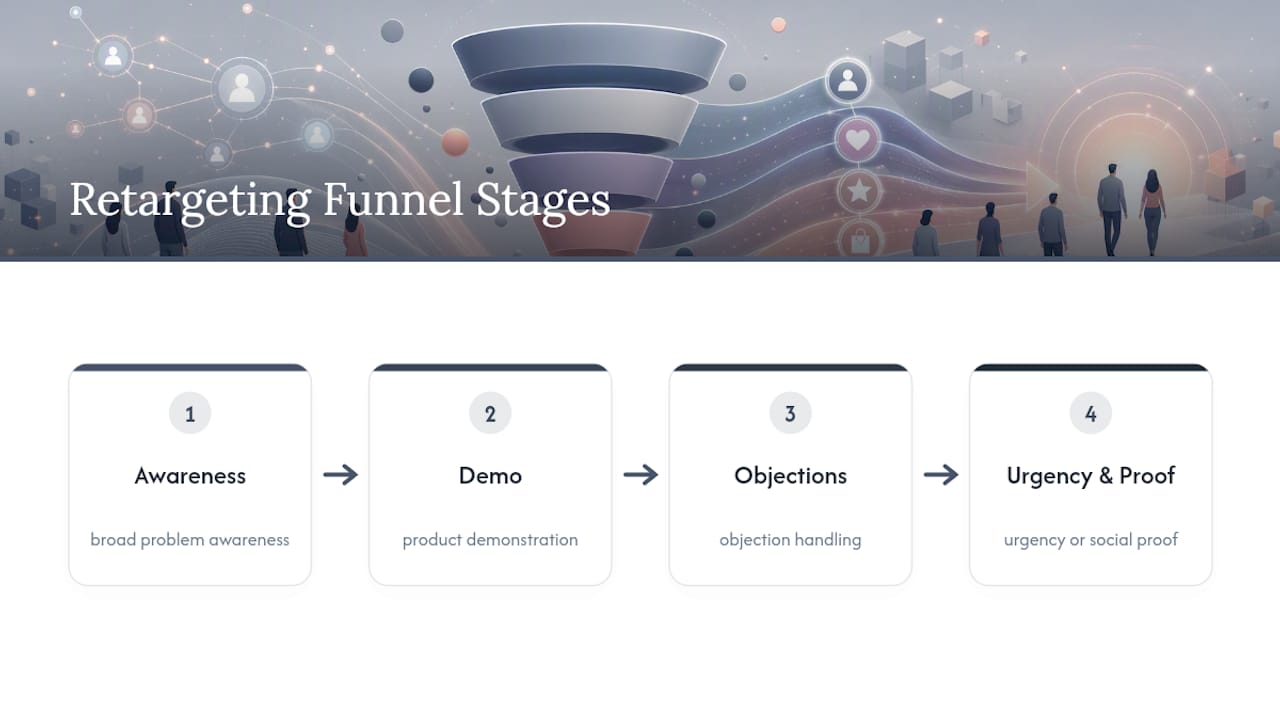
Retargeting sequences should escalate specificity as a prospect moves deeper into the cycle: broad problem awareness first, then product demonstration, then objection handling, then urgency or social proof right before a decision point. Treat each stage as a deliberate handoff rather than a repeated impression of the same message.
What Are the Best Practices for Video Ad Lead Generation in B2B SaaS?
Optimizing for lead generation starts with a hard truth: not every form fill is a good lead, and optimizing purely for volume often produces the opposite of what you want. A video ad with a broad, easy CTA like “Learn More” generates more clicks than one asking someone to “Book a Demo,” but the demo-request lead converts to paid at a meaningfully higher rate in most SaaS motions.
Match your CTA to your funnel stage deliberately. Cold-funnel video can ask for a lighter action, a newsletter signup or a resource download, since asking a stranger to book a sales call rarely works. Mid and warm-funnel video should ask for the real commitment: a demo, a trial, a direct sales conversation.
Landing page continuity matters just as much as the ad itself. If your video promises a specific outcome or number, your landing page needs to reinforce that same claim within the first few seconds of the page load, not bury it below three scrolls of generic copy. Continuity between ad and landing page is one of the most common, and most fixable, sources of conversion drop-off in B2B campaigns.
Finally, resist the temptation to judge a video ad’s success within its first week. B2B sales cycles mean the real signal, demo-to-paid conversion and CAC payback, takes weeks to materialize. Early click-through rate tells you the hook is working. It doesn’t tell you whether the leads it generates are worth closing.
What Should You Actually Prioritize Going Into Next Year?
The single biggest mistake in B2B SaaS video advertising right now is still treating video like a one-time production project instead of an ongoing testing system. Teams spend six weeks and a five-figure budget on one polished spot, run it for a month, watch it fatigue, and then wonder why performance dropped. It dropped because nothing replaced it.
Velocity beats perfection here. A library of five imperfect hook variants, tested and refreshed monthly, consistently outperforms a single flawless video run for a full quarter. That’s not a defense of low quality; it’s a recognition that B2B audiences are small enough that any single asset burns out fast, and the teams winning right now are the ones treating creative refresh as a governance process, not an occasional scramble.
Watch the measurement shortcuts closely too. It’s tempting to optimize toward whichever metric moves fastest, usually raw form fills or cost-per-click, but that’s the metric least connected to actual revenue. Build the CRM feedback loop before you scale spend, not after.
Where does a platform like Instant-UGC fit into that? As a tactical accelerant for the volume problem specifically. When five hooks need to become fifteen for a new market, or a testimonial-style asset needs to exist in three languages by Friday, speed matters more than incremental polish.
— Syno
How Instant-UGC Helps You Produce B2B SaaS Video Ads at Scale
Some AI-driven platforms address the volume problem of testing multiple hooks by turning product screenshots or app store assets into testimonial-style videos in minutes, using customizable AI avatars and automatic script generation, delivered in popular video formats.
Teams running localized campaigns gain value from platforms that support multiple languages, as producing native-sounding testimonial content for different markets often requires separate talent per region. A single workflow generating consistent creative across languages removes that bottleneck entirely. Brands report ROAS improvements ranging from more than double up to nearly five times, reflecting the impact of fast, testable creative volume when the rotation includes enough hook variants.
Whether you’re a SaaS marketing team building your first multi-hook test or an agency looking to offer video ad production to clients without a production team, the Instant-UGC platform gives you a starting point today: generate a test video, see the turnaround for yourself, and decide from there whether it fits your next campaign cycle.
Sources
- The 5-1-1 B2B Video Ad Framework | VideoRep
- Video Ad Creative for SaaS: Formats That Perform
- Meta Ads for B2B SaaS: 2026 Pipeline Playbook
- Google Ads for B2B SaaS: Strategy Guide 2026 | Involve Digital
FAQ
How Much Should a B2B SaaS Company Budget for Video Ads?
Budget depends heavily on production route and testing volume rather than a fixed industry rate. Teams running the 5-1-1 framework need at least five variants per campaign, so cost per video matters more than any single “total budget” figure since it directly determines how many hooks you can afford to test at once.
How Long Should a B2B SaaS Video Ad Be?
Cold-funnel ads on LinkedIn and Meta perform best around 12 to 20 seconds, while YouTube bumper ads run very short, approximately six seconds. Mid and warm-funnel content, including demos and video sales letters, can extend to 30 seconds or longer since the viewer already has context.
Which Platform Should You Start With for B2B SaaS Video Ads?
LinkedIn is the standard starting point for cold outreach to specific job titles and industries, since its targeting maps directly to buying committee roles. Meta works well as a retargeting layer once someone has shown initial interest, and YouTube fits mid-funnel demo-style content well.
How Many Video Variants Do You Need Before Testing Is Meaningful?
A minimum of five hook variations per core offer, following the 5-1-1 framework, gives you enough signal to identify which specific angle drives performance. Fewer than that makes it hard to separate a weak hook from a weak format or platform.
Can You Produce B2B SaaS Video Ads Without a Production Team?
Yes. Platforms like Instant-UGC generate testimonial-style videos from product screenshots or app assets in 90 to 120 seconds, which removes the need for a dedicated video team when testing multiple hooks or languages quickly. Current pricing and plan details are available directly on the Instant-UGC site.
