
Scale Arabic Video Ads for MENA: Ship Localized UGC Variants in Days
Short UGC Arabic video ads that convert in MENA. Production first workflow, dialect targeting, and Instant-UGC to scale localized variants in days.
Short-form, culturally tuned Arabic video ads built in the UGC style are the fastest route to measurable engagement and sales across MENA platforms. The winning approach pairs platform-native vertical formats with precise campaign language and geo settings, and increasingly relies on AI-assisted production tools like Instant-UGC to scale localized variants without the cost or delay of traditional shoots.
TL;DR:
- Short-form vertical Arabic videos are most effective for scroll-stopping engagement and conversions, especially when tailored to platform-specific formats and objectives.
- Dialect choice significantly impacts performance, with Gulf dialect generally outperforming Modern Standard Arabic for casual and commerce-driven campaigns.
- Proper language and geo targeting, along with Arabic captions, are crucial to ensure ads reach the intended audiences in the MENA region.
- AI-assisted tools can generate localized video variants rapidly, enabling fast testing and iteration without the high costs of traditional production.
Table of Contents
- 1. What Counts as an Arabic Video Ad
- 2. Platforms and Format Decisions for Arabic Audiences
- 3. Creative Best Practices: Making Arabic Video Ads That Stop the Scroll
- 4. Campaign Settings and Language Targeting
- 5. Measurement and Distribution: KPIs and Commerce-Proximate Channels
- 6. Production-First Workflow for Scaling Localized Arabic UGC Video
- Author Perspective: Priorities for 2026
- Try Instant-UGC for Your Arabic Video Campaigns
- FAQ
- Sources
1. What Counts as an Arabic Video Ad
An Arabic video ad is any promotional video built for Arabic-speaking viewers, whether the goal is awareness, app installs, or direct sales. Short-form content wins most jobs today: a 15 to 30 second vertical clip built for scroll-stopping works better for product discovery and conversion than long-form storytelling, which still has a role in brand-building on YouTube.
The format you pick should match the job the ad needs to do, leveraging tools like an Arabic AI content generator to create culturally relevant scripts and optimize multilingual SEO.
- Stop-the-scroll: fast hooks, bold text, and motion in the first three seconds for TikTok and Reels.
- Demonstration: product-in-use footage that answers “how does this work?” before the viewer swipes away.
- Testimonial: a creator or avatar speaking directly to camera about their experience, built for trust.
- Direct-response: a clear offer and call to action, often paired with Stories or feed placements tied to checkout.
CTV is worth watching for upper-funnel reach, but most Arabic campaigns still live and die on mobile vertical video.
2. Platforms and Format Decisions for Arabic Audiences
Platform choice should follow where Arabic-speaking audiences actually spend time, not assumptions. In Saudi Arabia, YouTube, Instagram, and TikTok all show very high penetration, and reach figures from ad planning tools put YouTube reach around 79.2% of the population in Saudi Arabia and 73.3% in the UAE in late 2025 data. That scale makes YouTube hard to skip for reach and storytelling goals, even as TikTok and Reels dominate engagement-focused campaigns.
Match the objective to the platform rather than forcing one format everywhere:
- TikTok and Reels: best for engagement, discovery, and UGC-style creative that feels native to the feed.
- YouTube: best for reach, brand storytelling, and longer product demonstrations, especially in-stream and Shorts combined.
- Meta (Facebook and Instagram): strongest for retargeting and in-platform commerce, where checkout friction is lowest.
Each platform has its own constraints: TikTok and Reels favor sub-30 second clips with burned-in captions, YouTube Shorts cap at 60 seconds, and Stories autoplay muted, so visual hooks and on-screen text matter more than voiceover in the first few seconds.
3. Creative Best Practices: Making Arabic Video Ads That Stop the Scroll
Cultural authenticity separates ads that get watched from ads that get skipped. A campaign by Shareet Studios for WABA during Ramadan leaned on region-specific wardrobe, settings, and seasonal hooks rather than a translated script. The result was a campaign that drove multi-million organic views and measurable sales uplift. The lesson applies beyond Ramadan: seasonal and regional specificity consistently outperforms generic translated creative.
A practical structure for Arabic UGC-style ads looks like this:
- Hook (0 to 5 seconds): a visual surprise, question, or bold claim in the viewer’s dialect.
- Product proof (5 to 15 seconds): the product in use, solving a real problem on screen.
- Social proof or testimonial (15 to 22 seconds): a natural, conversational line that sounds like a friend, not a script.
- CTA (final 3 to 5 seconds): one clear next step, spoken and shown on screen.
Dialect choice matters more than most marketers expect. Gulf dialect tends to outperform Modern Standard Arabic for casual, commerce-focused UGC, while Modern Standard Arabic still suits formal announcements or pan-regional brand campaigns. Subtitle every ad regardless of dialect, since many viewers watch muted.
Pro Tip: Shoot or generate three hook variations per ad concept and test them against each other before scaling spend, since the hook alone often decides whether the rest of the video gets watched.

4. Campaign Settings and Language Targeting
Getting the creative right means nothing if the ad never reaches the intended audience. Google Ads determines where ads appear based on campaign language settings, and a multilingual user can still be served ads in a different language unless advertisers configure language targeting correctly. That single setting is one of the most common reasons Arabic campaigns underperform before the creative is ever judged.
A practical checklist before launch:
- Language targeting: set Arabic explicitly rather than relying on browser or device defaults.
- Geo and dialect targeting: narrow by country first, then test dialect variants within that geo.
- Placement selection: exclude placements that historically serve low-intent traffic.
- Exclusion lists: block irrelevant regions or languages to protect budget.
- Captioning: always include Arabic captions, since autoplay-muted environments make them mandatory, not optional.
The MENA digital advertising market grew significantly in 2025, with social video among the fastest-growing segments. That growth, tracked by IAB MENA, signals rising competition for attention, which makes correct language and dialect targeting a bigger lever than most budgets account for.
5. Measurement and Distribution: KPIs and Commerce-Proximate Channels
Arabic video ads tied to business outcomes need a tighter metric set than vanity views. Track ROAS, conversion rate, click-through rate, view-through conversions, and cost per install depending on the campaign goal, and weight ROAS heaviest for e-commerce.
Distribution strategy matters as much as the metrics themselves:
- Commerce-proximate channels: social video and retail media placements that sit close to checkout tend to convert faster than display.
- CTV for upper-funnel scale: IAB MENA reports CTV spend up 31% year over year, making it a growing complement to mobile-first campaigns.
- Short test windows: run creative tests over days rather than weeks, since short-form attention cycles move fast.
Tag every variant with consistent UTM parameters and set up event-level tracking before launch, not after the first report is due. That discipline is what lets you compare dialect, hook, and platform variants without guessing which one actually moved the number.
6. Production-First Workflow for Scaling Localized Arabic UGC Video
Two production paths dominate Arabic UGC video today, and each has a real tradeoff. Creator-sourced content tends to feel the most authentic but takes longer and costs more per video. AI-assisted production trades some of that organic feel for speed and volume, which matters when a campaign needs a dozen localized variants tested in a week rather than one perfect video shipped in a month.
A workflow that works for either path, or a blend of both:
- Brief: define the product, the audience dialect, and the core message in one page.
- Assets: gather product photos, app screenshots, or raw creator footage.
- Localized script: write or generate a script tuned to the target dialect, not a direct translation.
- Generate variants: produce several vertical cuts testing different hooks and avatars.
- Platform tweaks: adjust captions, duration, and aspect ratio per placement.
- Test and iterate: launch small, measure fast, and kill underperformers within days.
Instant-UGC fits step four directly: we support 17 languages and more than 10 customizable AI avatars, generating a vertical video in 90 to 120 seconds from a product photo or app screenshot.
Pro Tip: Blend creator footage for your hero ad with AI-generated variants for rapid A/B testing, since authenticity and speed solve different problems.
Author Perspective: Priorities for 2026
Automation and cultural craft will decide which Arabic video campaigns win in 2026, not one or the other. The brands that treat localization as a checkbox will keep losing to the ones that write dialect-specific hooks and test them fast. Our practical bet: invest in culturally tuned creative, measure commerce-proximate outcomes over vanity metrics, and build a production pipeline that can ship localized variants in days, not weeks.
— Syno
Try Instant-UGC for Your Arabic Video Campaigns
We built Instant-UGC to close the gap between what traditional creator production allows and what fast-moving Arabic campaigns actually need. Our platform turns a product photo or app screenshot into a vertical video in under two minutes, with support for 17 languages and 10 or more AI avatars so e-commerce managers, app publishers, and agencies can test localized variants without booking a single shoot.
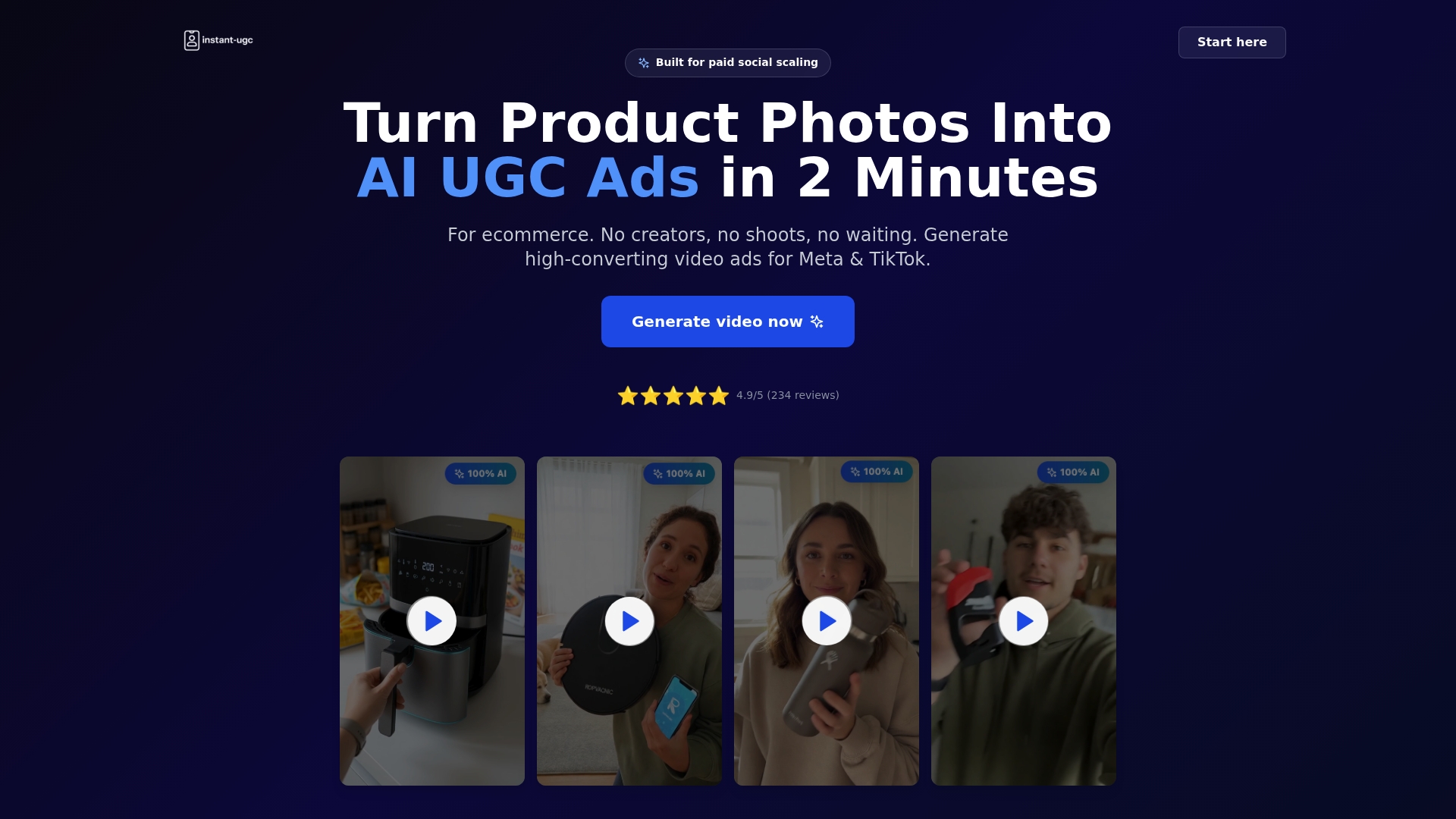
If you want to see how a localized Arabic variant looks before committing to a plan, try Instant-UGC and run your first video today.
FAQ
Why are my YouTube ads showing in a foreign language?
This usually happens because campaign language settings were not configured, so Google Ads served the ad based on browser or account language signals rather than audience intent. Set the language targeting explicitly in campaign settings to fix this.
Who are some popular Arab YouTubers?
Arabic-language YouTube hosts a wide range of creators across comedy, lifestyle, gaming, and commentary, with audiences concentrated heavily in Saudi Arabia, Egypt, and the Gulf states. Specific creator rankings shift often, so check YouTube’s own trending and creator discovery tools for the current landscape in your target country.
What is the best video advertisement format for Arabic audiences?
Short-form, vertical, UGC-style video built for TikTok, Reels, or YouTube Shorts tends to perform best for engagement and conversion goals. Testimonial and demonstration formats work especially well when paired with dialect-specific scripting rather than direct translation.
How much does a video ad cost to produce?
Traditional creator-sourced UGC videos commonly run from several hundred to a few thousand dollars per video and take two to three weeks to deliver. AI-assisted platforms change that math substantially: a single video through our Test option starts at $9, and ongoing plans like Starter at $19 per month make testing multiple localized variants far more affordable than booking individual shoots.
Sources
- About targeting by language - Google Ads Help
- 2025 MENA digital adspend - IAB MENA
- Digital 2026: Saudi Arabia — DataReportal
- Shareet Studios places Arab culture front and centre in WABA’s viral Ramadan campaign - Campaign Middle East
