
AI Voiceovers for Marketers: Compliance and 90–120s Test Workflow
Make AI voiceovers that convert: choose natural, regional voices, run 90–120s tests, include required disclosures, and scale winning variants.
A commercial AI voice workflow built around naturalness, clear licensing, and rapid A/B testing is the fastest way for marketers to produce ad voiceovers that convert. Platforms like Instant-UGC now let brands generate that workflow end to end, pairing voice with video in minutes rather than weeks. Expect strong quality out of the box, but budget time for disclosure checks and a short listening test before you scale spend.
TL;DR:
- AI voice quality depends heavily on naturalness, emotional range, pacing, and prosody, with regional accents often outperforming generic voices in brand uplift.
- Disclosing synthetic voices in ads is legally required when material to the ad, with methods including on-screen labels, pre-roll lines, or embedded metadata, especially in regulated regions like New York.
- Fast testing protocols involve blind listening panels and tracking key performance metrics such as CTR and brand lift, with regional accents often delivering better results in specific markets.
- Instant-UGC enables generating fully voiced ads from product images or screenshots in just 90 to 120 seconds across 17 languages, supporting multiple workflows and campaign types.
- For most performance campaigns, AI voices offer a rapid and cost-effective alternative to traditional production, but keeping a human spokesperson can preserve authenticity when necessary.
Table of Contents
- What to prioritize when choosing an AI voice for ads
- Regulatory and disclosure checklist for synthetic voice in ads
- How to evaluate voice quality and run fast creative tests
- Production workflow, speed and cost trade-offs
- Measurement and optimization: how to judge whether AI voice ads work
- Instant-UGC: platform features, workflows, and proof points
- How to choose the right AI voice for your brand identity
- A short playbook for getting started
- Try Instant-UGC for your next ad voiceover
- Sources
- FAQ
What to prioritize when choosing an AI voice for ads
Not every AI voice performs the same way in a 15-second ad. The attributes that separate a usable voiceover from a forgettable one are naturalness, emotional range, pacing, and prosody, meaning the natural rise and fall that signals emphasis and intent. A flat, monotone read kills a call to action even when the words are correct.
Localization matters just as much as tone. Industry research on AI voices in audio ads found that AI-generated voiceovers can match human voiceovers on attention and message clarity, and that regionally matched accents produced larger uplifts in recommendation intent than generic ones. If you sell into multiple markets, matching the voice to the region often beats picking the “best sounding” generic option.
Before you commit budget, confirm the license attached to the voice covers commercial advertising use, not just internal or editorial content, and check whether the platform restricts cloning of real people’s voices.
- Test naturalness and pacing against your actual script, not a demo sample.
- Confirm the license explicitly permits paid, public-facing ad placement.
- Check emotional range against your specific message: urgency, warmth, or authority read differently.
- Run the script past two or three colleagues unfamiliar with the project for a quick gut check.
Pro Tip: Read your script aloud yourself first. If a human stumbles over a phrase, an AI voice will expose that stumble even more clearly.
Regulatory and disclosure checklist for synthetic voice in ads
Disclosure rules for synthetic voices are tightening, and marketers who skip this step risk both legal exposure and audience trust. The IAB’s AI Transparency and Disclosure Framework recommends disclosure whenever AI materially shapes content in a way that could mislead a reasonable consumer, and it points to C2PA metadata fields as a practical way to encode that disclosure into the ad file itself.
State-level law is moving in the same direction. New York’s Senate Bill S8420A, signed in December 2025, requires disclosure of synthetic performers in commercial ads, though it exempts audio-only ads from its visual definition and places the obligation on ad creators rather than publishers.
- Determine if your ad uses a synthetic performer or a cloned voice of an identifiable person, and flag it for review.
- Choose a disclosure method: a brief spoken pre-roll line, an on-screen label, or embedded C2PA metadata.
- Keep the disclosure short and accurate rather than large or intrusive.
- Confirm with legal counsel that licensing the voice does not substitute for the disclosure itself, since legal analysis from KTS Law treats consent and disclosure as separate obligations.
For a deeper walkthrough of what this means for your creative pipeline, see this guide to AI UGC legal issues.
How to evaluate voice quality and run fast creative tests
A short testing protocol beats guesswork every time. Before launch, listen for brand fit, emotional match to the message, clarity of the call to action, and consistent pronunciation of product names or numbers. AI voices occasionally mangle brand names or units, and that single error can undercut an otherwise strong ad.
- Run a blind listening panel with five to eight people who don’t know which voice is AI generated.
- Structure paired A/B samples so each listener hears the same script in two voice options, never more.
- Track CTR, view-through rate, and any available brand-lift proxy as your primary decision metrics.
- Let each variant run long enough to collect a meaningful sample before calling a winner.
Regionally matched AI voices can outperform generic ones on brand metrics: an industry study of 3,000 UK listeners found AI voices often matched or exceeded human versions across six creative dimensions, with regional accents producing notably higher brand uplift. That makes accent-matched testing worth the extra render.
Production workflow, speed and cost trade-offs
The typical AI voice pipeline runs script, then voice render, then audio mix, then video integration, then test. Each step can now happen in minutes rather than the days a studio booking used to require.
Once you have a winning voice, scaling is where AI pulls ahead of traditional production. Batch rendering lets you generate the same script in multiple accents or languages at once, and some teams feed those variants into programmatic serving, often called dynamic creative optimization, to match voice and region automatically.
- Per-minute pricing suits one-off projects or single hero ads.
- Subscription tiers fit teams producing ads continuously across campaigns.
- Per-video pricing works well for e-commerce brands testing many product variants at once.
Human talent still has a place when a campaign leans on a recognizable spokesperson or when the brand’s identity is built around one specific voice. For most performance ad testing, though, the speed of AI rendering is hard to match.
Measurement and optimization: how to judge whether AI voice ads work
Judging an AI voice decision means separating campaign performance from creative performance. Campaign-level KPIs like CTR, conversion rate, cost per acquisition, and view-through rate tell you whether the ad is working overall. Creative-level signals like attention, brand linkage, and message distinctiveness tell you whether the voice itself is doing its job.
- Set up a holdout versus exposed cohort test so you can measure incremental lift, not just correlation.
- Run regional-accent variants through the same DCO structure to see which accent lifts brand metrics in each market.
- Track brand-lift proxies, such as recall or recommendation intent, alongside standard performance metrics.
- Compare results across at least one full campaign cycle before locking in a single voice long term.
For a broader look at how synthetic media is reshaping ad measurement, this overview of AI avatars in e-commerce advertising covers related strategic shifts worth factoring into your test design.
Instant-UGC: platform features, workflows, and proof points
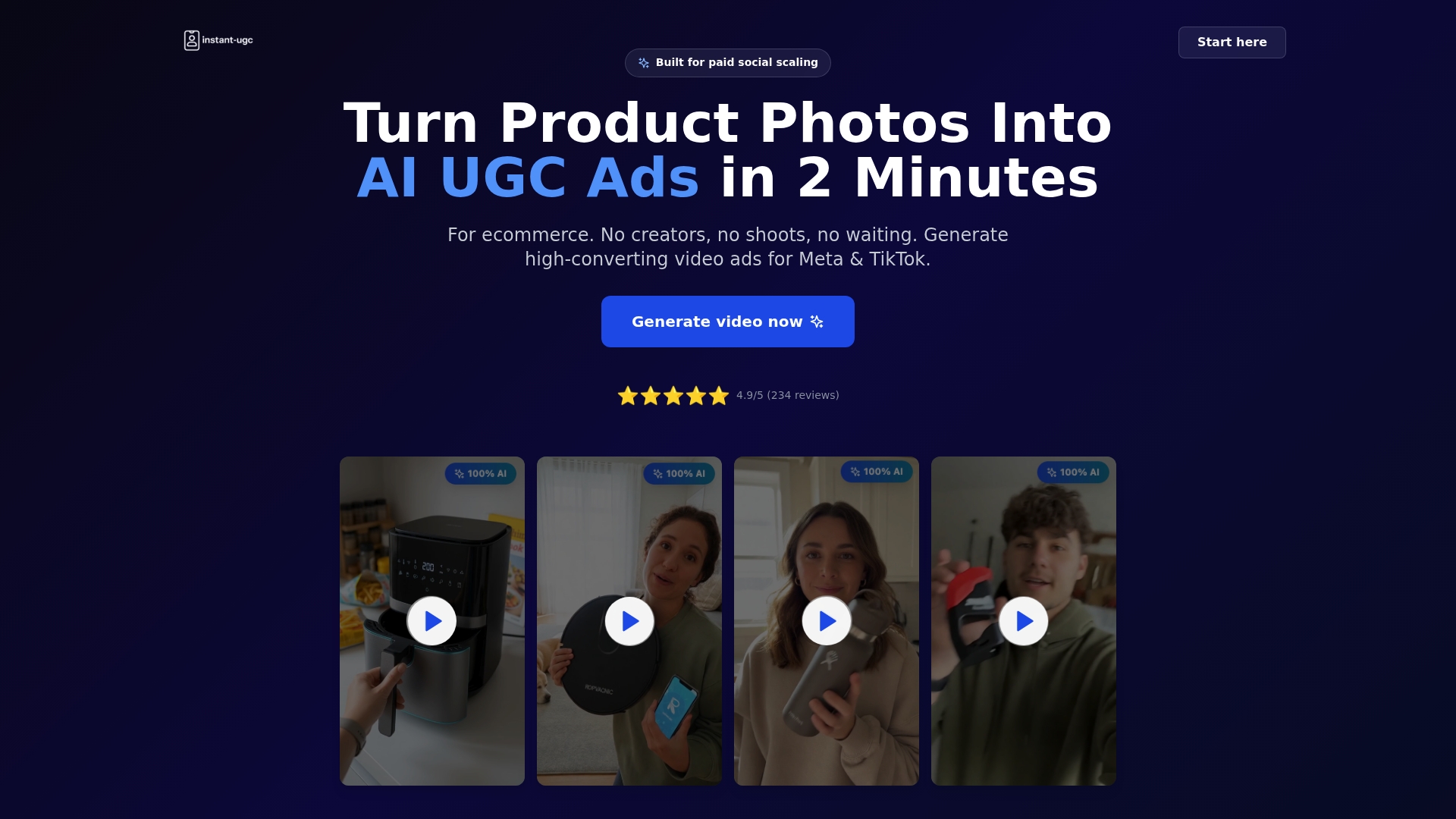
Instant-UGC pairs AI voice with AI video generation, turning a product photo or app screenshot into a finished ad in 90 to 120 seconds. The platform supports 17 languages and offers more than 10 customizable AI avatars, with automatic script generation built in so marketers don’t start from a blank page.
Two dedicated workflows cover different use cases: one built for physical products, suited to Shopify, Amazon FBA, and dropshipping sellers, and one built for mobile apps and SaaS, producing App Store-optimized testimonial-style videos. Both output in the vertical 9:16 format that Meta and TikTok favor.
- Video generation completes in 90 to 120 seconds per clip.
- 17 supported languages cover most global ad markets in one platform.
- Some brands report significant improvements in ROAS using platforms like this.
Pro Tip: Generate three voice and script variants for the same product photo before you pick a winner. The render is fast enough that testing costs almost nothing.
How to choose the right AI voice for your brand identity
Start with the brand’s existing tone of voice, whether that’s written in a style guide or simply reflected in how your best-performing ads already sound. A playful DTC skincare brand and a B2B SaaS tool need different pacing, warmth, and formality, and the AI voice you pick should mirror what already works in your copy.
Next, match the voice to the platform. A TikTok ad benefits from a faster, more casual read, while an Amazon Sponsored Display ad often performs better with a calmer, more informative tone. Testing the same script across two or three avatar and voice combinations quickly reveals which register fits each channel.
Consistency matters more than novelty. Once a voice tests well, reusing it across a campaign builds recognition the way a consistent logo or color palette does. Switching voices too often dilutes that recognition even if each individual voice sounds fine on its own.
Finally, weigh authenticity signals specific to your category. Physical product ads often benefit from a warmer, conversational voice that mimics a genuine customer review, while app and SaaS testimonials tend to perform better with a clear, confident tone that sounds like a real user explaining a benefit rather than reading a script. Matching that expectation, more than any single technical spec, is what makes a voice feel like it belongs to the brand.

A short playbook for getting started
My recommendation: pilot a two-week regional-accent test on your best-performing ad script, disclose the synthetic voice wherever the rules require it, then scale the winning variant with programmatic accent versions for other markets. Don’t discard human voice entirely: a hybrid approach, human for a signature spokesperson and AI for rapid market testing, often protects authenticity while still moving fast. For guidance on making generated scripts sound less mechanical, this resource on humanizing AI text offers practical phrasing tips.
— Syno
Try Instant-UGC for your next ad voiceover
If the testing process above sounds appealing but the timeline sounds impossible with a traditional production team, that’s the gap Instant-UGC is built to close. Instead of booking a studio and waiting weeks for a single cut, you generate a finished, voiced ad from a product photo or app screenshot in 90 to 120 seconds, then run the accent and script tests described earlier the same afternoon.
- Start with a one-off test to see a finished video before committing to a plan.
- Move to subscription plans suitable for ongoing campaigns and higher testing volumes as needed.
Visit the AI video generator for advertising to try a sample render, or explore multilingual video ad options if your next campaign spans more than one market.
Sources
This guide draws on the IAB’s disclosure framework, New York’s synthetic performer law, and published research on AI voice trust and engagement.
- IAB AI Transparency and Disclosure Framework — January 2026
- Lexology summary of New York Senate Bill S8420A
- AI voices in audio ads: research on trust and engagement (WPP / amp / Choreograph)
- KTS Law: Alert on AI disclosure and licensing
FAQ
Do I need to disclose an AI voiceover in my ad?
Disclosure is likely required when a synthetic performer or a cloned voice of an identifiable person appears in your ad, based on guidance in the IAB’s transparency framework. Rules vary by jurisdiction, so check the specific law that applies to where your ad runs, such as New York’s S8420A.
Does licensing a voice remove the need to disclose it?
No. Legal analysis from KTS Law treats licensing and disclosure as separate legal obligations, meaning a licensed or cloned voice can still require a disclosure under transparency or state law.
Can AI voiceovers really match human voice actors in ads?
In several industry tests, AI voices matched or exceeded human voiceovers on attention and message clarity, and regionally matched AI accents produced larger brand uplift in some cases, according to research from WPP Media. Human voice can still edge out AI on perceived authenticity, so many brands blend both.
How much does an AI voiceover ad cost with Instant-UGC?
Instant-UGC offers a $9 one-off test video, then monthly plans starting at $19 for Starter, $39 for Growth, and $99 for Pro. Each plan covers ongoing video and voiceover generation rather than a single clip.
How fast can I get a finished AI voiceover ad?
Platforms like Instant-UGC generate a finished video with voiceover in 90 to 120 seconds from a single product photo or screenshot. That speed makes same-day script and accent testing realistic for most marketing teams.
