
Scale AI Video for Agencies: $9 Tests, 24–48h SLAs, 3 Roles
Turn AI video into a billable agency service with practical pricing ($9 Test, $19–$99), 24–48h SLAs, three-role staffing, measurement, and an Instant-UGC...
The right approach to AI video for agencies is a platform-driven pipeline for volume production, paired with in-house creative oversight for strategy and brand control. Run this way, agencies typically see higher throughput, lower per-video costs, and revision cycles measured in minutes instead of days.
TL;DR:
- AI video is ideal for high-volume, quick-turnaround formats like testimonials, product demos, and multilingual versions, significantly reducing costs and production time.
- Workflow integration requires clear stages, shared brand kits, version control, and centralized queues to scale effectively across multiple clients and campaigns.
- Premature full-scale adoption risks brand voice drift, licensing issues, and platform penalties, so human review and compliance checks remain essential.
- Agencies should start with one account, build strong workflows and brand assets, and emphasize velocity and testing over cost-cutting to maximize ROI.
- Pricing models include per-video, credit-based, or retainer plans, with staffing typically involving three part-time roles focused on review, client management, and creative strategy.
Table of Contents
- Why Agencies Need AI Video (Benefits and Business Case)
- How to Integrate AI Video Into Agency Workflows
- Agency Use Cases and Fast-Win Formats
- Scaling Playbook: Staffing, Pricing, and SLAs
- Measuring Creative Performance and Testing at Scale
- Challenges, Limitations, and Risk Management
- Publisher Case Study and Instant-UGC Evidence
- Data Privacy and Ethical Considerations for AI Video
- Training Your Team to Use AI Video Well
- Author Perspective: Pragmatic Guidance for Agency Leaders
- Instant-UGC: How the Platform Maps to Agency Needs
- Sources
- FAQ
Why Agencies Need AI Video (Benefits and Business Case)
The economics of video production have been broken for years. A single UGC-style ad from a freelance creator often takes two to three weeks and costs $500 to $2,000, which makes testing five creative angles for one client a five-figure bet before a single dollar hits the ad account. AI video collapses that math. Instead of choosing three concepts to shoot and hoping one wins, agencies can generate a dozen variants, run them all, and let performance data decide.
That shift matters most for the work agencies already do constantly: A/B testing hooks, swapping captions, and localizing the same ad for five markets. AI-powered platforms let performance teams generate and test high volumes of creative variants without rebuilding a shoot from scratch, which means a revision requested at 4:00 PM can be live by 5:00 PM instead of waiting for the next production slot.
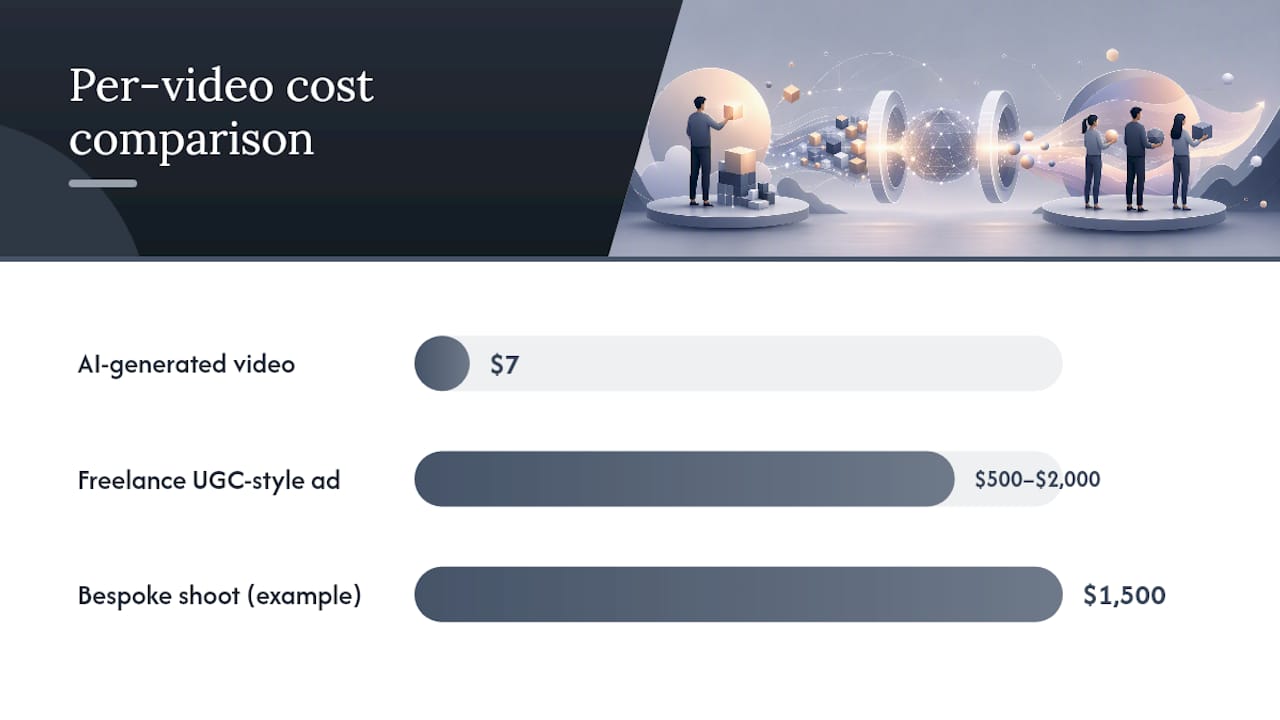
By the numbers: vendor case data on agency-focused AI video tools reports generation times as low as 5 to 10 minutes for short-form vertical output, with per-video pricing tied to quality tier rather than crew size.
Not every brief belongs on an AI pipeline, though. The split usually looks like this:
- Good fit for AI-driven execution: UGC-style testimonials, product demos, hook testing, seasonal refreshes, and multilingual versions of an already-proven ad.
- Better left to bespoke production: brand anthem films, complex live-action storytelling, and anything requiring real actors with contractual likeness rights.
- Margin math that changes the conversation: a $7 AI-generated video that replaces a $1,500 shoot doesn’t just save money. It lets an agency test ten variants for less than the cost of testing one the old way.
Agencies that treat AI video as a volume lever, not a replacement for every deliverable, tend to protect both quality and margin.
How to Integrate AI Video Into Agency Workflows
Bolting an AI tool onto an existing production process without redesigning the handoffs is the fastest way to end up with a faster mess instead of a faster pipeline. The workflow needs defined stages and clear ownership.
- Intake and brief. The account manager captures the client’s objective, target platform, and brand constraints in a standardized brief, not a loose email thread.
- Script and concept. A creative lead drafts the angle and hook, either manually or using automatic script generation, then approves it before generation starts.
- Generation. The operator queues the video through the AI platform, selecting an avatar, language, and format preset tied to the client’s brand kit.
- Internal review. A second set of eyes checks brand voice, claims accuracy, and platform fit before anything leaves the building.
- Client approval. The client reviews a small batch rather than one video at a time, which cuts down on round-trip delays.
- Publish and tag. Final files are versioned, tagged by campaign and variant, and pushed to the ad platform with UTM parameters intact.
Centralizing brand kits, templates, and a shared generation queue is what makes this scale past one client. Product research on agency workflows shows that shared workspaces with channel-specific presets and per-client queues let a single operator manage dozens of active campaigns without losing track of which brand voice belongs where. Without that structure, the same operator is stuck rebuilding settings from memory every time a new brief lands.
Version control deserves its own discipline. Every generated video should carry a filename convention that includes client, campaign, variant number, and date. It sounds bureaucratic until the third time someone asks, “wait, which version did we actually run?”
Pro Tip: Build one master brand kit per client before you generate a single video, not after. Retrofitting brand consistency across 40 already-published variants costs more time than building the kit up front ever would.
Agencies that need extra hands for review or bespoke script work can also hire freelance AI-generated video specialists on Upwork rather than staffing every stage internally. That hybrid model works well for agencies still building internal AI fluency.
Agency Use Cases and Fast-Win Formats
Some formats are built for AI video. Others aren’t worth the effort yet. Knowing the difference up front saves a lot of wasted generation cycles.
- UGC-style product ads: 15 to 30 seconds, 9:16 vertical, built for Meta and TikTok feed placements.
- Social proof and testimonial cuts: 20 to 45 seconds, first-person delivery, ideal for retargeting audiences already familiar with the brand.
- App and SaaS demo walkthroughs: 30 to 60 seconds, App Store optimized, showing a screen flow narrated by an avatar rather than a talking head.
- Localized market variants: the same script rebuilt in a second or third language for regional ad sets, without re-shooting anything.
- Hook and CTA test batches: five to eight versions of one ad differing only in the opening line, caption, or closing call to action.
“Publish-ready” means different things depending on the destination. A Meta feed ad needs safe zones for text overlay and captions baked in for sound-off viewing. A TikTok cut needs a faster opening beat and native-feeling pacing. An App Store preview video has strict format and duration rules that differ from social specs entirely. Building format-specific presets into the generation queue avoids the common mistake of exporting one version and cropping it five different ways after the fact, which almost always looks like exactly what it is.
The real advantage shows up in variant testing. Instead of debating internally which hook will perform best, agencies can generate three hook variants, three caption variants, and two CTA variants, then let the ad platform’s own delivery data settle the argument.
Scaling Playbook: Staffing, Pricing, and SLAs
Turning AI video into a real service line means deciding how to price it, who runs it, and what you’re willing to promise a client in writing.
Three pricing models dominate agency practice:
- Per-video pricing: simplest to explain to clients, works well for one-off campaigns or small brands testing the waters.
- Credit-based pricing: aligns cost with actual deliverables instead of seat licenses, which simplifies retainer math when a client’s volume fluctuates month to month.
- Retainer with volume tiers: best for larger accounts where the agency commits to a set number of variants per month at a blended rate.
Staffing doesn’t need to be heavy. Most agencies running this well use three roles: a review operator who checks brand and quality gates, an account manager who manages client expectations and turnaround, and a creative lead who sets the strategic direction for what gets tested. That’s often three part-time responsibilities split across two people, not three new hires.
| Model | Best for | Typical structure |
|---|---|---|
| Per-video | One-off campaigns, new clients | Fixed price per delivered asset |
| Credit-based | Fluctuating monthly volume | Prepaid credit pool drawn down per video |
| Retainer with tiers | Established accounts, ongoing testing | Monthly fee covering a set variant count |
SLAs should reflect what the pipeline can actually deliver, not what sounds impressive in a pitch deck. A realistic promise is 24 to 48 hour turnaround for standard variants and two included revision rounds before additional generation is billed separately. Overpromising same-day turnaround on every request is how review quality quietly erodes.
Measuring Creative Performance and Testing at Scale
Volume without measurement is just noise. The KPIs that matter shift depending on where the video sits in the funnel: top-of-funnel work should be judged on hook retention and click-through rate, while retargeting and conversion-focused creative needs to be judged on conversion rate and ROAS.
AI-powered platforms increasingly integrate with analytics tools to track viewer duration and click metrics, which gives agencies the data needed to iterate creative rather than guess at it. That integration matters more than the generation speed itself, because speed without a feedback loop just produces more untested content faster.
Good experiment design isolates one variable at a time. Changing the hook, the avatar, and the caption all in the same test batch makes it impossible to know which change actually moved the needle. A disciplined agency runs hook tests separately from CTA tests, even when it means more generation cycles up front.
By the numbers: partner research on creative-economics shifts shows that when production moves to automated volume pipelines, effective CPM and creative ROI both improve because more variants get tested in the same media budget window.
Feeding results back into the marketing stack closes the loop:
- Track view-through duration and hook retention inside the ad platform’s native analytics.
- Tag every variant with a consistent naming convention so performance data maps cleanly back to the creative brief.
- Review results weekly, not monthly, since AI generation speed means creative decisions should move at the same pace as media buying decisions.
- Feed winning hooks and formats back into the next generation batch instead of starting from a blank brief each time.
Tools purpose-built for performance marketer video ad testing make this loop tighter by keeping generation and testing inside one workflow.
Challenges, Limitations, and Risk Management
AI video isn’t risk-free, and agencies that skip the guardrails eventually pay for it in client trust or platform penalties.
- Brand voice drift: without locked brand kits and phrase guardrails, avatars and scripts can slowly wander from a client’s approved tone.
- Licensing and originality: verify that generated avatars, voices, and any stock elements are cleared for commercial ad use before a client’s media budget touches them.
- Platform policy risk: claims made by an AI avatar are still subject to the same advertising standards as a human-shot testimonial, so exaggerated performance claims can trigger takedowns.
- Quality ceiling on complex storytelling: AI video still struggles with nuanced emotional narrative, which is where human production earns its cost.
Common vendor guidance and agency best practice both point to the same fix: add a human approval gate before publish, every time, no exceptions for “simple” variants.
Pro Tip: Keep a running checklist of banned claims and required disclosures per client, and check every AI-generated script against it before generation, not after. It’s far cheaper to catch a compliance issue in the script stage than after fifty variants are already rendered.
When a brief calls for real emotional depth or a complex brand story, hire a human producer. AI video is a volume and speed tool, not a universal replacement for craft.
Publisher Case Study and Instant-UGC Evidence
Instant-UGC’s own product data offers a useful benchmark for what a mature AI video pipeline can deliver at agency scale. The platform reports transforming product photos or app screenshots into ad-ready videos in 90 to 120 seconds, supports 17 languages, and offers more than 10 customizable AI avatars across two dedicated workflows: one for physical products and one for apps and SaaS.
For an agency managing multiple client accounts, that kind of throughput changes what a “testing budget” can actually buy.
The two-workflow structure matters for agencies juggling different client verticals. Shopify, Amazon FBA, and drop-shipping clients get a workflow built around product photos. App developers and SaaS clients get a testimonial-style workflow optimized for App Store presentation. Running both from one platform means an agency doesn’t need separate tools, separate logins, or separate learning curves for each client type it serves.
Data Privacy and Ethical Considerations for AI Video
Client trust depends on handling their assets responsibly, and AI video introduces a few privacy questions that traditional production doesn’t. Product photos, app screenshots, and customer testimonial content often contain identifiable details, so agencies should confirm what a platform does with uploaded assets before committing a client’s brand materials to it. Read the retention and training-data policy, not just the feature list.
Disclosure is the ethical question that comes up most often with clients. Some platforms, ad networks, and regional regulators expect AI-generated content, particularly avatar-led testimonials, to be identifiable as such. Agencies should build a simple internal policy on when disclosure is required and apply it consistently across clients rather than deciding case by case under deadline pressure.
Consent matters too, especially for avatar likeness and voice cloning features. If a workflow ever uses a real person’s voice or face as a reference, written consent needs to exist before that asset touches a live campaign. Even when working entirely with synthetic avatars, agencies should avoid designs that could be mistaken for a specific real individual, since that ambiguity creates legal exposure with no upside.
None of this should slow a well-run pipeline down much. A short privacy and disclosure checklist added to the intake stage covers most of the risk, and it costs a few minutes per brief compared to the cost of unwinding a client dispute after the fact.
Training Your Team to Use AI Video Well
The agencies getting the most out of AI video aren’t necessarily the ones with the best tools. They’re the ones who trained their teams to use those tools with real creative judgment instead of treating generation as a vending machine.
Start with the creative lead, not the intern. The person setting creative direction needs to understand what the AI platform can and can’t do well, because that knowledge shapes better briefs from the start.
Review operators need a different kind of training: pattern recognition for brand drift, script inconsistency, and subtle avatar delivery issues that a rushed reviewer might miss. This is closer to proofreading discipline than creative skill, and it’s teachable in a few sessions with real examples pulled from past client work.
Account managers benefit most from understanding turnaround realities well enough to set client expectations honestly. Nothing damages trust faster than promising same-day delivery on every request and then missing it because a batch needed rework.
A short weekly review of what worked and what didn’t across the past week’s generated videos does more for team skill than any formal training module. Real examples, real mistakes, and real wins teach faster than a slide deck ever will.
Author Perspective: Pragmatic Guidance for Agency Leaders
Most agencies overthink the decision between AI video and human producers, when the real answer is that both belong in the same pipeline. Invest in AI video for volume, testing, and localization. Keep human producers for the handful of briefs each quarter that demand genuine storytelling craft. Trying to force everything through one lane wastes either speed or quality.
For the next 90 days, I’d resist the urge to roll AI video out across every client at once. Pick one account with active testing budget, build the brand kit and workflow properly, and prove the throughput and ROAS case with real numbers before scaling to the rest of the roster. Agencies that skip this proof step tend to hit brand-drift problems right when a client is watching most closely.
The mistake I see most often isn’t technical. It’s treating AI video as a cost-cutting trick instead of a testing engine. The agencies winning with it are the ones selling velocity, not just cheaper video.
— Syno
Instant-UGC: How the Platform Maps to Agency Needs
Some AI video solutions aim to reduce the agency bottleneck of waiting weeks for freelance UGC creators by generating ad-ready video in under a few minutes, at substantially lower cost than what traditional creators typically charge per video.
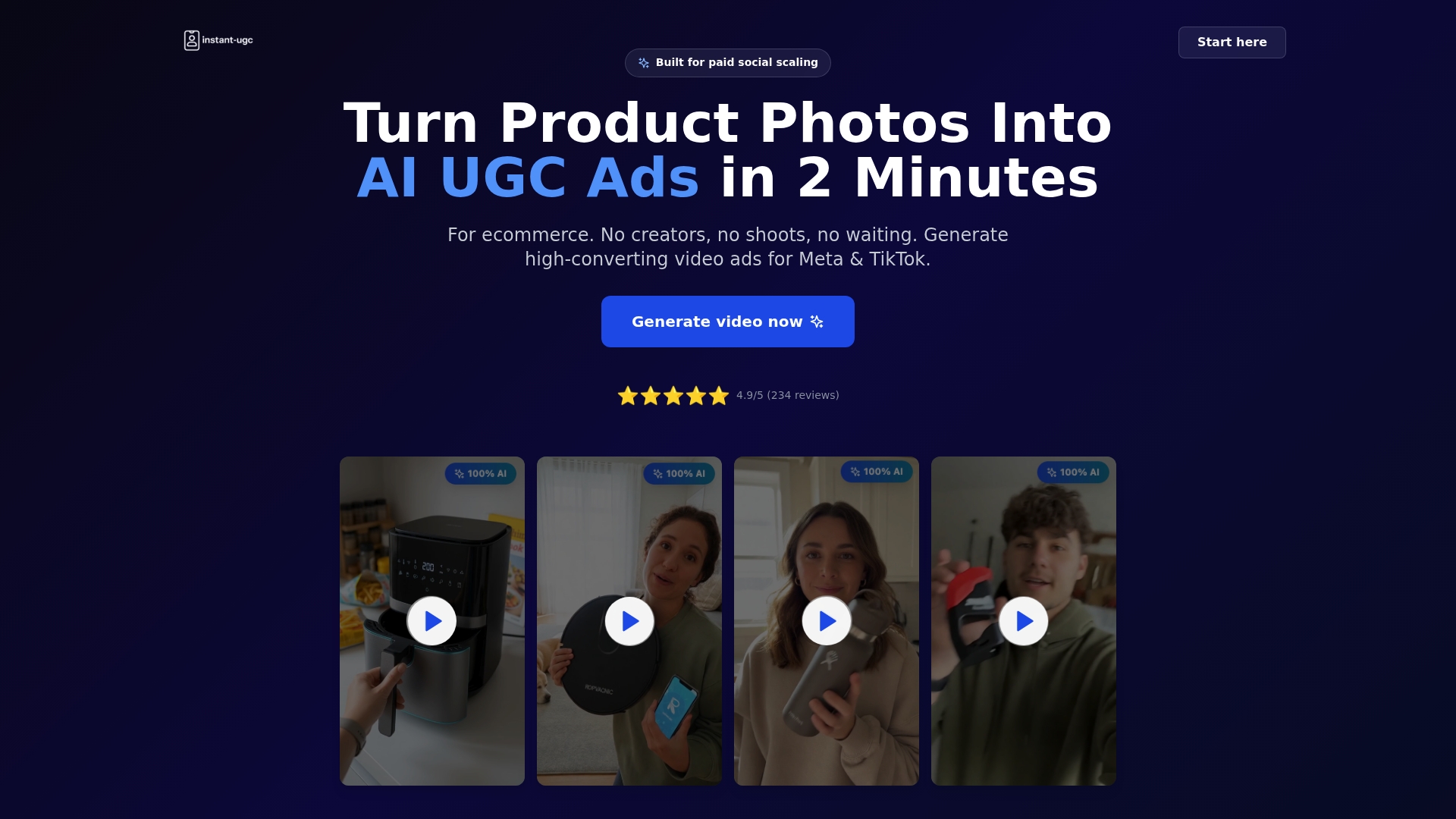
Agencies typically integrate it in one of two ways: as a production layer feeding their existing paid social workflow, or as a white-label service line billed to clients on a per-video or retainer basis. Because the platform runs two dedicated workflows, one for physical products and one for apps and SaaS, agencies serving mixed client rosters don’t need separate tools for each vertical. The 17 supported languages make it a practical fit for agencies running multi-market campaigns, and the multilingual video ad workflow is worth testing directly against whatever localization process you’re running today.
Pricing runs on a simple structure: a $9 one-off Test for agencies that want to try a single video before committing, then monthly plans starting at Starter for $19 per month, Growth at $39 per month, and Pro at $99 per month for higher-volume needs. Start with the Test option on your next client brief and measure the turnaround against your current pipeline.
Sources
For deeper reading on the economics behind this shift, 121 Group’s analysis of creative production economics breaks down how automated volume affects CPM and creative ROI. Agencies exploring hybrid staffing models can also review Instant-UGC’s ad-generator feature page for a closer look at workflow mechanics before piloting a client account.
FAQ
What Is AI Video for Agencies?
AI video for agencies refers to platform-driven pipelines that generate ad-ready video content, often UGC-style, from product photos or scripts, letting agencies scale output without proportional increases in production cost or time.
How Much Does an AI-Generated Video Cost?
Costs vary by platform and volume, but Instant-UGC’s pricing starts at a $9 one-off Test video, with monthly plans from $19 to $99 depending on volume needs.
How Long Does It Take to Generate an AI Video?
Agency-focused platforms report generation times ranging from a few minutes for short-form output up to Instant-UGC’s reported 90 to 120 seconds for product-to-video conversion.
Should Agencies Hire Freelancers or Use a Platform?
Many agencies run a hybrid model: platforms handle volume generation while freelance AI video specialists handle bespoke scripts, review, or client-specific creative direction.
Can AI Video Replace Traditional UGC Production Entirely?
Not entirely. AI video works best for testing, localization, and high-volume formats, while complex storytelling and brand films still benefit from human production.
