
Six-Week Cadence Stops Video Ad Fatigue for Marketers
A video-first playbook for performance marketers: one-session audit, six-week cadence, and 90–120s AI UGC swaps to end ad fatigue fast.
Video ad fatigue is the drop in response you see once viewers have seen a creative too many times, and it shows up as a synchronized slide in click-through rate, retention, and cost per result against the ad’s own baseline. If your CTR and early-retention numbers are falling while frequency and CPA climb, stop optimizing the ad and start replacing it. Run a creative-level audit today, then queue at least three new hook variants for testing.
TL;DR:
- Running a creative audit can identify fatigue signals, such as declining CTR, retention, and climbing frequency, which typically occur together across all three metrics.
- It is essential to focus on individual creatives rather than campaign averages, as fatigue often affects only specific assets or placements rather than the entire campaign.
- Platform-specific strategies, like Google’s campaign frequency caps, Meta’s ad set refreshes, and TikTok’s rapid content rotation, help mitigate different fatigue risks effectively.
- Refreshing ads should involve structural changes to hooks, visuals, or pacing, rather than superficial cosmetic tweaks, and new creatives should be introduced before performance declines become severe.
- Using AI-assisted tools like Instant-UGC enables quick production of new, diverse hooks, supporting a disciplined weekly testing cycle to prevent fatigue and maintain campaign performance.
Table of Contents
- What Video Ad Fatigue Is and Why Repetition Turns Against You
- Early Warning Signs: Separating Creative Fatigue From Everything Else
- Platform Differences: How Fatigue Shows Up on Google, Meta, and TikTok
- The Prevention Playbook: What to Change and How Often
- Building a Testing Cadence That Keeps Creative Ahead of Fatigue
- A One-Session Ad Fatigue Audit Checklist
- What Experienced Creative Teams Do Differently
- Make Fatigue Prevention Part of Your Operating Rhythm
- How Instant-UGC Fits Into Your Creative Refresh Cycle
- Platform Docs and Research Worth Reading Next
- Sources
- FAQ
What Video Ad Fatigue Is and Why Repetition Turns Against You
The first few views of a video ad usually work in your favor. Viewers notice something new, recognition builds, and clicks hold steady or even climb. Academic work on ad wearout shows that pattern flips at some point: familiarity curdles into boredom, and the same repetition that built recall starts suppressing it. The research on ad repetition and the reversal effect makes clear this turning point is context dependent, not fixed.
Video carries extra risk here because the entire value of the ad hinges on the first one to three seconds. Miss that window and the platform’s delivery algorithm reads it as low engagement, which throttles reach on the exact creative you need most.
That’s also why chasing a single frequency number is a trap. There’s no universal threshold at which fatigue kicks in. Instead, fatigue shows up as a synchronized pattern across three signals at once:
- Frequency climbing against the same audience segment
- Attention metrics (CTR, thumb stop rate) sliding from their baseline
- Cost or conversion metrics (CPA, ROAS) moving the wrong direction
One signal moving alone rarely means fatigue. All three moving together almost always does.
Early Warning Signs: Separating Creative Fatigue From Everything Else
Fatigue mimics other problems, and treating a tracking bug or a landing page issue as a creative problem wastes your testing budget on the wrong fix. The diagnostic move is a side-by-side comparison at the ad level, never the campaign level, since campaign averages hide a single dying asset behind three healthy ones.
Run this comparison in order:
- Pull 7-day and 14-day CTR for each individual creative and look for a widening gap between the two windows.
- Check first-seconds retention (often labeled thumb-stop rate or 3-second view rate) against the creative’s own launch-week number.
- Check completion rate, particularly the 50% mark, since a drop here alongside falling retention usually means the hook has stopped working, not the message.
- Check CPA and ROAS against the same creative’s baseline week, not against a portfolio average.
- Check frequency for the specific audience segment the ad is running against.
Amazon Advertising’s own ad fatigue guide recommends this exact creative-level audit, and it explicitly warns against blaming creative before ruling out landing page changes, tracking errors, audience overlap, placement shifts, or auction dynamics.
The decision tree is simple once you have the numbers in front of you. If conversions alone are falling but CTR and retention hold steady, the problem lives downstream, likely the landing page, the offer, or tracking. If CTR and retention are both sliding while frequency climbs on the same segment, you’re looking at genuine creative fatigue.
Pro Tip: Segment every metric by placement and device before you conclude anything. A creative can be dying in Stories while still performing fine in feed, and averaging the two hides the exact signal you need.
Platform Differences: How Fatigue Shows Up on Google, Meta, and TikTok
Each platform gives you different levers, and knowing which one you’re pulling matters more than most advertisers assume.
Google Ads and YouTube let you set frequency caps at the campaign level, capping impressions or views per user over a set period. Google’s own frequency capping guidance recommends supplying at least as many unique creatives as your target frequency number, so a target frequency of 4 means you need four genuinely distinct assets, not four cuts of the same script.
Meta treats fatigue as a repeated-exposure problem at the ad-set level. Meta’s own analysis found that adding new creative into a fatigued ad set improves conversion rates in most cases, which makes creative refresh the primary lever rather than bid or budget adjustments.
TikTok and other short-form feeds compress the fatigue curve. Creative lifespans run shorter, audiences scroll faster, and a hook that underperforms shows weak signal within days rather than weeks. Cadence has to match that speed:
- Google/YouTube: campaign-level caps, multi-creative supply matched to target frequency
- Meta: ad-set-level monitoring, refresh over reallocation
- TikTok/Shorts: faster hook rotation, shorter tolerance for a flat opening
The Prevention Playbook: What to Change and How Often
Here’s where most teams undercut their own fix. Swapping a color, a font, or a music bed is not a refresh. The viewer’s brain has already coded that ad as familiar, and a cosmetic tweak doesn’t reset that.
- Change something structural, not cosmetic. Vary the hook, the opening visual, the script angle, the proof point, the avatar or presenter, and the pacing. Tinuiti’s ad fatigue measurement guidance is specific on this point: keep the offer and the proof that already converted, but change how the viewer experiences the first few seconds and the overall rhythm.
- Introduce replacements before the winner dies, not after. Waiting until CPA has doubled means you’ve already burned budget on a declining asset. Launch the next creative at low spend while the current one is still working, then shift budget once the new version proves itself.
- Exclude recent converters from repeat exposure. Someone who bought last week doesn’t need to see the same testimonial again; move them into a different message or suppress them entirely.
- Mix video formats to widen the creative experience, not just the creative content. Google’s video reach guidance recommends combining bumper, skippable, non-skippable, in-feed, and Shorts formats rather than running one format at higher frequency. A 6-second bumper reaches the same person differently than a 15-second skippable, even with related messaging.
- Sequence messages across the funnel instead of showing every viewer the same ad regardless of where they are in the buying decision. Cold audiences see the hook-heavy version; retargeting audiences see the proof-heavy version.
The operational loop that ties this together runs in four steps: detect the decline using the metrics from the audit checklist, validate the replacement with a small test budget, replace the underperformer once the new version clears a threshold, then scale the winner. Skipping validation and jumping straight to scale is how teams burn budget on a hook that looked good in a meeting but flops with real audiences.
Building a Testing Cadence That Keeps Creative Ahead of Fatigue
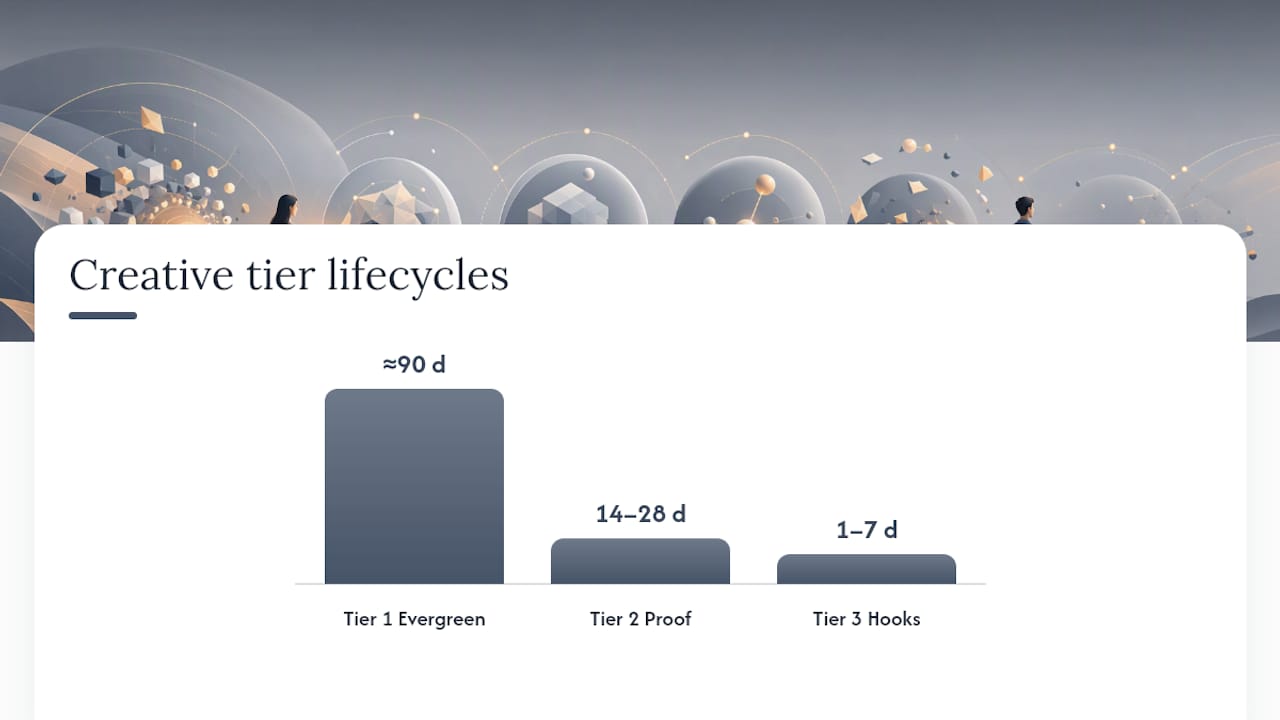
Treat your creative library like a portfolio with three tiers, each on its own clock.
- Tier 1, evergreen brand: Foundational brand or hero videos that change slowly, maybe once a quarter, since they’re built to hold up over months.
- Tier 2, proof and product: Testimonial, demo, and product-focused videos on a 2 to 4 week lifecycle, refreshed as soon as retention starts slipping.
- Tier 3, hook tests: Six to ten second opening variants rotated daily or weekly, purpose-built to find what stops the scroll before the rest of the ad matters.
A workable six-week cadence looks like this: weeks one and two run four to six hook variants at conservative spend to find which opening earns attention. Weeks three and four take the winning hooks and test full-body variations, different proof points, different pacing, different avatars. Weeks five and six validate the strongest combination at a slightly higher budget before committing full scale.
Set a kill threshold before you launch, not after you’re disappointed.
The teams that beat fatigue consistently, according to a creative-system breakdown from DTC Times, log every hook, placement, audience, and outcome as it happens. That log becomes creative research: the losing hooks tell you what not to repeat, and the winners tell you which structural elements to carry into the next batch. Fatigue data isn’t just a warning sign here. It’s raw material for your next round of concepts.
A One-Session Ad Fatigue Audit Checklist
Run this in under an hour once a week, and you’ll catch fatigue before it costs you real budget.
- Pull the numbers. Grab 7-day and 14-day CTR, 3-second retention, 50% completion rate, CPA or ROAS, and frequency for every active creative, at the ad level.
- Segment and compare. Break each metric out by placement, device, and audience segment, then look for one specific creative dragging the average down rather than a portfolio-wide dip.
- Rule out downstream issues. Run a quick control on the landing page and a tracking sanity check. If clicks are steady but conversions fell, the issue almost certainly isn’t the video.
- Queue replacements. Move approved hook variants into testing and build an exclusion list so recent converters stop seeing the same message on repeat.
What Experienced Creative Teams Do Differently
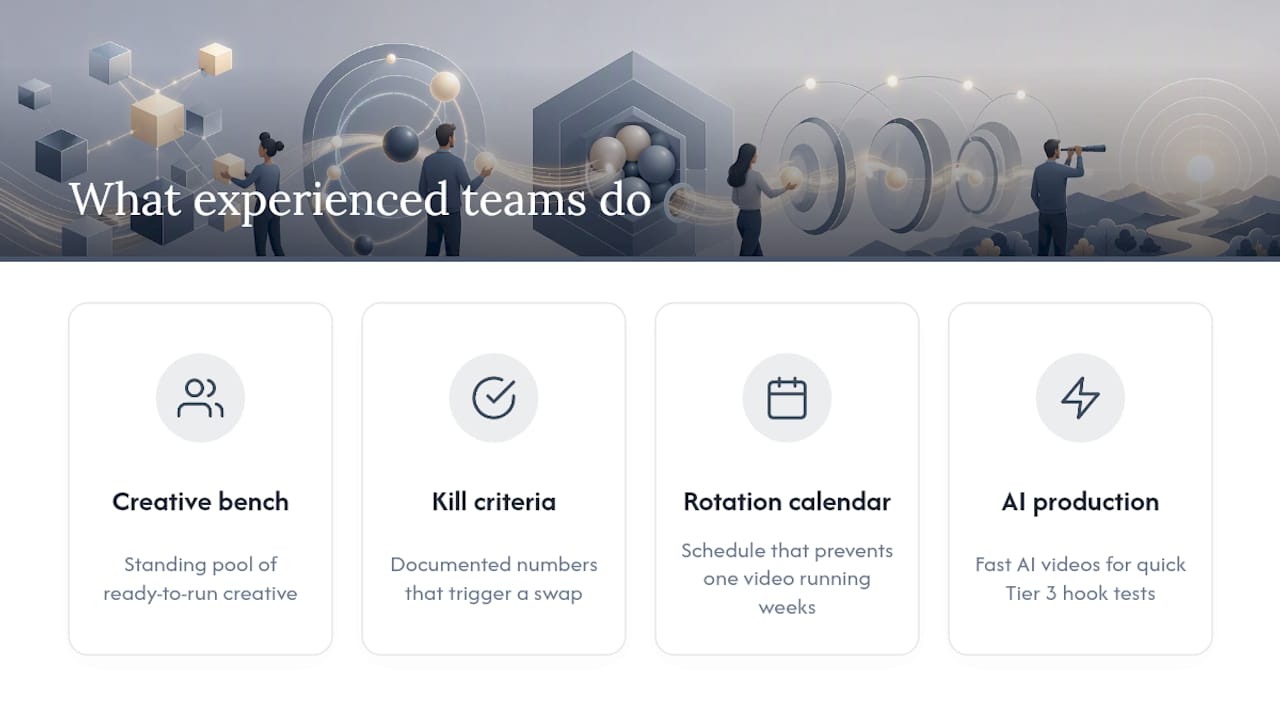
The gap between teams that manage fatigue well and teams that scramble every few weeks isn’t creative talent. It’s structure. The former group runs a standing creative bench, a documented kill criteria, and a calendar that assumes decay is coming rather than treating every dip as an emergency.
The advertisers who avoid fatigue-driven performance crashes aren’t the ones with the biggest budgets. They’re the ones with a system: a bench of ready creative, clear numbers that trigger a swap, and a calendar that never lets one video carry the whole campaign for more than a few weeks.
Where this gets hard for most teams is production speed. A three-tier system sounds simple until you’re staring down a Tuesday deadline and your only proof-of-concept video takes two weeks to shoot and edit. That bottleneck is exactly where AI-assisted video generation earns its place in the workflow rather than replacing judgment. The platform generates video ads from product photos or app screenshots in a short time, with multiple customizable AI avatars and support for various languages, which shortens the gap between “we think this hook is dying” and “we have a tested replacement live.” That speed doesn’t substitute for the audit or the kill criteria above. It just means Tier 3 hook testing stops being the thing your team never gets around to.
(Case studies and specific campaign results from teams using structured creative testing systems will be added here as they become available.)
Make Fatigue Prevention Part of Your Operating Rhythm
Fatigue prevention fails when it’s a fire drill instead of a habit. Teams that check metrics only after a campaign has already tanked spend weeks recovering ground they never should have lost. The ones who run the audit weekly, on a fixed day, catch the decline while it’s still a dip rather than a collapse. Build the habit before the next campaign forces you to.
— Syno
How Instant-UGC Fits Into Your Creative Refresh Cycle
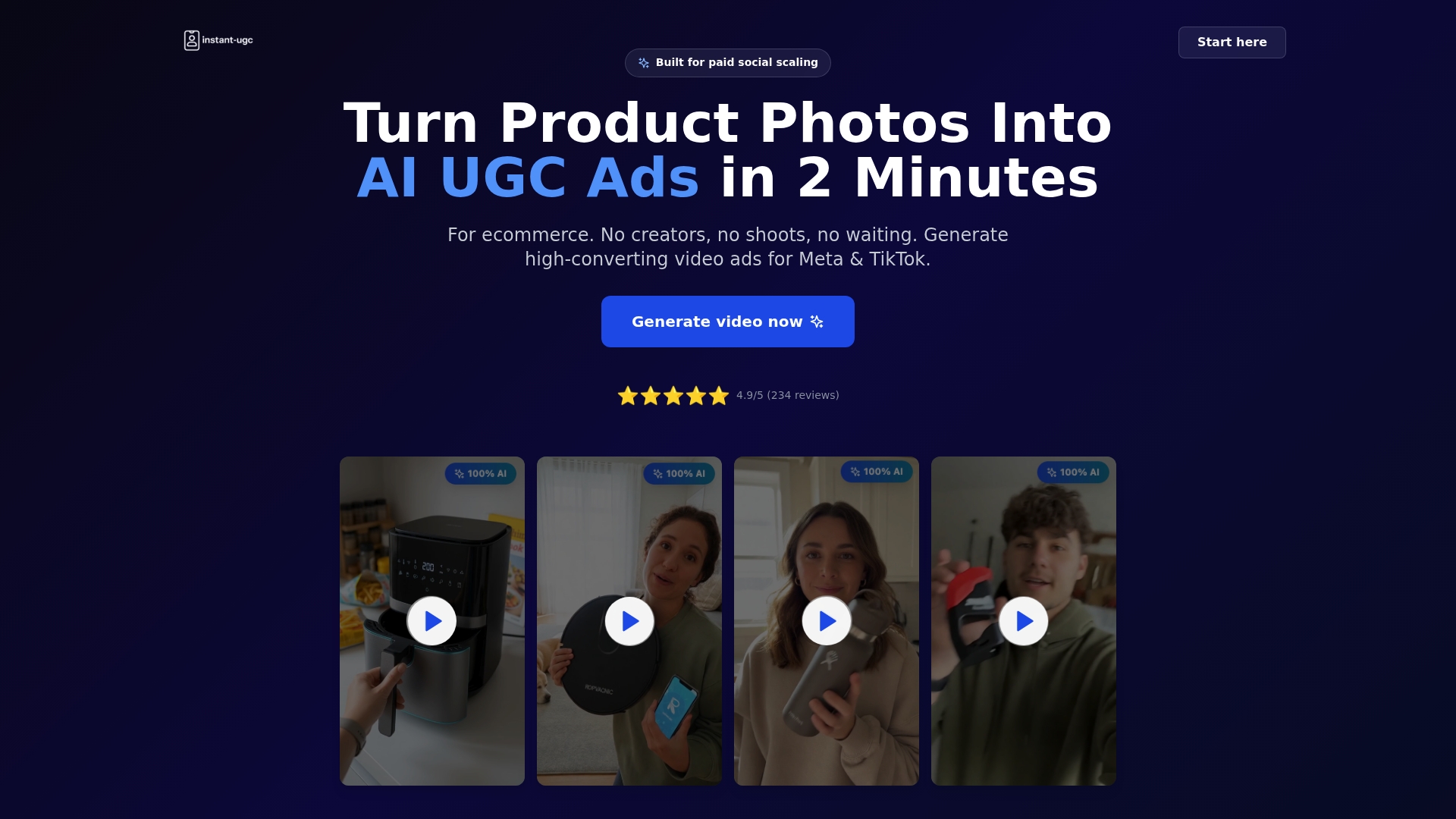
Instant-UGC exists for the exact moment your audit flags a dying hook and you need a genuinely new concept fast, not a reshoot in three weeks. The platform turns product photos or app screenshots into ready-to-run video ads in 90 to 120 seconds, with over 10 customizable AI avatars, automatic script generation, and support for 17 languages, so testing four or five structurally different hooks in a week is realistic instead of aspirational.
Brands using the platform have reported ROAS moving from 2.1x to 4.8x, a shift that tracks with what the fatigue data above predicts: fresh concepts convert better than tired ones. Whether you’re running Shopify product ads or App Store testimonial-style videos, the adaptive responsive video formats let you output the same concept across vertical, horizontal, and square without starting from scratch each time. If you want to see how fast a real replacement hook comes together, start with a single test video for $9, or move into the Starter plan at $19 a month once you’re ready to run a real testing cadence.
Platform Docs and Research Worth Reading Next
- Google Ads frequency capping: how campaign-level caps work and why creative supply should match target frequency.
- Amazon Advertising’s ad fatigue guide: the audit framework this article’s checklist is built on.
- Meta’s creative fatigue analysis: data on why fresh creative outperforms bid changes.
- Conversion rate optimization tips: diagnostic steps for isolating creative fatigue from landing page issues.
Sources
- Fatigue-Aware Ad Creative Selection (arXiv)
- Use frequency capping - Google Ads Help
- Ad fatigue guide (Amazon Advertising)
- Tinuiti: Ad fatigue measurement guidance
- Google Ads: Video reach guidance
- Creative fatigue: How advertisers can improve performance by managing repeated exposures (Analytics at Meta)
FAQ
What Does Ad Fatigue Mean?
Ad fatigue is the decline in viewer response, lower clicks, weaker retention, and rising cost per result, that happens after an audience sees the same creative too many times. It’s confirmed by a synchronized drop across frequency, attention, and cost metrics compared to that ad’s own baseline, not by frequency alone.
Why Do Ads Feel So Much Worse Now Than They Used To?
Feed and platform algorithms serve more total ads to each viewer than they did a few years ago, which compresses how long any single creative stays fresh before audiences tune it out. That’s less about ad quality declining and more about exposure volume climbing, which makes a disciplined refresh cadence more important than it used to be.
Is YouTube Losing Viewers Because of Ads?
There’s no solid evidence tying viewer decline specifically to ad load; claims like that require independent audience data separated from ad frequency, market shifts, and content trends, which most viral claims skip. Advertisers should focus on their own frequency and retention numbers, using Google’s target frequency guidance, rather than broader platform-usage speculation.
How Much Does It Cost to Fix Video Ad Fatigue Fast?
Traditional UGC production takes far longer than a weekly cadence. Instant-UGC offers a single test video for $9, with monthly plans starting at $19 for the Starter tier, letting teams produce replacement hooks in minutes instead of weeks.
