
Ship 40–80 Variants Fast: AI UGC Ad Concept Testing for Scaling Brands
A production-first playbook for ad concept testing with AI UGC. Generate 40–80 variants per cycle, run clean tests, and scale winning creative faster.
Ad concept testing works best as rapid, in-market testing: produce a batch of low-cost UGC-style video variants for each competing idea, run them under equal conditions, and let structural patterns (not single winning ads) tell you which concept to scale. The fastest way to build that batch is an AI UGC pipeline that goes from brief to finished video in minutes instead of weeks, which is exactly where Instant-UGC fits into the process below.
TL;DR:
- Running multiple diverse concepts with AI-generated videos allows scaling testing from 2-3 concepts per month to dozens or more weekly, significantly increasing insight speed.
- Testing 6 concepts with 3 variants each is common for mid-market brands, producing around 64 variations per cycle and guiding better creative decisions.
- Observation windows are platform-dependent, with Meta taking 7 to 14 days and TikTok only 3 to 5 days to show stable results, requiring patience before declaring winners.
- Prioritizing concept-level testing before variation testing ensures meaningful insights, avoiding optimization of ideas that haven’t proven their core strength.
- AI production enables rapid, cost-effective batch creation, turning a photo into a finished testimonial video in minutes, which expands testing capacity without proportional budget increase.
Table of Contents
- What Is Ad Concept Testing and How Do You Run It?
- Concept Testing vs. Variation Testing: What’s the Difference?
- What Does an AI UGC Production Pipeline Look Like?
- How Often Should You Test, and What’s the Right Production Ratio?
- How Do You Set Up a Clean Test and Which Metrics Matter?
- What Should Your QC and Launch Checklist Include?
- How Do You Read Results and Turn Them Into Better Briefs?
- Why an AI-First Approach to Creative Testing Actually Holds Up
- Get Your Testing Pipeline Running With Instant-UGC
- Sources
- FAQ
What Is Ad Concept Testing and How Do You Run It?
Ad concept testing means putting several distinct creative ideas in front of real audiences to see which one earns attention and converts, before you spend real money scaling any single execution. A “concept” is the big idea: an unboxing-style demo versus a founder-testimonial versus a before-and-after comparison. That’s different from tweaking a headline or swapping a background color, which is variation testing and comes later.
Here’s a checklist you can start on today.
- Write one-paragraph briefs for each concept: state the hook, the emotional or rational angle, the proof point, and the call to action in four sentences or less.
- Decide your cycle size. A lean cycle tests 3 to 4 concepts with 2 variants each; a standard cycle runs 6 concepts times 3 variants, a ratio used by teams auditing hundreds of ad accounts in the creative testing framework that cut Meta CPA by 42%.
- Batch-generate the assets, then quality-check every single clip before it touches an ad account.
- Equalize budgets and audiences across every ad set so no concept gets an unfair head start.
- Set your kill and scale thresholds before launch, not after you see the numbers and get tempted to move the goalposts.
Pro Tip: Write your kill/scale thresholds on a sticky note and tape it to your monitor before you launch. Once results start rolling in, it’s tempting to rationalize a mediocre performer into “promising.” Decide the bar in advance.
Concept Testing vs. Variation Testing: What’s the Difference?
Concept testing compares fundamentally different creative approaches, an emotional testimonial against a rational feature walkthrough, a UGC-style clip against something more polished, and it should always happen before you touch smaller variables, according to the creative testing framework for paid social. Variation testing zooms in on the details inside a proven concept: the opening line, the CTA button, the font on a text overlay.
Skipping straight to variation testing is the most common mistake teams make. If you’re A/B testing three CTA phrasings on a concept nobody actually likes, you’re optimizing a loser.
- Test one variable at a time. When comparing concepts, keep the CTA, format, and overall length constant so the concept itself is the only difference.
- Hold spend and audience constant across every concept in the same test round.
- Move to variation testing only after a concept wins. Once a structure proves itself, isolate hooks, then pacing, then CTA copy, one at a time.
Rushing this order produces noisy data that looks like a signal but isn’t.
What Does an AI UGC Production Pipeline Look Like?
A repeatable AI UGC workflow runs in seven stages, and you can move through all of them in a single afternoon: brief, hooks, scripts, avatars, batch generation, QC, and launch, following the structure laid out in the AI UGC workflow breakdown.
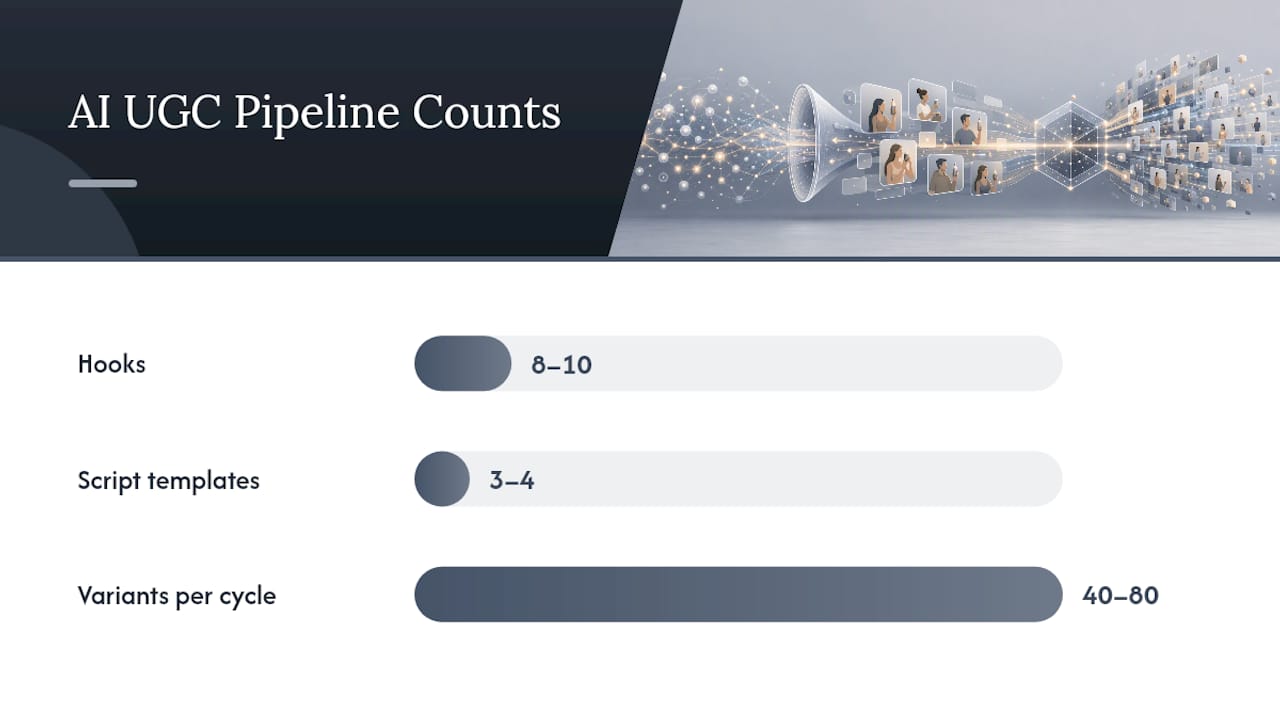
Start with the brief: one paragraph per concept, covering audience, pain point, and proof. From there, write hooks in batches of 8 to 10 before you write a single full script. Hooks decide who watches past the first two or three seconds, so they deserve the most attention in the whole pipeline. Draft 3 to 4 script templates that can flex around different hooks, then assign avatar personas, keeping each one visually consistent across cycles so viewers start to recognize a “voice” rather than seeing a rotating cast of strangers.
Batch generation is where the math gets interesting:
That range, 40 to 80 readable variants per cycle, comes directly from multiplying hooks by scripts by avatars. Producing that volume with traditional UGC creators, at $500 to $2,000 per video and multi-week turnarounds, simply isn’t realistic for most budgets. Once assets are generated:
-
Run a QC pass on every clip.
-
Confirm formats match the platform (9:16 for Meta and TikTok feeds, App Store-style testimonial cuts for app marketers).
-
Launch with equal budgets across every ad set.
How Often Should You Test, and What’s the Right Production Ratio?
Cadence should scale with budget, but nobody benefits from testing so slowly that momentum dies between cycles. Enterprise teams with heavier spend can sustain 8 to 10 hooks and dozens of variants weekly. Mid-market brands often land on the 6 concepts times 3 variants weekly target that shows up repeatedly in accounts audited for the Meta CPA reduction framework. Lean teams can still run a meaningful test with 3 to 4 concepts and 2 variants each.
By the numbers: Brands scaling on TikTok typically ship 8 to 15 new video creatives per month, while Meta advertisers often work from a baseline of 4 to 8 per month depending on spend.
Within any cycle, split your production effort roughly like this:
- 60% iterate on concepts that already show promise.
- 30% remix proven winners into new formats or hooks.
- 10% test completely new concepts you haven’t tried before.
AI production is what makes this ratio realistic. Manual UGC sourcing caps most teams at a handful of concepts a month; batch generation removes that ceiling, letting you push volume without multiplying your budget.
How Do You Set Up a Clean Test and Which Metrics Matter?
Start with the setup, not the metrics. Give every concept an equal budget, run them against comparable audiences and placements, and split into separate ad sets when you need to isolate a variable cleanly, a principle backed by the enterprise creative testing framework.
Once ads are live, read signals in this order:
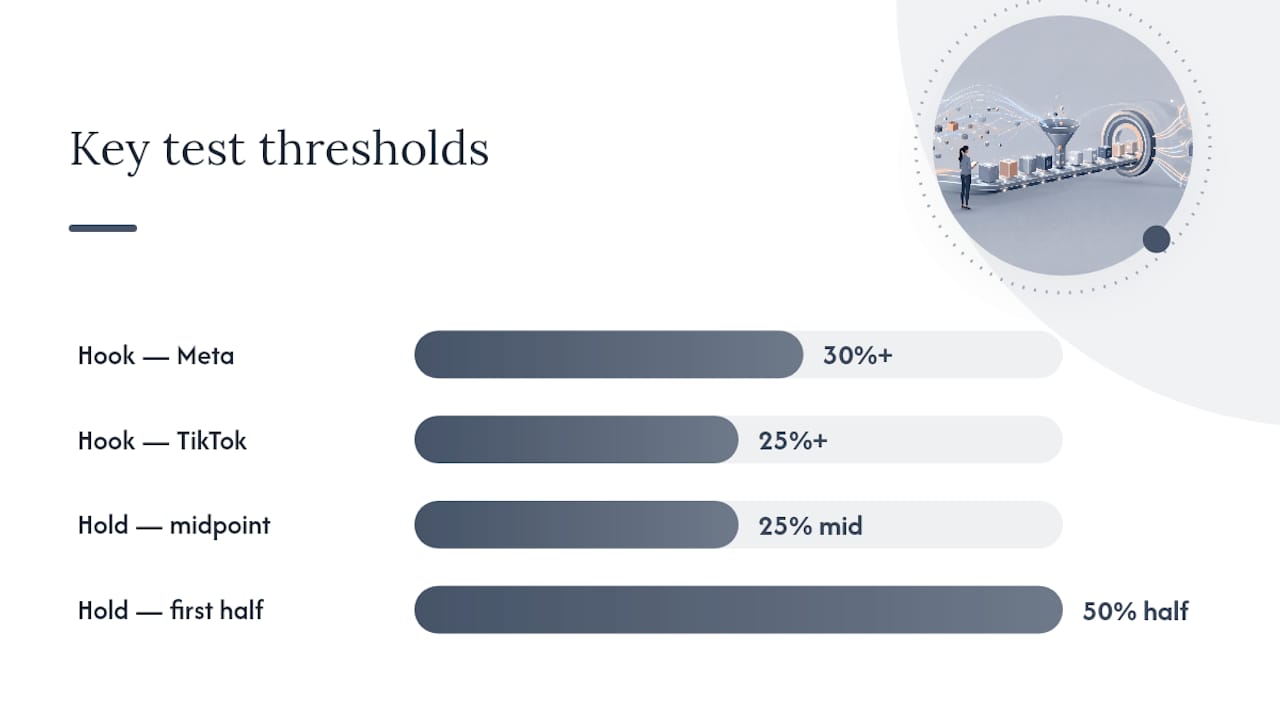
- Hook rate (3-second view rate). This is the earliest and most predictive metric available. Target 30%+ on Meta and 25%+ on TikTok for cold audiences, per benchmarks from UGC ad creative testing research.
- Hold rate. Look for 25% retention at the midpoint and 50% or better through the first half of the video before you trust the concept.
- Click-through rate. Confirm the message is compelling enough to move someone off the platform.
- Add-to-cart, CPA, and ROAS. These later-stage numbers tell you whether attention is converting into revenue, and they’re what ultimately justify moving a creative to scaled spend.
Timing matters as much as thresholds. Meta typically needs 7 to 14 days to stabilize a test, while TikTok can show usable signals in 3 to 5 days, according to the same Flare research on UGC ad testing. Don’t call a winner before your platform’s minimum window has passed.
What Should Your QC and Launch Checklist Include?
Give every AI-generated clip a focused 30 to 45 second review before it goes live: check audio clarity, watch for avatar artifacts around the mouth and hands, confirm text overlays are readable, and verify the CTA lands with enough time left on screen.
- Run each concept through a test reader filter: a strategist first, then someone unfamiliar with the brand, then an actual customer if you can get one, a sequence shown to reduce wasted spend from unclear or unbelievable creatives.
- Confirm format specs match the destination: 9:16 for Meta and TikTok feeds, App Store-optimized cuts for app installs.
- Launch with equal budgets and a fixed monitoring cadence, not ad hoc check-ins.
Pro Tip: Have the “non-customer” reader watch with sound off first. If the message doesn’t land without audio, your hook probably won’t survive the first three seconds on a muted mobile feed either.
How Do You Read Results and Turn Them Into Better Briefs?
Judge concepts by structure, not by a single standout ad. A hook, format, or claim that repeats across several winning clips is a genuine pattern; one viral outlier is often noise. A workflow that separates concept and variation testing and reads structure across 20 to 30 ads tends to stabilize signals within 2 to 3 weeks.
Build a simple tagging system for every clip you launch: hook type, script angle, avatar used, and format. After each cycle, tag which hooks pulled strong hold rates, which script beats caused drop-off, and which avatar personas outperformed.
- Review results weekly, not daily. Daily checks tempt you to react to noise.
- Feed winning hooks directly into the next brief instead of starting from a blank page.
- Retire underperforming avatar and script combinations rather than running them again “just in case.”
- Treat every cycle’s tagged data as the brief for the next one.
This is also where tools built for testing multiple ad creatives at scale earn their keep. Manually tracking 60 to 80 variants across spreadsheets is where most teams lose the thread.
Why an AI-First Approach to Creative Testing Actually Holds Up
Most teams don’t fail at concept testing because they lack a framework. They fail because producing enough variants to make a framework meaningful used to take weeks and thousands of dollars, which pushed everyone back toward guessing. AI UGC production removes that constraint, and the pipeline described here only works because generation time drops from weeks to minutes.
That said, AI is a multiplier for strategic thinking, not a replacement for it. The brief still has to be sharp, the hook still has to earn attention, and someone still has to read the results honestly. Treat the platform as leverage, not autopilot, and this framework starts producing real answers within a few cycles.
— Syno
Get Your Testing Pipeline Running With Instant-UGC
The platform is built around a pipeline that turns a product photo or app screenshot into a finished, testimonial-style video in minutes, offers customizable AI avatars, and generates scripts automatically instead of requiring manual writing.
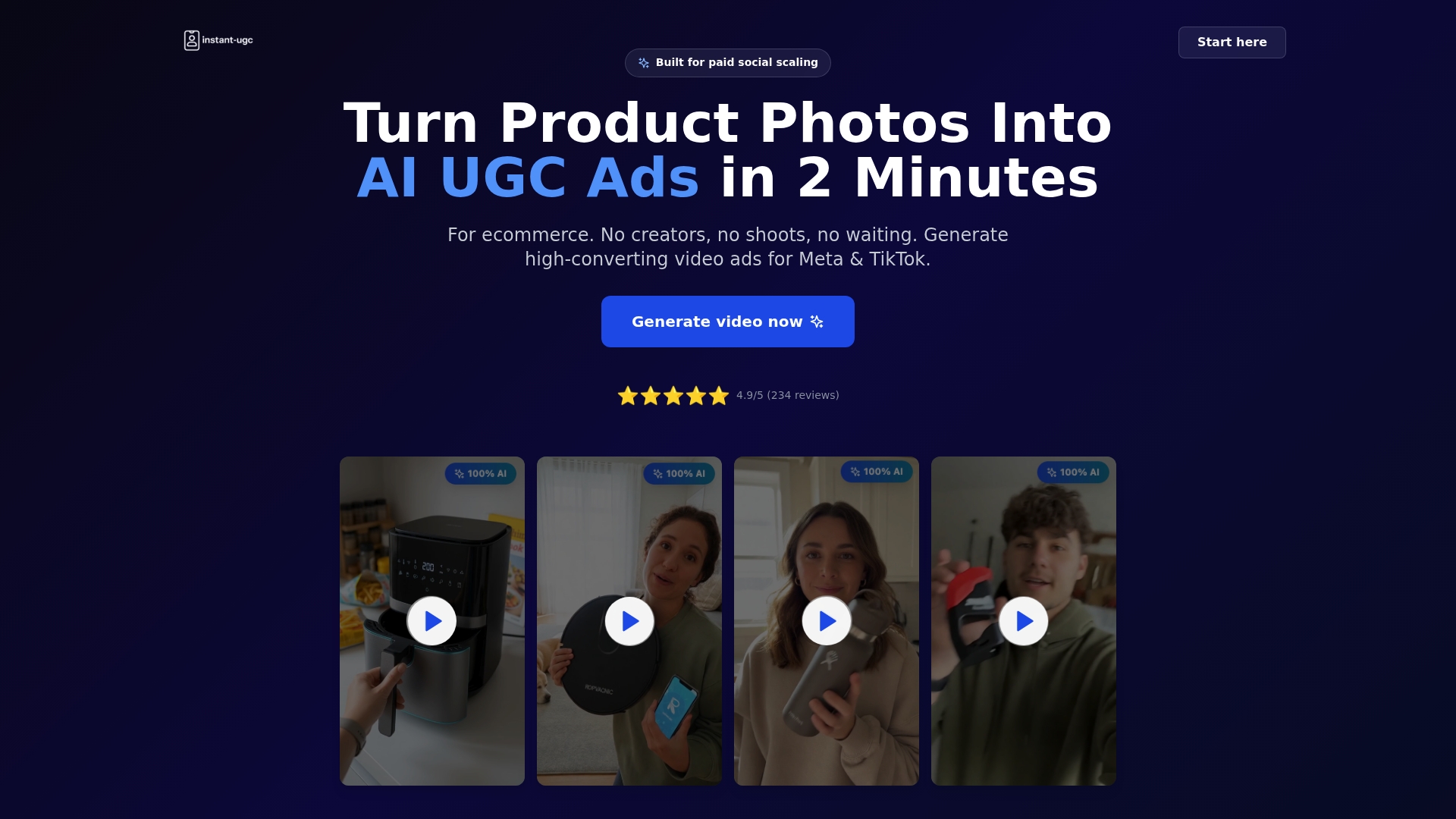
It supports multiple languages and delivers videos in 9:16 format across workflows tailored for physical products and for apps and SaaS, enabling teams to run concept tests for various campaigns without switching tools. If your current process caps you at two or three concepts a month, that’s the bottleneck worth fixing first. Explore the AI video generator for advertising and see how many concepts you could actually be testing this week, or check out accelerating ad creative testing with AI UGC for a closer look at the batch workflow in action.
Sources
For deeper detail on the concepts covered above, these sources are worth your time:
- Creative Testing Framework for Paid Social on Enterprise Teams (2026)
- The creative testing framework we use to cut Meta CPA by 42% · GrowthFather
- UGC ad creative testing: how to find winners fast | Flare
FAQ
What Is Ad Concept Testing?
Ad concept testing is the practice of running several fundamentally different creative ideas, different hooks, angles, or formats, against real audiences to find which one performs best before scaling spend.
How Many Variants Should I Test Per Concept?
A standard cycle runs 6 concepts times 3 variants weekly, while combining 8 hooks, 4 scripts, and 2 avatars can produce 64 distinct, readable variants in a single production cycle.
How Long Should I Wait Before Calling a Test Winner?
Meta typically needs 7 to 14 days to stabilize results, while TikTok can show reliable signals in 3 to 5 days, so wait for your platform’s minimum window before making a decision.
Can AI Tools Really Replace Traditional UGC Creators for Testing?
For the testing phase, yes: platforms like Instant-UGC generate testimonial-style videos in minutes instead of the 2 to 3 weeks and $500 to $2,000 per video that traditional UGC creators typically require.
